
As U.S.-Iran tensions temporarily ease, Washington is simultaneously signaling restraint while issuing hardline threats, outlining U.S. President Donald Trump’s current “dual approach” toward Iran.
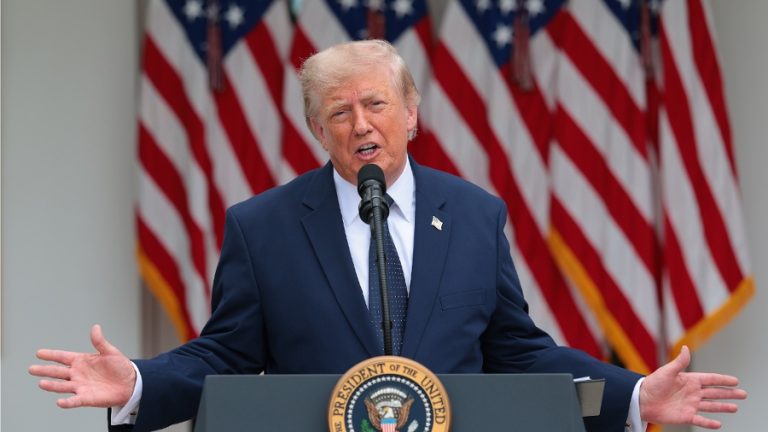
According to the New York Post, on April 8 Trump posted on his social media platform, Truth Social, warning that any country supplying military equipment to Iran would immediately face a 50 percent tariff on all exports to the U.S., “with no exceptions or exemptions.” This statement has been widely interpreted as directly aimed at Russia and China.
However, the legal basis for this threat remains uncertain. Previously, the U.S. Supreme Court had struck down a key Trump-era tariff tool—the International Emergency Economic Powers Act (IEEPA)—making it difficult to set flexible, differentiated tariffs under this mechanism. Although Trump later turned to other legal authorities to restore some tariff measures, these alternative paths are procedurally complex and harder to enforce, leaving it unclear whether the “50 percent tariff” threat can be fully implemented.
Signals of restraint amid a ceasefire window
Reuters also reported that following the announcement of a two-week ceasefire, President Trump stated Wednesday that the U.S. would closely cooperate with Iran, with discussions underway on tariff and sanction relief.
Just hours earlier, the U.S. had approached the brink of a full-scale military strike on Iran. Trump had set a final deadline requiring Tehran to open the blocked Strait of Hormuz, but he abruptly pulled back two hours before the cutoff. He later said on social media that “many” of the 15 proposed measures had already received agreement, without disclosing specific details.
Success
You are now signed up for our newsletter
Success
Check your email to complete sign up
Although Trump’s tone was optimistic and both Iran and global markets briefly breathed a sigh of relief, core disagreements between Washington and Tehran remain unresolved, and both sides’ key demands for a potential peace agreement remain opposed.
READ MORE:
- What the US Iran Ceasefire Means as Geopolitical Tensions Continue
- Hegseth: US ‘Responding’ to Russian and Chinese Involvement in Iran Conflict
Comments on ‘regime change’ draw attention
In the same series of statements, Trump unusually praised the Iranian regime, saying the U.S. would work with Iran, which had “experienced a highly productive regime change.” Earlier, U.S.-Israeli strikes had killed several senior officials, including Supreme Leader Ali Khamenei, and his son Mojtaba Khamenei is reportedly now the new Supreme Leader.
Trump also emphasized that Iran will not engage in uranium enrichment in the future, and the U.S. will cooperate with Iran to remove residual nuclear facilities buried underground. He added that since the strikes, “the relevant facilities have seen no further changes.”
Nevertheless, military actions have yet to fundamentally degrade Iran’s nuclear capability or its missile and drone strike capacity. Analysts note that Iran still possesses near-weapons-grade uranium stockpiles and the capability to strike neighboring countries. Moreover, despite mass protests months ago, this six-week military pressure has not triggered significant signs of domestic regime instability.