Foreign media has reported that underground agencies in China’s major cities are openly offering surrogacy services. Through surveillance cameras installed in surrogate mothers’ rooms, clients “can track the progress of a pregnancy the same way they would track a package.”
On April 6, France’s Le Monde published a lengthy investigation into China’s underground surrogacy black market. Although the Chinese Communist Party has officially banned surrogacy since 2001, underground surrogacy agencies in major Chinese cities continue to operate. State-run Chinese media regularly report on police raids against suspected surrogacy operations, but the agencies keep expanding. Authorities have been unable to contain the rapidly growing black market.
A Beijing surrogacy agency has run from a commercial tower since 2017
Le Monde reported on an underground surrogacy agency in Beijing’s Chaoyang District that has been running since 2017. The agency operates out of an office building in Beijing’s Guomao central business district, one of the city’s most prominent commercial areas.
After clients called the agency, a few minutes of conversation was all it took before egg donor profiles arrived on their phones. Each profile contained two videos, multiple photos, blood test results, and personal details: education, hobbies, ethnicity (Han, Mongolian, and others), virginity status, menstrual regularity, and whether the donor had double eyelids.
Egg “donations” in China’s surrogacy black market cost between 6,000 and 12,000 euros (1 euro ≈ 7.96 yuan) depending on the donor’s profile. Eggs from students at Tsinghua University, China’s most prestigious institution, commanded the highest prices. Prospective parents who wanted to meet a donor before selecting paid an extra 2,000 euros.
Success
You are now signed up for our newsletter
Success
Check your email to complete sign up
The second step was an in-person visit to the agency, where staff walked clients through the surrogacy process: selecting a surrogate mother, embryo transfer, and fees.
The agency’s walls were covered with calligraphy praising virtue, photocopied medical diplomas, photos of happy couples holding newborns, and red banners reading “Excellent Service.” A man identifying himself as a “fertility consultant” handed over a glossy brochure and introduced the services.
Surrogate mothers recruited from China’s poorest ethnic minority regions
The Beijing surrogacy agency maintained roughly 80 surrogate mothers, most recruited from impoverished ethnic minority areas in Sichuan and Yunnan provinces. Some were married with children, but the agency barred them from seeing their families during the surrogacy period. They ranged from 20 to 33 years old, had typically given birth once or twice before, and had delivered naturally. The women were housed in dormitory-style apartments in Hebei province, roughly an hour from Beijing by car.
A single child cost approximately 91,000 euros through this underground surrogacy agency; twins cost double. The agency said its pricing reflected partnerships with experienced doctors from public hospitals, including physicians from university hospitals and China’s military medical system.
Surrogacy procedures took place at a private clinic in Daxing, a district in southern Beijing. Paying clients could meet the surrogate mother, attend prenatal checkups, and watch live surveillance camera feeds from the women’s rooms through a smartphone app every day at noon. The agency representative said with a smile: “That way you can track the progress of the pregnancy just like tracking a package.”
The agency provided end-to-end surrogacy services: screening egg donors and surrogate mothers, recruiting clients, coordinating with doctors, and obtaining birth certificates. The agency did not directly perform the illegal medical procedures itself but managed the operation through contracts that carry no legal force. Chinese courts consider these surrogacy contracts violations of public order and morality, which means commissioning parents have virtually no legal recourse if a dispute arises.
A Hunan raid shows what these operations look like on the ground
Le Monde’s investigation documented the polished sales pitch. A raid in central China revealed the other end of the industry: the conditions inside an actual surrogacy lab.
Last year, Shang Guan Zhengyi, one of China’s best-known anti-trafficking volunteers, reported an underground surrogacy lab in Changsha, the capital of Hunan province. The facility was shut down and staff on site were detained. Between 2023 and 2025, Shang Guan has reported 43 hospitals and institutions across China involved in illegal surrogacy and the sale of forged birth certificates. Despite repeated threats, he says he will not back down.
On May 12, 2025, Shang Guan posted on Weibo, China’s heavily censored social media platform, alleging that a surrogacy ring was conducting illegal egg harvesting and embryo transfer operations inside a villa in rural Changsha County. The group took serious precautions against detection. It used multiple unlicensed vehicles to shuttle egg donors and surrogate mothers around the area, with four to ten women undergoing procedures daily.
Elephant News, a Chinese media outlet, reported that its journalists worked alongside Shang Guan to conduct an undercover investigation of the lab. They staked out the location for several days, documenting unusual vehicle traffic and movement around a rural self-built house, then reported their findings to authorities.
During the stakeout, they observed multiple vehicles picking up and dropping off unidentified women at the house. The operation appeared to be performing egg harvesting procedures on the women, then handing them off to a second driver who returned them to the city. The women were told to “change into slippers” when switching vehicles. The journalists believed this was to prevent them from hiding GPS tracking devices in their shoes.
A rural house converted into a surrogacy operating room
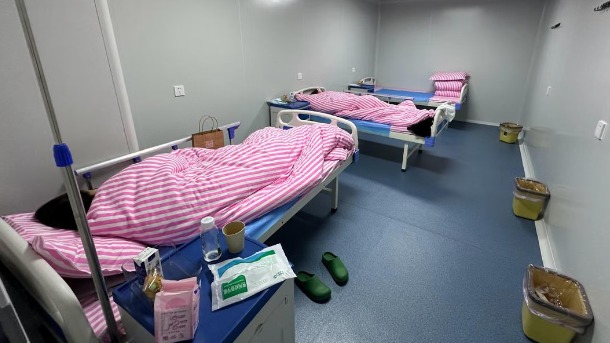
The underground surrogacy lab occupied a self-built rural house. On the ground floor, journalists found a laboratory, an operating room, and a patient ward stocked with embryo transfer and egg harvesting equipment and drugs. The ward contained 16 beds. When law enforcement entered, nine women were still lying in the beds, a mix of egg donors and surrogate mothers.
Journalists found one surrogate who was deaf and mute. Shang Guan communicated with her through sign language. She said she was from Shangluo, a city in Shaanxi province. Someone from outside had brought her to the facility; she was unclear on exactly when. She had undergone an embryo transfer and received 280,000 yuan from her handler.
A woman in another bed told journalists she was 29 years old and had been brought to the house that same day. She had just undergone an embryo transfer and received 190,000 yuan. The procedure was performed without anesthesia. When the journalist asked if it hurt, she shook her head and said “no.”
According to a separate account published on Chinese social media by the user “Eight Towers,” a Miao ethnic minority woman from Guizhou province said she had agreed to an embryo transfer for 160,000 yuan, but the raid interrupted the procedure before it was completed. The facility also held other women who were deaf, mute, or intellectually disabled.
These women were exploited by their own families or by black-market trafficking rings, reduced to birthing tools. They endured the physical toll of egg harvesting while being treated as products in the surrogacy trade.