On April 3, 2026, federal agents arrested Hamideh Soleimani Afshar and her daughter, the niece and grand-niece of Qasem Soleimani, the late commander of the Quds Force, the Islamic Revolutionary Guard Corps’s elite overseas operations unit, whose killing by a U.S. drone strike in 2020 nearly triggered open war between Washington and Tehran. Both women were detained by Immigration and Customs Enforcement.
Afshar had publicly praised Iran’s new supreme leader, celebrated attacks on U.S. forces in the Middle East, and called the United States the “Great Satan.” Secretary of State Marco Rubio revoked the pair’s legal status in early April. Rubio also terminated the legal residency of Fatemeh Ardeshir-Larijani, daughter of Ali Larijani, the Iranian security chief killed in an Israeli airstrike in March 2026, and her husband, Seyed Kalantar Motamedi. That couple had already left the United States and had been barred from returning.
The arrests set off a wave of anxiety in Chinese American communities. Even a secure legal status, many concluded, offers no permanent shelter.

A Shanghai entrepreneur’s warning: CCP officials’ US-based families are next
Hu Liren, a Shanghai-born entrepreneur living in the United States, addressed the developments on his independent media program. He laid out the logic plainly.
Once Washington classifies a government as hostile, he argued, it begins scrutinizing the relatives of that government’s officials on American soil, examining where their assets came from. Soleimani’s niece, he noted, built her wealth on money extracted from the Iranian people. CCP officials, he said, are in the same position.
Success
You are now signed up for our newsletter
Success
Check your email to complete sign up
If the CCP attacks Taiwan, the United States will formally designate China as a hostile state. At that point, Hu said, Washington will pull the names of CCP officials, identify their relatives living in America, and initiate deportation proceedings. Green cards and even U.S. citizenship would be revoked, and the precedent, he said, is already set.
The reach would not stop at the immediate family. Collateral relatives could also be swept in. “The sky is changing,” Hu said. “America’s political conditions are changing. For the CCP, this is a deterrent.”
The Party’s long effort to trap its own officials abroad
For years, many CCP officials have pursued a strategy known in Chinese as “naked official” status. They quietly moved their spouses, children, and illicitly acquired wealth out of China, typically to Western countries, while remaining at their posts inside the Party system. The arrangement was meant to provide an exit guarantee: family and money safely beyond the Party’s reach, the official himself insulated at home.
That calculation is now under pressure from two directions simultaneously.
American law enforcement has been building files on these officials’ overseas relatives and assets for years. And the Party itself has been closing the net.
On April 2, 2026, the CCP’s Central Commission for Discipline Inspection’s office for international anti-corruption coordination convened a planning session to map out what the Party is calling its 2026 cross-border corruption enforcement work, launching what it has branded “Operation Skynet 2026.” The session specifically directed the Party’s Central Organization Department to work with the Ministry of Public Security and the National Immigration Administration to tighten monitoring of naked officials’ sensitive posts and enforce rules against unauthorized overseas travel by Party cadres.
The pressure has been building for over a year. In February 2026, Hong Kong’s South China Morning Post reported that since early 2025, Party departments and state-owned enterprises had conducted multiple internal audits specifically targeting senior officials and executives with overseas family ties. Sources cited in the report described those officials whose spouses and children are based abroad as long-standing priority targets for the Party’s internal anti-corruption apparatus. More recently, Beijing has widened its scrutiny to include a new category: officials whose children live overseas while their spouses remain in China, a category Beijing’s internal documents now label “quasi-naked officials.” Officials who fall into this group are being placed under heightened supervision and are required to report their overseas connections.
According to the Post’s sources, the Party’s Organization Department ran a nationwide investigation in the first half of 2025 specifically designed to expose the overseas links of officials in sensitive positions. The sweep directly cost several state enterprise executives and research institute directors their posts, not because they were found guilty of corruption, but simply because their children held foreign green cards or lived permanently abroad.
A foreign residency in the family, without any evidence of financial wrongdoing, has proven sufficient to end a career.
In November 2025, the Standing Committee of the Chinese People’s Political Consultative Conference, the Party’s political advisory rubber-stamp body, announced that eight vice-chairmen of various committees were being removed. None had reached mandatory retirement age. None was publicly linked to a corruption investigation. All were naked officials.
A defected United Front official exposes the Party’s overseas surveillance network
While some officials gambled on moving their families abroad and staying in post, others reached a different conclusion. In recent years, a small number of officials have chosen to flee the system entirely, getting their families out before speaking out about what they had witnessed.
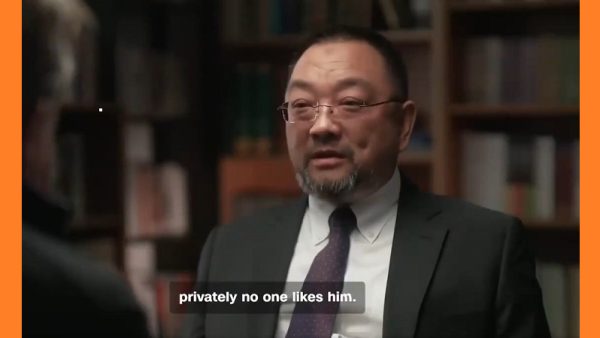
In February 2024, Ma Ruilin, who had served as a deputy Party secretary of the United Front Work Department in Gansu Province, escaped to the United States with his family. In March 2026, he gave a wide-ranging interview to CNN.
“This system has always been evil,” Ma told CNN. “If you don’t leave, you keep doing evil inside it.”
Ma spent his career inside the CCP’s United Front Work Department, the Party organ responsible for co-opting, monitoring, and manipulating non-Party constituencies inside China and, increasingly, Chinese communities abroad. He said that since Xi Jinping, the CCP’s general secretary, consolidated power, and especially since 2019, the United Front system’s staffing has roughly doubled. It has shifted from an institution primarily managing political advisory bodies inside China to a sprawling surveillance and propaganda machine operating in close coordination with the Ministry of State Security and the Public Security Bureau.
The overseas reach, Ma said, is direct and operational. The United Front works through overseas Chinese “hometown associations” and student groups to recruit informants, establish what internal documents call “overseas police service stations,” and monitor, intimidate, and in some cases physically assault dissidents abroad.
Ma said he remains under surveillance even in the United States. He described seeing an internal document listing United Front informants who had been arrested in America.
CNN’s reporting framed Ma’s decision to go public as providing U.S. law enforcement with significant evidence for its broader effort to counter what authorities describe as the CCP’s transnational repression operations. United Front operatives have been accused in recent years of targeting advocates for Taiwan, Hong Kong, Tibetan, and Xinjiang independence, as well as Falun Gong practitioners.
“I know all the details,” Ma told CNN, “everything that happened in the Xinjiang camps, down to the small things. How brutal it was.”
When the CNN interviewer asked whether Xi Jinping is genuinely popular within the Party, Ma’s answer was terse: “Based on everyone I know, nobody likes him in private. But everyone praises him in public.”