China’s activities in the disputed South China Sea continue to escalate, with Beijing recently constructing a barricade at the entrance to Scarborough Shoal, further heightening tensions with the Philippines.
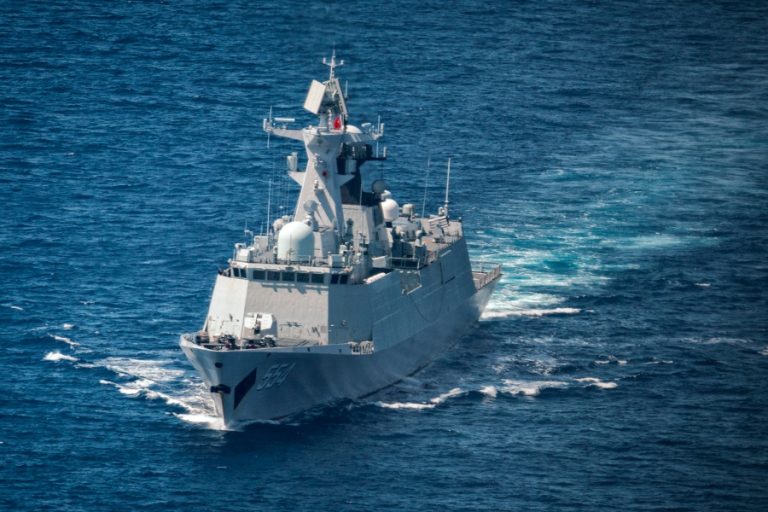
Satellite imagery analyzed by Reuters from April 10 and April 11 shows the barricade consisting of “four fishing boats, a Chinese naval or coast guard ship, and a new floating barrier.” A maritime expert told Vision Times that the move reflects Beijing’s ongoing push for maritime dominance in the South China Sea.
“The Chinese Navy and Coast Guard are undertaking multiple expeditions to ensure complete maritime dominance in the region,” Arnab Das, founder and director of an India-based maritime research center, said in an email.
The imagery, provided by Vantor (formerly Maxar Technologies), was corroborated by Philippine authorities. Jay Tarriela, a spokesperson for the Philippine Coast Guard, told Reuters that six Chinese maritime militia vessels were positioned within the shoal, with three more outside, effectively obstructing access to Scarborough Shoal — also known as Bajo de Masinloc (BDM).
- BYD Shenzhen Fire Destroys Over 1,000 Test Vehicles; Contractor Safety Breach Cited
- US Plans Fuel Depot in Philippines for South China Sea Operations
- China Reportedly Preparing to Supply Iran With New Air Defense Systems
The shoal lies within the Philippines’ exclusive economic zone (EEZ), though China claims it as part of its territory. Das described the barricade as an act of intimidation and part of a broader Chinese maritime strategy.
Success
You are now signed up for our newsletter
Success
Check your email to complete sign up
“The comprehensive Underwater Domain Awareness (UDA) being progressed by the Chinese, where civil and military assets are deployed in coordination, is a formidable power projection,” he said.
Disputed waters and rising China-Philippines tensions
The situation at Scarborough Shoal remains highly contested. Despite its classification within the Philippines’ EEZ, Manila has struggled to assert control, while Beijing has steadily expanded its presence.
Incidents such as vessel collisions and water cannon confrontations between Chinese and Philippine forces have been repeatedly reported, underscoring the ongoing tensions.
“We need to take a historic perspective on this,” Das said. “The Chinese announced the Underwater Great Wall project in 2015, and since then they have adopted a far more aggressive posture in the South China Sea.”

He said the project reflects China’s ambition to gain technological superiority in maritime surveillance and to challenge freedom of navigation operations conducted by the United States.
In 2016, the Permanent Court of Arbitration ruled in favor of the Philippines on several South China Sea issues, rejecting many of China’s claims. However, the court did not rule on sovereignty over Scarborough Shoal itself, leaving the dispute unresolved.
Das noted that major powers have long recognized the strategic importance of the region. He cited the U.S.-led ASIAEX (Asian Seas International Acoustics Experiment) project in 2001 as an example of early efforts to understand the region’s underwater environment for naval strategy.
The U.S. is reckoning with China’s growing strength and “has been working towards strengthening its strategic presence in the region and China has been continuously investing on its strategic capabilities” to counter Washington’s position in the West Pacific, he said.
He added that Beijing may be taking advantage of perceived distractions to American foreign policy in the form of the ongoing war in the Middle East.
“The Iran crisis has exposed U.S. warfighting limitations” he said.
Economic and fishing interests drive control
Beyond military strategy, Scarborough Shoal holds significant economic value. The area is rich in marine biodiversity and supports the livelihoods of Filipino fishing communities, while being coveted by Chinese fishers.
“The huge Chinese Fishing Fleets are always looking for fishing grounds and thus the economic dominance will always be a driving factor. The socio-economics of the fishing communities being dependent on these areas for their livelihood and survival makes them politically sensitive,” he said.
China has increasingly used its fishing fleets as part of a broader maritime militia strategy, reinforcing its presence and control in contested waters. The scale of their activity is threatening many fisheries with rapid depletion, as well as endangering marine ecosystems.
“The Chinese with their economic, political and military dominance and more importantly their realization as a global power, are making them take strategic decisions to maintain that reputation,” Das said.
He added that China views dominance in the South China Sea as essential to its broader geopolitical standing and Indo-Pacific strategy.
Military drills add to regional pressure
The latest development comes just days before the start of the annual Balikatan exercises, joint military drills between the United States and the Philippines that began Monday.
The drills involve more than 17,000 troops and include operations across air, land, sea, cyber, and space domains across the Philippine archipelago, including areas near the South China Sea.
Japan is also participating in a major way for the first time, marking a significant expansion of U.S.-Philippines-Japan military cooperation and raising additional concerns in Beijing.
Analysts say the timing of China’s actions at Scarborough Shoal underscores the growing strategic competition in the region, where military activity, economic interests, and geopolitical rivalry are increasingly intertwined.