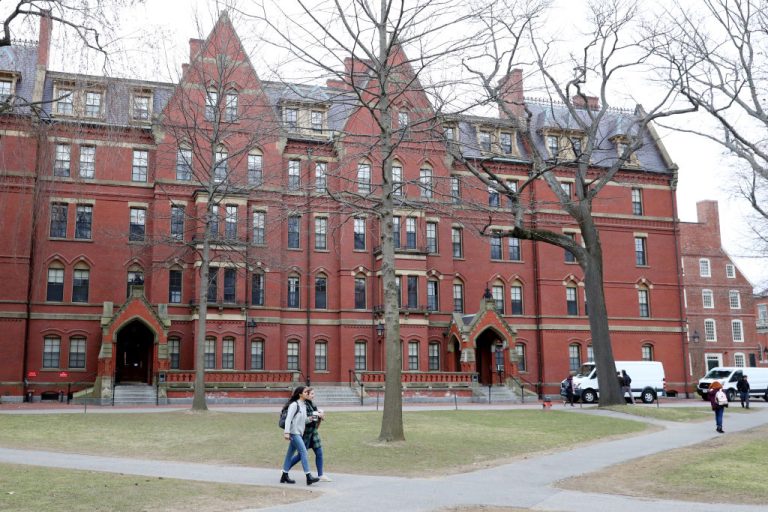
On April 15, 2026, U.S. Supreme Court Justice Clarence Thomas delivered a special speech commemorating the 250th anniversary of the Declaration of Independence at the invitation of the Civics Leadership Institute at the University of Texas at Austin. The following is a full translation of the speech:
President Davis, Provost Inboden, Dean Dyer, faculty, and students thank you for the invitation to visit the University of Texas at Austin. It is an honor to be here at one of the nation’s finest universities to celebrate the 250th Anniversary of the Declaration of Independence.
If my memory serves me, this is my second visit to the University of Texas. But, I have hired and worked with a number of outstanding young people associated with this University. My first was now Chief Judge Greg Maggs of the U.S. Court of Appeals for the Armed Services who was a fairly new member of the law school faculty when I became a member of the Court. He took a leave of absence to help me as a law clerk during the second half of my first Term. My first UT law graduate to serve as a law clerk was Greg Coleman three decades ago. Greg went on to become the first Solicitor General of Texas. He was simply outstanding as was his son, Reid, also a graduate of your law school. Greg’s widow and our very dear friend, Stephanie is with us today. And, they both clerked for my dear friend, Judge Edith Jones, whom I admire greatly and who is here today. And, I have had other UT alumni from both the undergraduate and law school who were similarly outstanding. Several of my former law clerks have joined us and I would ask them to stand to be recognized.
I am pleased to join you all today. I hope that my talk today will help in some small way to inaugurate another great initiative, the State of Texas’s plan to restore the teaching of civics and western civilization to a central place in its flagship university. And, I am grateful and honored to have been invited by Justin Dyer, the dean of the new School of Civic Leadership. I am also grateful for the assistance of my former law clerk Professor John Yoo who has spent the last three decades at Berkeley law school but is joining Justin Dyer and his team. The school’s stated mission is to help students “encounter the distinct inheritance of Western civilization and the American constitutional tradition as part of a larger quest for wisdom about how to live and how to lead.”
Your plans could not come at a more important moment for our nation, when, as we celebrate the 250th anniversary of the Declaration of Independence, the very values announced in it have fallen out of favor. It is my sincere hope that your work to revitalize the teaching and research of western civilization and the American constitutional tradition will lead the way in the reform of our nation’s colleges and universities. And, I hope that your example will help to rejuvenate our fellow citizens’ commitment to the principles of the Declaration of Independence.
Success
You are now signed up for our newsletter
Success
Check your email to complete sign up
I seem to always enjoy my travels to this amazing state. My wife, Virginia, and I have many wonderful friends and acquaintances here. And, it is so special to have our dear friends, Harlan and Kathy Crow join us today. One of the features of this state that stands out is the way that Texans talk about it. What comes through is the sustained and sustaining affection that they have for their home state. That reverential feeling for and attachment to Texas is to be respected, admired, and, if possible, emulated. This affection is similar to the attachment that I grew to have for my home state of Georgia and certainly for our country, despite the indelible mark of segregation and its companion evils. I was proud to say that I was American by birth and Georgian by the grace of God. And, it was not uncommon to hear others proclaim their allegiance to “God and country” or, as Superman was wont to say, “Truth, justice, and the American way.”
At our grammar school, St. Benedict’s, we started each school day by lining up two by two and class by class in the school yard to watch the raising of the American flag and to say the pledge of allegiance before silently marching to our respective classrooms. Even as so much of our God-given and Constitutional rights were denied us, we still faithfully said the pledge of allegiance, memorized the preamble to our Constitution, and yearned for the fulfillment of its promised ideals.
Sadly, these sentiments are not as widely shared among our fellow citizens today. And, they certainly do not seem to have that sustaining strength that they had back then. In fact, all too often the sentiments tend toward cynicism, rejection, hostility, and animus toward our country and its ideals. With the foregoing in mind, I would like to begin by addressing my first encounter with the principles of the Declaration of Independence. It is perhaps not what you would immediately think.
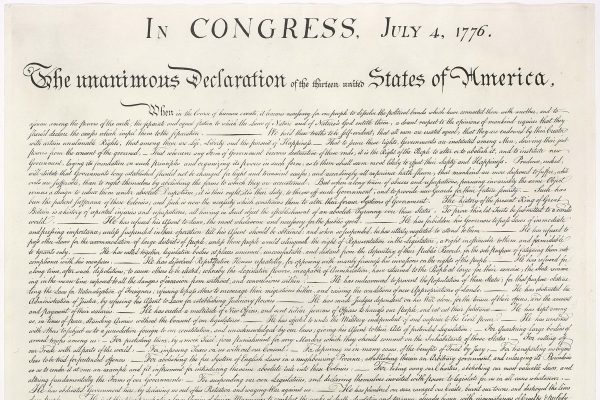
The second paragraph of the Declaration proclaims: “We hold these truths to be self-evident, that all men are created equal, that they are endowed by their Creator with certain unalienable Rights….” Throughout my youth, these truths were articles of faith that were impervious to bigotry or discrimination. The American Heritage Dictionary of the English Language defines “self-evident” as “obviously true, and requiring no proof, argument or explanation.” Whether they had a divine source, or a worldly one, they were never questioned. They were the Holy Grail, the North Star, the rock – immovable and unquestioned.
Despite the multiplicity of laws and customs that reeked of bigotry, it was universally believed among those blacks with whom I lived and who had very little or no formal education, that “in God’s eyes and under our Constitution we are equal.” This was also the case with my nuns, most of whom were Irish immigrants. At home, at school, and at Church, we were taught that we are inherently equal; that equality came from God; and that it could not be diminished by man. We were made in the image and likeness of God. That proposition was not debatable and was beyond the power of man to alter. Others, with power and animus, could treat us as unequal but they lacked the divine power to make us so.
Somehow, without formal education, the older people knew that these God-given or natural rights preceded and transcended governmental power or authority. When you lived in a segregated world with palpable discrimination and the governments nearest to you enforced laws and customs that promoted unequal treatment, it was obvious that you did not get your rights or your dignity from those governments, but from God. Though not a literate man, my grandfather often spoke of our rights and obligations coming from God, not from the architects of segregation and discrimination. Men were not angels. They were subject to the constraints of antecedent rights. And, we were not subject to them even as we were subjected to their whims. We knew that life, liberty, and property were sacrosanct. These truths were self-evident to the adults in our lives and were taught to us as undeniable truths. Those around us could endure with dignity the insults of segregation because they knew that, in God’s eyes, they were equal.
All too often, there is an unfortunate tendency, when discussing the Declaration, to make these self-evident truths and first principles of government obscure. Intellectuals want you to believe that our founding principles are matters of esoteric philosophy or sophisticated debate. Even those who support them too often talk about them as if they were academic playthings. They overcomplicate them, take the spirit out of them, and discuss them in a manner that puts us to sleep.
But the principles of the Declaration of Independence, as I encountered them, are a way of life. They are not an abstract theory that you learn in college or law school but the basic premises of our Constitution and government that you learn from the people all around you. When Alexis de Tocqueville visited early America from France, he was struck that there was “no country in the civilized world where they are less occupied with philosophy than the United States.” But there was likewise no country where the principles of the Declaration were more deeply ingrained or more fiercely defended than those same United States. That is the sense in which I knew the principles of the Declaration in my childhood; that is the only sense in which those principles can sustain our country; and that is the sense in which I will speak to you about those principles today.
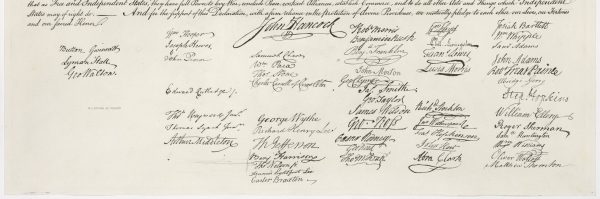
I still believe now, as I did then, that the Declaration of 1776 provides us with the principles to guide us as citizens of our great Republic. Even in this time of questioning and criticism of our founding, we should not forget that the Declaration established the principles that produced – despite all of our imperfections, miscues, and tragic mistakes – the freest, wealthiest, and most powerful nation in the history of the world. It provided the moral principles by which Frederick Douglass, Abraham Lincoln, and Martin Luther King, Jr. could criticize the institutions of slavery and segregation. The Declaration is, in fact, along with the Gospels, one the greatest antislavery documents in the history of Western Civilization. It did not establish a form of government – that was the job of the Constitution that followed – but it stated the purpose of government. The Declaration made clear in clear prose that the purpose of government is to protect our God-given inalienable rights, rights that all individuals equally possess. As Abraham Lincoln declared in 1858, in the midst of his great debate with Stephen Douglas, “drop every paltry insignificant thought for any man’s success. It is nothing; I am nothing; Judge Douglas is nothing. But do not destroy that immortal emblem of Humanity – the Declaration of Independence.”