By Du Zheng, Commentary
Xi Jinping, the Chinese Communist Party’s (CCP) top leader, has spent much of the past decade positioning himself as a central figure in the Party’s anti-corruption campaign. Yet alongside this effort, another dynamic has unfolded: While officials tied to Xi’s own faction have faced repeated purges within the military and security apparatus, family members of earlier Party leaders have continued to expand their influence across key sectors of the economy.
Recent developments suggest a renewed alignment between Xi and the family of his predecessor, former CCP leader Jiang Zemin—an evolution that may carry significant implications for both political stability and elite economic interests.
RELATED: Xi Jinping Military Purge Leaves Leadership Vacancies Across China’s Armed Forces
Growing economic reach
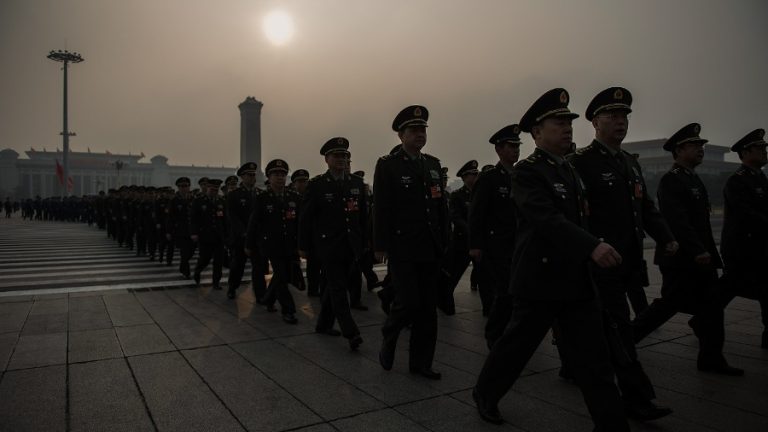
Following the CCP’s 20th Party Congress in October 2022, Xi’s allies consolidated control over many of the Party’s top positions across political, military, and administrative systems. However, subsequent developments have included a series of internal investigations and removals involving senior officials.
Success
You are now signed up for our newsletter
Success
Check your email to complete sign up
Zhang Youxia and He Weidong, both vice chairmen of the Central Military Commission, have been linked in overseas reporting to internal disciplinary actions. Meanwhile, Li Xi, head of the Central Commission for Discipline Inspection (CCDI), has reportedly moved against officials connected to his earlier tenure in Guangdong, including Ma Xingrui.
While these shifts unfolded within the political sphere, parallel developments have emerged in the commercial sector. In November 2024, Starbucks announced a joint venture with Boyu Capital, a private equity firm founded by Jiang Zhicheng, the grandson of Jiang Zemin, to operate its China business. Under the agreement, Boyu Capital would hold up to a 60 percent stake, with Starbucks retaining 40 percent. The transaction was finalized in April 2025, with plans to expand store operations across China.
Around the same time, Liu Lefei, the son of former Politburo Standing Committee member Liu Yunshan, extended his presence in the investment sector. Liu controls CPE Yuan Feng, a firm that evolved from the state-linked CITIC Industrial Investment Fund. In November 2025, the firm entered into a joint venture with Restaurant Brands International, parent company of Burger King, committing $350 million in initial funding and securing a controlling stake. The deal closed in early 2026.
Since 2025, Boyu Capital has expanded into high-profile investments across China’s consumer and technology sectors, including stakes in Beijing SKP and involvement in companies such as Mixue Ice Cream and Tea, CATL, and Hengrui Pharmaceuticals. Liu Lefei has similarly participated in international acquisitions, including a controlling stake in SML Group, a firm specializing in RFID and brand identification technology.
Observers have noted the concentration of such investments among individuals linked to families of former senior officials, drawing comparisons to systems in which economic influence is closely tied to political lineage.
Allegations of economic coordination
The recent activity involving individuals connected to the Jiang family has also revived earlier claims that circulated in overseas Chinese political discussions more than a decade ago.
In 2014, reports surrounding the CCP’s Beidaihe meetings described a possible alignment between Alibaba founder Jack Ma and figures associated with elite political families, including Jiang Zhicheng and Liu Lefei. These claims, sometimes referred to as the “Anti-Heaven Plan,” alleged efforts to consolidate influence across China’s financial and internet sectors. While these claims were never independently verified, subsequent developments are well documented.
In October 2020, Jack Ma publicly criticized China’s financial regulatory system. Shortly thereafter, Ant Group’s highly anticipated IPO was suspended, and Ma largely disappeared from public view for an extended period.
According to reporting by The Wall Street Journal, the decision followed internal reviews of Ant Group’s shareholder structure, which included individuals connected to politically influential families. Ant Group was later forced to restructure, and Alibaba faced regulatory penalties. By 2023, Ma’s voting control in Ant Group had been significantly reduced.
Boyu Capital’s earlier investment in Ant Group, completed in 2016, was structured through intermediary entities, including Beijing Jingguan Investment Center. The firm had also participated in a consortium that repurchased Alibaba shares from Yahoo in 2012, ahead of the company’s U.S. listing.
Some analysts describe these relationships as part of a broader system in which private entrepreneurs operate alongside politically connected families. In Chinese political discourse, the term “white glove” is sometimes used to describe business figures who manage assets on behalf of individuals unable to hold them directly.
Longstanding political arrangements
Analysts of Chinese elite politics have long pointed to informal arrangements between leadership factions as a mechanism for maintaining stability.
One such arrangement, often described as “skip-generation succession,” involved senior leaders designating successors beyond their immediate replacements, creating expectations of long-term continuity and protection for affiliated networks.
Deng Xiaoping designated Hu Jintao as a future leader. Jiang Zemin later supported Xi Jinping’s rise. Hu Jintao, in turn, was widely reported to have promoted Hu Chunhua as a potential successor. Xi’s consolidation of power and departure from this pattern has disrupted these expectations, particularly among political families that once relied on such arrangements for long-term security.
Earlier accounts suggest that Jiang’s support played a role in Xi’s elevation to the Politburo Standing Committee in 2007. During Xi’s first term, anti-corruption campaigns targeted senior figures such as Zhou Yongkang and military leaders Xu Caihou and Guo Boxiong.
At the 20th Party Congress in 2022, Xi secured a third term while some officials linked to earlier political networks remained in senior roles, reflecting continued accommodation between factions.
Jiang’s legacy
Recent developments indicate a shift in how Jiang Zemin’s historical role is being presented. Chinese authorities have announced renovations at the Mao Zedong Mausoleum in Beijing, with work scheduled between March and August. Reporting by Hong Kong-based Ming Pao suggests that a centennial commemoration for Jiang may be held during this period, potentially signaling a level of recognition reserved for a select group of Party leaders.
At the same time, individuals associated with Jiang’s network, including his son Jiang Mianheng, have not been publicly implicated in recent investigations, despite broader disciplinary actions affecting related sectors.
Jiang Mianheng has held positions within the Chinese Academy of Sciences and played a role in major national science and technology initiatives, including the Shenzhou space program and the Chang’e lunar missions. Some officials within these systems, including Ma Xingrui and Zhu Zhisong, have more recently been linked to disciplinary probes.
Observers suggest that the selective nature of these investigations reflects the complexity of factional dynamics within the CCP.
A delicate balance of power
Xi’s current position appears to reflect a balancing act, maintaining authority while managing relationships across competing political networks. In this context, renewed references to Jiang Zemin’s legacy may serve to reinforce continuity within the Party’s leadership structure, even as internal tensions persist.
While Xi has long sought to distinguish his leadership from earlier eras associated with corruption and patronage, recent developments point to a more intricate reality, one in which political authority, historical legacy, and elite networks remain deeply intertwined within China’s governing system.
This article was originally published by Upright News (上報). Reproduction or copying without permission is prohibited. The views expressed are solely those of the author.