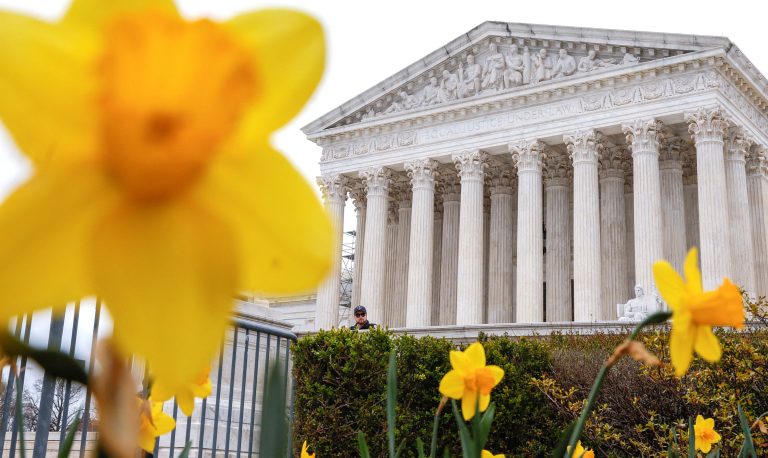
The U.S. Supreme Court on April 28 heard arguments in a case that could shape the future of American corporate accountability for human rights abuses abroad, as justices considered whether Cisco can be held liable for allegedly helping Chinese authorities target practitioners of Falun Gong.
At the center of the case, Cisco Systems v. Doe I et al., are claims that the California-based company knowingly assisted in developing surveillance tools used in the Chinese Communist Party’s long-running violent campaign against the spiritual group. Falun Gong, also known as Falun Dafa, teaches meditation and principles centered on truthfulness, compassion, and forbearance, and has been subject to extensive repression in mainland China since 1999.
The case reached the Supreme Court after the U.S. Court of Appeals for the Ninth Circuit ruled in 2023 that the plaintiffs had sufficiently established standing to proceed.
The lawsuit was originally filed in 2011 and accuses the company and several executives of contributing to abuses including detention, torture, and forced disappearance.
The justices are now considering whether two longstanding statutes — the Alien Tort Statute of 1789 and the Torture Victim Protection Act of 1991 — permit such claims to proceed in U.S. courts.
Success
You are now signed up for our newsletter
Success
Check your email to complete sign up
A final decision by the Supreme Court is expected in June.
Building China’s ‘Great Firewall’
The plaintiffs argue that Cisco’s involvement went beyond ordinary commercial activity, pointing to its alleged role in designing and refining “Golden Shield,” a nationwide surveillance infrastructure used by Chinese security services.
Launched in 2006, “Golden Shield” was the CCP’s first comprehensive program to censor and surveil the Chinese internet — which had, much to Beijing’s concern, been increasingly used since the 1990s by dissidents, religious believers, and other members of Chinese civil society as a means of freer communication and expression.
According to the lawsuit, the platform was designed and adapted in ways that enabled the CCP’s secret police to identify and monitor Falun Gong practitioners across China.
Evidence cited by the plaintiffs includes a 2008 leaked Cisco marketing presentation describing the system’s capabilities, including a reference to efforts to “combat ‘Falun Gong.’”
More than a dozen individuals are part of the case, including at least one U.S. citizen, who allege they were detained or subjected to abuse connected to the use of the surveillance network.
Paul Hoffman, representing the Falun Gong practitioners, argued that limiting Cisco’s liability could have far-reaching deleterious effects, as U.S. companies would have protection regardless of “how substantial and direct their contributions were” in enabling or aiding human rights abuses overseas.
“Under Cisco’s theory, even the corporate actors who provided the poison gas for Nazi crematoria would not be liable,” Hoffman told the Supreme Court. “There’s no basis in international law [for] such an absurd result.”
He urged the justices not to “give the green light to U.S. corporations acting from the United States to help foreign governments commit torture or extrajudicial killing.”
Cisco has denied the allegations and has asked the court to narrow the scope of the laws in question.
Foreign policy and access to justice
Attorney Kannon Shanmugam, representing Cisco, told the Supreme Court that successful claims under the Alien Tort Statute have been rare. Of some 300 cases seeking damages under the Statute, he said that only six cases saw plaintiffs awarded monetary compensation.
Later, Hoffman disputed this claim, saying that he had personally worked on more than that number of cases in which the plaintiffs won.
Terri Marsh, executive director of the Human Rights Law Foundation, which filed the case on behalf of the plaintiffs, said the arguments presented gave the court “the information they needed to hold Cisco accountable for their complicity in human rights violations against Falun Gong believers in China.”
“We hope that the justices will allow our lawsuit to proceed on the merits, and we look forward to their decision,” she told The Epoch Times.
The case has attracted significant outside interest, with 18 amicus briefs filed in support of the plaintiffs by lawmakers, legal scholars, human rights organizations, and former international officials.
Government lawyers, along with Cisco, have argued that allowing the lawsuit to proceed could create complications for U.S. foreign policy. The Trump administration, as previous administrations, has indicated support for Cisco’s side in the case.
During the hearing, Deputy Solicitor General Curtis Gannon said lower courts have been “too permissive” in allowing similar cases to proceed. Some justices appeared unconvinced by his assertion.
Supreme Court Justice Ketanji Brown Jackson questioned whether hypothetical diplomatic consequences should outweigh the plaintiffs’ right to seek redress.
“Why would Cisco be absolved and the plaintiffs here not get a remedy on the basis of some speculation about a foreign policy concern that the United States is not even willing to say in writing right now would actually occur?” she said.
Harold Hongju Koh, a former State Department legal adviser and professor of international law at Yale University, described concerns about the case’s interference with foreign policy as being “vastly overblown.”
Writing in digital law journal Just Security, he said that the allegations suggest conduct that goes beyond routine business dealings. He characterized the company’s role, if proven, as shifting from a “passive supplier to knowing abettor.”
Advocacy groups also stressed the wider stakes of Cisco Systems v. Doe I et al. In a filing, the Electronic Frontier Foundation argued that technological expertise from private companies often plays a role in modern repression.
“In the digital age, repressive governments rarely act alone,” the group wrote, adding that victims frequently lack meaningful avenues for justice in their home countries. The Alien Tort Statute, it said, remains a critical pathway for accountability.