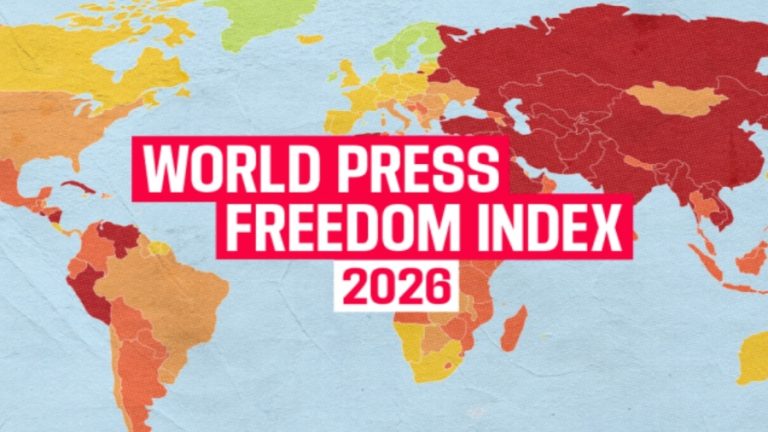
Reporters Without Borders (RSF) published the 2026 World Press Freedom Index on April 30. The report shows that Hong Kong ranks 140th and remains in the worst-rated category of “very serious situation.” Taiwan ranks 28th, placing first in Asia, while China ranks third from the bottom (178th).
RSF’s report (pdf) indicates that among the 32 countries and territories ranked in the Asia-Pacific region, 21 are classified as having either a “difficult situation” or a “very serious situation” in terms of press freedom. These regions are among the most repressive in the world, and conditions continue to deteriorate.
The report warns that authoritarian governments—led by the Chinese Communist Party—have developed numerous censorship and propaganda tools, which are now expanding beyond borders into other countries.
The report states that over the past 25 years, the information space in some countries has significantly shrunk due to political changes and increasingly authoritarian regimes. For example, Hong Kong has seen a sharp decline since Beijing strengthened its control. It has ranked 140th for two consecutive years, with its score slightly dropping from 39.86 last year to 39.49 this year, mainly due to declines in political, economic, and social indicators.
The report notes that Hong Kong was once considered a stronghold of press freedom, but since the implementation of the National Security Law in 2020, press freedom in Hong Kong has suffered a series of unprecedented setbacks.
Success
You are now signed up for our newsletter
Success
Check your email to complete sign up
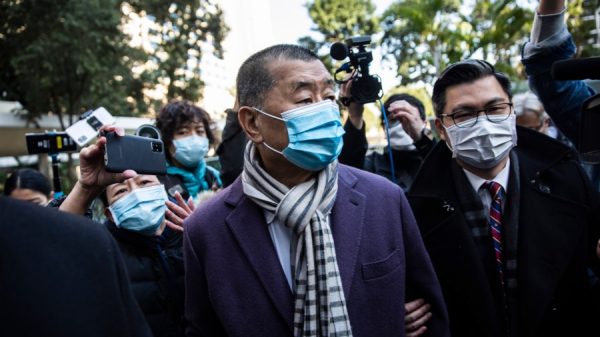
The report further states that the founder of the Apple Daily, Jimmy Lai, was severely sentenced under the stringent National Security Law. In February of this year, he was sentenced to 20 years in prison on charges related to national security offenses, including “conspiracy to collude with foreign forces.”
The Hong Kong Special Administrative Region government strongly condemned the report, stating that the rankings lack credibility and criticized Reporters Without Borders for “whitewashing” Jimmy Lai.

China is the world’s largest prison for journalists
The report states that China ranks 178th (third from the bottom). Due to suppression by the Chinese Communist Party, press freedom in China remains unchanged. Major media outlets there are still state-owned and directly controlled by the authorities.
In the eyes of the CCP, the role of the media is to serve as the party’s mouthpiece and function as government propaganda. Independent journalists and bloggers who dare to report sensitive information are often monitored, harassed, detained, and even subjected to torture.
The report also notes that China is the world’s largest prison for journalists, with a total of 121 media workers currently imprisoned.
It adds that press freedom has declined in countries such as Iraq, Sudan, and Yemen due to the impact of war.
Russia, which continues its war against Ukraine, remains one of the countries with the worst press freedom conditions (ranked 172nd), while Iran (177th) also remains near the bottom.
Taiwan ranks 28th, first in Asia
The report states that Taiwan ranks 28th globally, down four places from 2025, but still holds first place in Asia. The report analyzes that Taiwan is facing challenges in maintaining information credibility.
In this year’s rankings, Norway has topped the list for the tenth consecutive year, followed by the Netherlands in second place and Estonia in third. Eritrea remains at the bottom for the third consecutive year, ranked 180th.
The United States fell seven places to 64th, due to factors such as political pressure.
Reporters Without Borders concluded that, overall, the global press freedom environment is worsening.
For the first time in the history of the index, more than half of the world’s countries have been classified as having either a “difficult situation” or a “very serious situation.” The average score of all evaluated countries is also the lowest ever recorded.
The report also states that among the five indicators used to assess global press freedom—economic, legal, safety, political, and social environments—the legal indicator experienced the largest decline this year.
Jimmy Lai’s harsh sentence creates chilling effect
According to Pulse HK News, regarding the current state of press freedom in Hong Kong, Gary Yuen Po-kwong, chairman of the Hong Kong Overseas Media Association (HKMO), said that a ranking of 140 places Hong Kong close to the level of authoritarian states, in stark contrast to its former status as a top-ranked jurisdiction.
Yuen stated that the heavy sentencing of Jimmy Lai, founder of Apple Daily, and senior executives of the publication has created a strong chilling effect within the industry.
In addition, independent media outlets such as InmediaHK have had their journalists harassed by unknown individuals, while law enforcement agencies have appeared to turn a blind eye.
He further noted that, due to the loss of financial support, the credible Hong Kong team of Yahoo News was ultimately forced to cease operations. This highlights the significant shrinking of space for the media to perform its watchdog role over the government.
By Li Jingyao, Vision Times