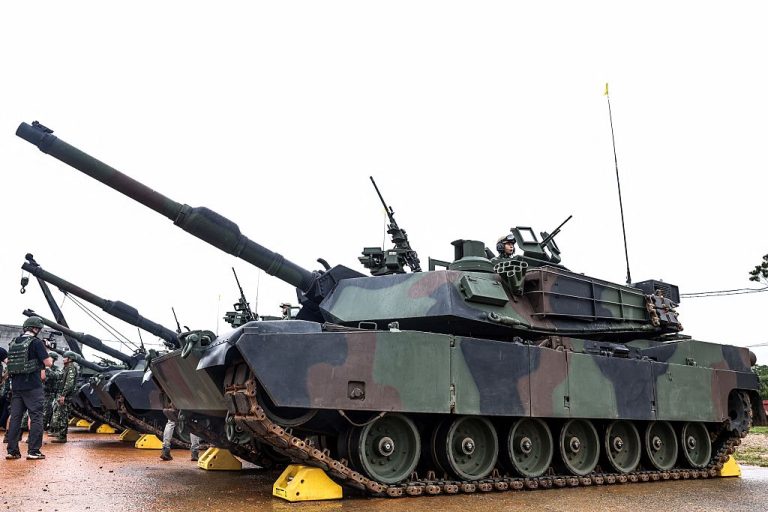
The final batch of 28 M1A2T tanks purchased by Taiwan from the United States arrived in Taiwan on April 27.
The M1A2 Abrams tank, in standard use with the U.S. armed forces, is considered one of the most formidable tanks in the world.
According to Liberty Times, anonymous military sources said these tanks could be formally commissioned by the end of this year, further strengthening armored combat capability in northern Taiwan.
The Army Command stated that all 108 M1A2T tanks purchased from the U.S. have been delivered on schedule, marking what it described as a successful model of Taiwan–U.S. arms procurement.
Arrival of final batch
According to the Central News Agency, Taiwan’s Army currently operates around 1,000 tanks, including the CM-11 “Brave Tiger” and M60A3 tanks, many of which have been in service for over 20 years. Since 2019, Taiwan has procured upgraded engines for the M60A3 and allocated NT$40.5 billion to purchase 108 M1A2T tanks, which are described as the “world’s most powerful tanks.”
Success
You are now signed up for our newsletter
Success
Check your email to complete sign up
The “T” in M1A2T reportedly denotes a Taiwan-specific customized variant. The 108 tanks were delivered in three batches: 38 in the first batch, 42 in the second, and 28 in the final batch.
According to Liberty Times, on April 27, the final 28 tanks were transported from Taipei Port on multiple flatbed trucks to the Army Armor Training Command in Hukou, Hsinchu. The convoy was escorted by police vehicles and military police under strict traffic control. The tanks were covered with black waterproof tarps during transport. After arriving at the base, they were unloaded and undergo handover procedures conducted by both U.S. and Taiwanese personnel.
The first batch of 38 M1A2T tanks arrived in Taiwan in December 2024, after which personnel training conversion, logistics support, and maintenance preparations were immediately carried out. In July 2025, live-fire validation tests were completed. During the exercise, four tanks fired 19 rounds in total, all successfully hitting targets designed to simulate the frontal profile of PLA tanks, demonstrating the accuracy and stability of the Hunter-Killer system. This batch was officially commissioned in October of the same year, with the entire process taking approximately 10 months.
The second batch of 42 M1A2T tanks arrived in Taiwan in July 2025 and has since been gradually commissioned and deployed under the existing training system. These 80 tanks in total have been assigned to the Army’s 584th Combined Arms Brigade (1st and 3rd battalions) and one tank company of the 269th Brigade.
The Liberty Times also reported that military sources said the newly arrived 28 tanks will be assigned to the 2nd Battalion of the 584th Brigade, completing the brigade’s overall conversion.
The source added that the successful establishment of training, maintenance, and readiness verification mechanisms from the first two batches has allowed subsequent deliveries to follow a more mature and accelerated process.
Regarding the final batch’s commissioning timeline, the military remains cautiously optimistic. If training progresses smoothly, the tanks are expected to be commissioned by the end of this year, though final decisions will depend on training outcomes and readiness standards.
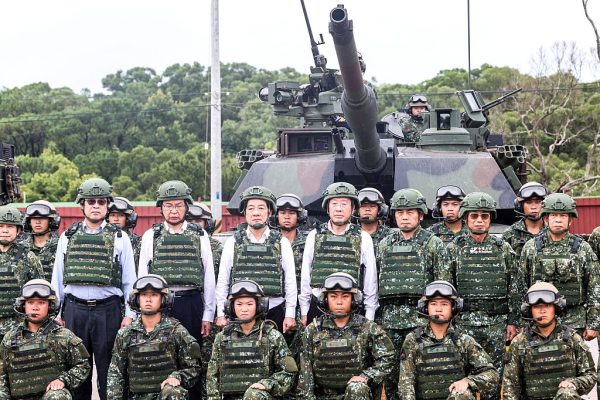
Army: a model of successful Taiwan–US arms cooperation
According to Storm Media, Taiwan’s Army Command stated on the 27th that all 108 M1A2T tanks purchased from the United States were delivered in three batches as scheduled and according to specifications.
The third and final batch arrived at the Armor Training Command on the same day. After completion of acceptance and testing, they will be gradually incorporated into the operational order of battle, contributing to the modernization of Army combat capabilities.
Storm Media reported that the Army stated that the 28 tanks were delivered to the Armor Training Command on the 27th, with all equipment handed over as scheduled and training now underway.
According to FTV News, the M1A2 Abrams weighs 63 tons, has a maximum speed of 67 km/h, and an operational range of 426 km, meeting Taiwan’s defense requirements. The tank features strong firepower, protection, and mobility, enabling effective operations in urban and complex terrain environments, while enhancing the overall combat effectiveness of ground forces.
According to reports, the Army Command also stressed that maintaining effective deterrence capability to ensure national security is the shared responsibility and goal of all personnel. It called on the public to support and encourage the procurement of new weapon systems and the phased replacement of outdated equipment that no longer meets operational needs or cost-effectiveness requirements, in order to sustain combat readiness.
Other procurement
Next Apple News reported that in addition to the 108 M1A2T tanks, Taiwan has also procured 14 M88A2 recovery vehicles, 16 M1070A1 transport trucks, and 16 M1000 transport trailers as supporting equipment.
Equipped with 120mm smoothbore guns, the new main battle tanks—combined with advanced fire-control systems and a “hunter-killer” capability—are expected to become a key ground strike force for the defense of northern Taiwan, marking an important transition in the modernization of armored forces.
According to FTV News, legislator Wang Dingyu stated Taiwan pays for the procurement according to delivery milestones rather than paying upfront, dismissing rumors to the contrary, reported the Minsheng News. He added that misinformation is being used to obstruct further acquisition of advanced military equipment and defense funding.
Wang emphasized that these tanks will form an important defensive force in northern Taiwan and urged opposition parties not to block the defense budget.
The Executive Yuan’s proposed NT$1.25 trillion special defense budget bill remains stalled, with three negotiation rounds failing to reach consensus. A fourth round is scheduled for May 6. The Kuomintang and Taiwan People’s Party have proposed alternative budgets of NT$380 billion plus additional items, and NT$400 billion respectively. Major disagreements between ruling and opposition parties center on the total budget size, content, and timeline.
Concerns over Taiwan’s defense budget delay have repeatedly been expressed by the United States, which has also sent bipartisan officials to Taiwan to understand the situation. In the most recent visit, a delegation from the U.S.-based Center for Strategic and International Studies (CSIS) met with Speaker of the Legislative Yuan Han Kuo-yu on April 22.
According to Liberty Times, Democratic Progressive Party legislator Wang Ding-yu, Kuomintang legislator Chen Yong-kang, and Taiwan People’s Party legislator Wang An-xiang were also present at the meeting.
It is reported that some members of the delegation warned Han Kuo-yu that Taiwan’s defense budget must be passed before a potential “Trump–Xi meeting,” otherwise Taiwan could face severe consequences.
By Li Jingyao