Japanese Prime Minister Sanae Takaichi visited Vietnam from May 1–3 and Australia from May 3–5, launching initiatives, signing agreements, and reinforcing Japan’s vision for a Free and Open Indo-Pacific (FOIP).
Takaichi arrived in Hanoi with a focus on strengthening long-term political and economic ties, with particular emphasis on energy security, critical minerals, and supply chain resilience. The two sides agreed to increase Japanese investment in Vietnam to $5 billion annually and boost bilateral trade to $60 billion by 2030.
Throughout the visit, Takaichi repeatedly emphasized the importance of a “Free and Open Indo-Pacific” for regional stability, economic growth, and a rules-based international order.
According to Japan’s Ministry of Foreign Affairs, Tokyo places significant importance on its relationship with Hanoi, aligning with its broader goals of “strategic autonomy” and “international integration.”
FOIP and the Iran war
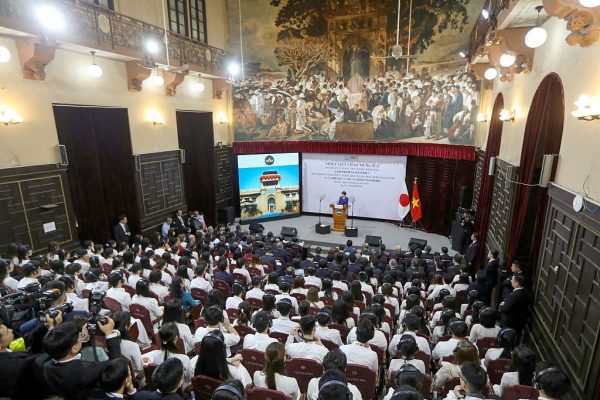
In a speech at Vietnam National University, Takaichi outlined Japan’s FOIP strategy, first introduced by former Prime Minister Shinzo Abe in 2016, highlighting principles such as freedom of navigation, rule of law, and free trade.
Success
You are now signed up for our newsletter
Success
Check your email to complete sign up
“This concept has since been widely shared as a clear vision of Japanese diplomacy, not only within Japan but also having an impact on the foreign policies of the United States and many other nations, and its circle of resonance has steadily expanded,” she said, noting that ASEAN adopted the ASEAN Outlook on the Indo-Pacific (AOIP) in 2019, reflecting FOIP’s core principles.
In Canberra, Takaichi advanced an “upgraded” Indo-Pacific strategy and described Australia as a “Special Strategic Partner” in Japan’s efforts to enhance regional autonomy and resilience.
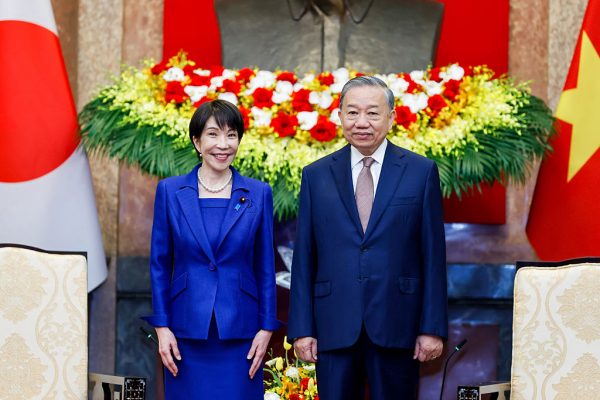
Amid the global economic and political disruption caused by the Iran conflict, particularly across Asia, Takaichi stressed the growing importance of the Indo-Pacific strategy and regional energy security.
At the Asia Zero Emission Community Summit in April, Japan launched a Tokyo-led initiative known as the Partnership on Wide Energy and Resources Resilience (Asia), or POWERR Asia, committing approximately $10 billion to support energy supply stability and crisis response.
“Including cooperation under the ‘POWERR Asia’ initiative I announced last month—formally, the ‘Asia Energy and Resources Supply Resilience Partnership’—we will advance efforts to secure stable, two-way energy supplies and to strengthen supply chain resilience for critical minerals, among other measures,” Takaichi said during a joint press announcement with Australian Prime Minister Anthony Albanese.
A joint statement said the initiative would strengthen the “autonomy and resilience” needed to advance a Free and Open Indo-Pacific.
In Hanoi, Takaichi described the Iran war as a test of Japan’s commitment to FOIP and called on ASEAN countries to strengthen regional supply chains and economic cooperation.
“In the Indo-Pacific, where supply chains cross national borders in complex ways, maintaining and expanding a rules-based economic order is indispensable for sustainable economic growth,” she said.
Reigniting Quad cooperation
While emphasizing ASEAN’s role in Hanoi, Takaichi highlighted the importance of the Quadrilateral Security Dialogue, or Quad — comprising Japan, Australia, India, and the United States — during her visit to Canberra.
In talks with Albanese, the leaders discussed regional developments, including those involving China, Southeast Asia, the Pacific Islands, North Korea, and Iran, underscoring shared security concerns and geopolitical challenges.
“In the midst of a severe international environment, cooperation with the United States—our shared ally—is indispensable,” she said. “We will further strengthen frameworks such as Japan-Australia-India-U.S. (Quad) and Japan-U.S.-Australia.”
Speaking again at Vietnam National University, Takaichi referenced historical maritime ties in the region while reaffirming Japan’s strategic vision.
“More than 400 years ago, from the South China Sea, through the Taiwan Strait, and on to the East China Sea, Japanese and Vietnamese people engaged in dynamic trade. Together, we have enjoyed the blessings of free and open seas,” she said.