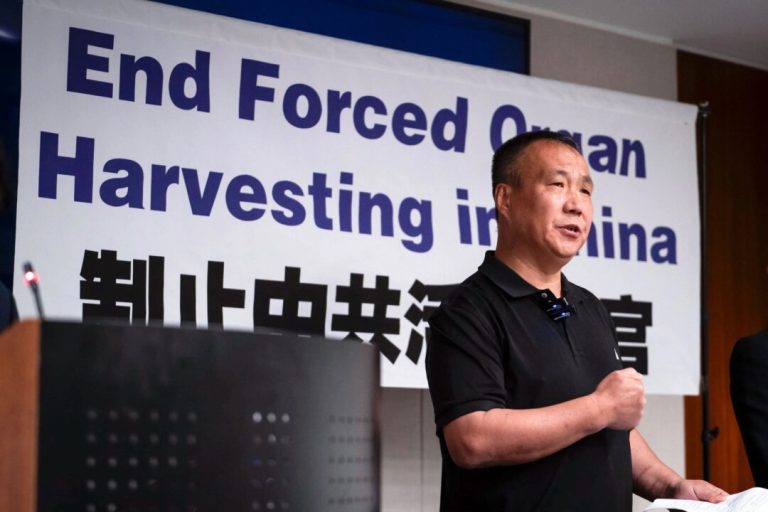
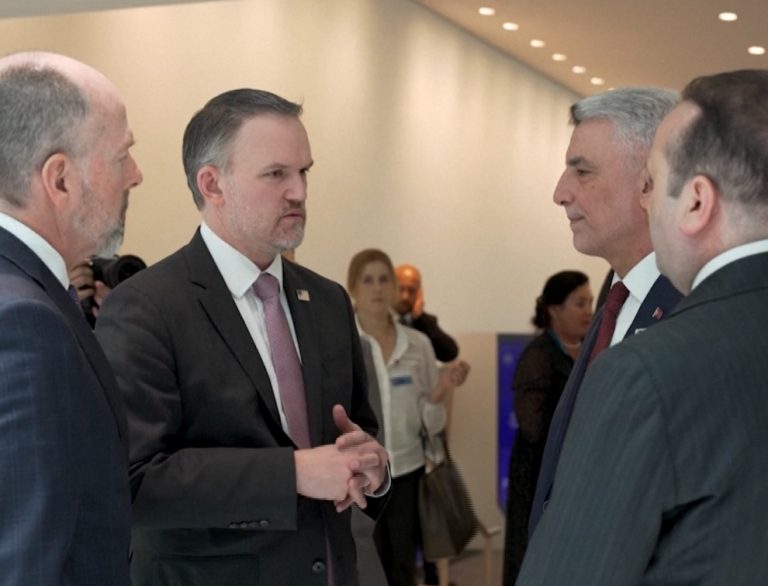
According to The Bureau, The federal trial of Lu Jianwang, also known as Harry Lu, the 64-year-old former chairman of the New York-based America ChangLe Association accused of acting as an undeclared agent of the Chinese government, continued on Thursday, May 7, 2026, in the U.S. District Court for the Eastern District of New York in Brooklyn. On the trial’s second day, federal prosecutors introduced testimony from FBI witnesses and technologically recovered WeChat chat records from the defendant’s phone. The records further documented that New York’s “Chinese Communist Party Overseas Police Station” was directly set up by China’s Fuzhou Public Security Bureau, with Lu responsible for establishing the U.S. operation and maintaining its day-to-day function. The trial has produced the most detailed courtroom picture yet of how Beijing’s security apparatus has penetrated overseas Chinese communities in the United States.
Lu Jianwang is a U.S. naturalized citizen from Changle in China’s Fujian province. He has spent decades working in restaurants, real estate, and international trade, and previously served as chairman of the America ChangLe Association in New York. He faces charges of operating an overseas covert outpost of China’s Ministry of Public Security, acting as an unregistered foreign agent in violation of the Foreign Agents Registration Act (FARA), and obstruction of justice. The case has drawn significant public attention because of its connection to a separate New York case last year involving former state official Linda Sun, in which the U.S. government laid out broader patterns of Chinese influence operations.
FBI witnesses detailed how the outpost was established and what WeChat records showed
According to The Bureau and other outlets covering the trial, FBI computer analyst Jessica Volchko took the stand and described the data recovered from Lu’s phone. Deleted material that FBI technicians had professionally recovered showed that Lu’s contacts included three WeChat groups created by Liu Rongyan of the Fuzhou Public Security Bureau, containing a total of 2,619 chat messages. One group brought together 65 members drawn from “Police-Overseas Chinese Service Stations” around the world. The other two contained 39 and 81 members respectively, all drawn from similar stations in multiple countries, showing that the New York operation was part of a transnational structure run by China’s Ministry of Public Security.
FBI Special Agent Devin Perry testified about his October 4, 2022 interview with Lu, the first agents conducted with him after the FBI raid. Lu told Perry that during his return trip to China in early 2022 he had been introduced to the “Overseas 110 Police-Overseas Chinese Service Station” program by Lin Yuping, director of the Fuzhou Federation of Returned Overseas Chinese. Lin had explained to Lu that since pandemic travel restrictions made it harder for Chinese citizens abroad to access official services such as driver’s license renewals, the Chinese government wanted to establish overseas stations to provide those services. After Lu agreed, Lin introduced him to Officer Liu Rongyan, head of the Fuzhou Public Security Bureau’s Overseas 110 office.
Lu met Liu during the Fujian Provincial Political Consultative Conference. On Jan. 10, 2022, Fuzhou Public Security held a launch ceremony at Wuyi Square in Fuzhou. Lu attended and was photographed with Liu. Lu told the FBI that the Manhattan ChangLe Association station was the first such operation in the United States, and that he was aware of similar stations in Spain, France, Canada, and the Netherlands. His responsibility was to maintain communication with Fuzhou Public Security and to bring the station online, while the day-to-day operation was handled by association secretary general Chen Jinping, who has since pleaded guilty. Chen in turn delegated specific tasks to others. Lu also provided the FBI with the names of several additional contacts.
Success
You are now signed up for our newsletter
Success
Check your email to complete sign up
Recovered WeChat messages showed active Fuzhou command over the New York station
Court records of the recovered WeChat messages showed that on Feb. 10, 2022, Liu Rongyan created a WeChat group titled “Fuzhou Public Security Bureau Overseas 110 Police-Service Desk,” and that the two communicated frequently. The content included requests from Fuzhou for the New York station to submit lists of its activities and for the station’s press releases to be reviewed by the Fuzhou side. Messages also documented Chinese technicians arranging to install a Huawei cloud system connecting the New York operation to what the parties referred to internally as “Overseas 110 system backend police-overseas residents access permissions.”
In one exchange, Lu asked whether he could include the phrase “Respected Officer Liu” in his ceremony speech. Liu replied that the project was led by “Deputy Mayor Liu” and that personal attention should not be drawn to himself.
Prosecutors also produced photographs from an April 2022 “Overseas 110” launch event hosted by the America ChangLe Association. Deputy Consul General Wu Xiaoming of China’s New York Consulate attended in an official guidance role, with banners reading “Police-Overseas Affairs Overseas Service Station” hung at the event and additional signs reading “Deputy Consul General Wu Xiaoming Arrives to Provide Guidance.” The then-serving Consul Yan Peng was also present.
A disputed $100 fee showed Fuzhou’s direct operational oversight
The trial also disclosed that the America ChangLe Association had at one point collected a $100 “donation fee” from overseas Chinese residents who came to the station for paperwork services. Fuzhou Public Security, when informed, reacted strongly against the practice. Liu Rongyan criticized the fee as “disguised charging” and “disgusting,” and demanded that the money be refunded immediately. Liu’s deputy added that the practice made the Chinese side look bad. Chen Jinping explained to the FBI that the fee had been intended to cover time-zone-related coordination costs and volunteer overtime, but the money was ultimately returned.
Lu told the FBI that the America ChangLe Association was selected for the program because it had a permanent location and reliable personnel. Other smaller community organizations that had tried to participate in the program had been rejected because they lacked Fuzhou Public Security approval. Prosecutors highlighted this point to argue that the program was directed top-down from official Chinese government channels rather than a spontaneous community service initiative.
Indictment alleges Lu helped harass US-based dissidents beginning in 2018
According to the underlying indictment, Lu has been accused of participating in the harassment of dissidents in the United States as far back as 2018. According to the indictment, members of the America ChangLe Association threatened Victim 1’s family in the United States by telephone, demanding the target return to China or face violence; public security officers in China also harassed members of Victim 1’s family inside China. Co-conspirators provided Lu with personal information and surreptitiously taken photographs of Victim 2, asking Lu to help locate the target. Victim 3, a pro-democracy activist in California who had previously served as an adviser to former U.S. congressional candidate Yan Xiong, faced similar demands.
The case cross-references a separate federal prosecution, United States v. Lin Qiming, which involves surveillance and threats against Yan Xiong. Recordings introduced in that case capture co-conspirators discussing plans to “beat him to the point where he cannot run for office” and to “manufacture a car accident.”
These allegations indicate that the “Overseas 110” station, beyond its public-facing role as a convenience service, also functioned as a vehicle for tracking dissidents, pressuring targets to return to China, and conducting political and intelligence work on U.S. soil.
In recess discussions, prosecutors indicated that they will next introduce evidence of Lu’s long-running cooperation with Chinese government objectives. This includes Lu’s role during Xi Jinping’s 2015 U.S. visit, when he organized people to travel to Washington to participate in counter-demonstrations against Falun Gong practitioners. Prosecutors argue the evidence demonstrates that Lu’s willingness to assist with Beijing’s overseas political objectives long predates the pandemic, and weighs against any suggestion that his 2022 involvement with the “Overseas 110” station was an isolated response to COVID-era travel restrictions.
Defense response and broader significance of the case
Defense attorney John Carman has continued to push back against the political characterization of his client. In cross-examination, Carman has stressed that Lu was “asked” to help provide community services, not “tasked” with carrying out political work. Carman has argued that the core of the case may be a failure to register under FARA rather than serious criminal conduct, and has noted that neither of Lu’s two FBI interviews was recorded, The Bureau reported.
Outside the courthouse, supporters of Lu from the Fujian and Changle communities have gathered each day holding American flags and signs reading “I Love America” and “Stop Discrimination.” Federal prosecutors have raised concerns to the trial judge that the support may be organized and intended to influence the jury. Lu’s network has also included Brooklyn Fujianese community figure John Chan, with whom Lu was photographed together at an event in 2015.
The trial has built a granular courtroom picture of how the CCP’s United Front system, overseas Chinese community associations, consular officers, and the Ministry of Public Security operate as interlocking layers of a hidden architecture for transnational pressure work. From the Fuzhou launch ceremony, to the Manhattan Chinatown outpost, to similar stations across multiple countries, prosecutors have laid out a Beijing-directed transnational “Police-Overseas Chinese Service” network. China’s Ministry of Public Security is enormous in scale, and because its officers face official restrictions on traveling abroad in their formal capacity, the ministry relies on overseas “friends and allies” to do its work.
The New York station’s public-facing services may have looked like community conveniences. Operating without registering under FARA was already a federal violation, and the hidden communications channels, the Huawei cloud system data linkage, and the documented harassment of victims point to a more serious national security concern.
The trial has also drawn attention because of the Huawei cloud system details, which have raised additional data security concerns. The Royal Canadian Mounted Police has previously investigated similar networks in Canada, indicating the global reach of the structure. Legal experts have noted that the case tests the practical enforcement of the Foreign Agents Registration Act and highlights the loyalty-and-security balance facing overseas Chinese communities against the backdrop of complex U.S.-China relations.
As the trial proceeds, more evidence is expected. Prosecutors hope to prove that Lu’s conduct went far beyond community service and constituted part of a Chinese overseas influence operation, while the defense continues to emphasize good-faith assistance. The trial is expected to continue for several days, with both sides further debating the evidence, the defendant’s intent, and the nature of the program.
By Jin Yan, Vision Times