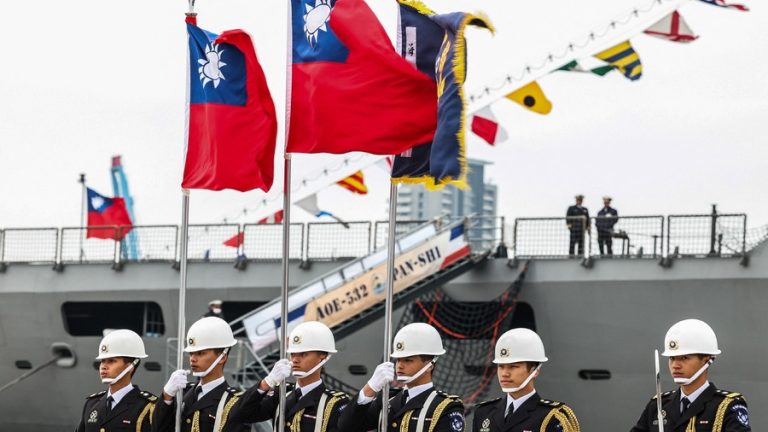
Taiwan’s Legislative Yuan passed the third reading of a special defense bill on May 8, approving a ceiling of NT$780 billion for arms procurement from the United States, while completely excluding commercial purchases and commissioned development projects.
According to the Central News Agency (CNA), Taiwan’s Ministry of National Defense said the version passed by the legislature, which removes both commercial procurement and domestically commissioned development items, undermines the integrity of Taiwan’s defense force development planning and could easily create capability gaps. The ministry said it will actively study response measures to minimize the impact.
Ministry of National Defense warns of potential capability gap
CNA reported that Taiwan’s Legislative Yuan passed the “Special Act for Safeguarding National Security and Strengthening Asymmetric Combat Capabilities Procurement” on Friday, which authorizes a total budget ceiling of NT$780 billion ($24.8 billion) for U.S. arms purchases.”
The first phase of procurement is capped at NT$300 billion ($9.5 billion), while the second phase is capped at NT$480 billion ($15.2billion).
Regarding the potential impact of excluded items, Taiwan’s Ministry of National Defense stated that the “Qiang Gong” medium-range anti-ballistic missile system, originally planned to be developed by the National Chung-Shan Institute of Science and Technology, was intended to be a core component of building Taiwan’s air defense shield.
Success
You are now signed up for our newsletter
Success
Check your email to complete sign up
It warned that if the system cannot be procured in time after being removed from the special budget, Taiwan’s air defense combat effectiveness could be seriously affected.
Ministry of National Defense said that several key unmanned and asymmetric warfare systems have been removed from the special defense budget, including: Rui Yuan II maritime reconnaissance tactical drones; vertical takeoff and landing (VTOL) drones; coastal surveillance and coastal strike drones (four types);small suicide unmanned surface vessels; portable counter-drone systems; mobile obstacle and denial equipment
The ministry stressed that these systems are not only critical combat capabilities for defense operations, but also the foundation for building Taiwan’s domestic drone industry supply chain and strengthening indigenous defense capacity.
It warned that the full removal of these programs would significantly delay the military’s asymmetric capability development timeline and negatively affect Taiwan’s drone industry, leading to potential losses in economic growth and job creation.
AI battlefield systems and command networks affected
The ministry also said urgently needed systems such as AI-assisted intelligence and decision-making modules, Tactical Awareness Kit (TAK) and Taiwan Tactical Network (TTN) are essential for improving operational decision-making and building a common operational picture.
Their exclusion will delay the military’s AI development and hinder the establishment of a complete “kill chain.”
The ministry noted that, considering peacetime training consumption and the large ammunition demand expected under a wartime blockade scenario, previously planned expansion of munitions production capacity and facilities and procurement of general-purpose ammunition were all removed.
It warned this would affect production expansion and may prevent the military from meeting training and readiness requirements.
Taiwan–US cooperation projects impacted
The ministry also emphasized that Taiwan–U.S. joint research, development, and procurement cooperation programs are an innovative mechanism to ensure regional security and allow Taiwan to quickly adopt emerging technologies.
Their removal, it said, would hinder implementation of the overall plan and weaken Taiwan’s operational resilience and asymmetric warfare capabilities.
The ministry stressed that Taiwan faces a severe and continuously escalating security threat environment, requiring rapid strengthening of multi-layered asymmetric deterrence capabilities.
However, it said annual defense investment budgets are already at peak payment stages with no capacity to absorb additional programs.
The armed forces will therefore continue developing response measures for excluded items, communicate with the Legislative Yuan, seek to minimize operational impact and ensure troops maintain more complete combat readiness to safeguard national security.
Jeanne Shaheen, the Democratic ranking member of the U.S. Senate Foreign Relations Committee, and Republican Senator John Curtis issued a joint statement on Friday welcoming Taiwan’s passage of the NT$780 billion defense procurement bill.
“Taiwan’s approval of this supplementary defense budget sends a strong signal of resolve at a critical moment for peace and stability across the Indo-Pacific,” they said in the statement.
“During our visit to Taipei in March, we urged Taiwan’s leaders to move quickly to approve a supplementary defense budget that would accelerate the procurement of critical U.S. defense equipment and strengthen Taiwan’s asymmetric capabilities.”
The senators said the vote shows Taiwan is taking seriously the urgent need to strengthen its defense amid increasing military coercion and pressure from Beijing. They added that as China continues to test limits through intimidation and aggression, Taiwan’s long-term investment in deterrence demonstrates unity and readiness.
“We also expect Taiwan’s leadership to take further steps to strengthen investment in asymmetric capabilities and domestic defense production, which remains essential for long-term deterrence,” said the Senators.
The statement concluded that the partnership between the United States and Taiwan remains “rock solid,” and that the U.S. Congress will continue supporting Taiwan’s self-defense capability and maintaining stability in the Taiwan Strait.
Executive Yuan: key defense pillars not included
According to Mirror News, the spokesperson for Taiwan’s Executive Yuan, Lee Hui-chih said that since the Executive Yuan submitted the special legislation in November last year, there have been 162 days of consultations between the Ministry of National Defense and legislative party caucuses across the political spectrum.
She noted that although part of the defense force-building plan, including U.S. arms procurement, has moved forward, key elements were not included in the final bill.
She emphasized that the three core pillars, Taiwan’s Shield, AI Kill Chain and Defense Self-Reliance are interlinked and indispensable. However, they were not incorporated in this version of the legislation.
The Executive Yuan expressed hope that all parties in the Legislative Yuan would continue working together to quickly complete the missing parts of Taiwan’s overall defense system and safeguard national security.
Su Tzu-yun, director of the Institute for National Defense and Security Research’s Defense Strategy and Resources Division said it is regrettable that provisions on defense self-reliance were not included in the final bill, the CNA reported.
According to the same report, he noted that ahead of a possible “Trump–Xi summit” between the U.S. President Donald Trump and Chinese President Xi Jinping, Taiwan has passed what he described as a “baseline version” of the special defense legislation, demonstrating its basic determination and practical steps toward self-defense. However, he added that the absence of defense self-reliance provisions remains a key shortcoming.
Su said that U.S. arms sales to Taiwan have now gone beyond simply “giving fish, but also fishing rods,” but he regretted that the legislation did not include Taiwan–U.S. joint R&D programs or domestically developed drones and unmanned surface vessels.
He emphasized that defense technology development does not benefit from economies of scale, and manufacturers need sustained demand from the military to support production. He therefore hopes that future annual budgets or additional special legislation can better support Taiwan’s defense industry and strengthen defense autonomy.
Need of long-term deterrance
In an interview with CNA, National security expert Chen Wen-chia said the version passed by the Legislative Yuan differs significantly from the Executive Yuan’s original NT$1.25 trillion proposal. He said this difference reflects two strategic approaches: “overall defense transformation” versus “limited procurement reinforcement.”
He explained that the Executive Yuan version focuses on long-term comprehensive deterrence, emphasizing the “Taiwan’s Shield” concept, defense resilience, AI-driven systems, and unmanned warfare capabilities. It aims to build an integrated defense system combining air defense, drones, C5ISR networks, non-red supply chains, and defense self-reliance, forming a cross-service and cross-domain denial capability.
Chen warned that unmanned systems depend on integrated supply chains involving AI, semiconductors, batteries, communications, and sensors. Without sufficient domestic demand, Taiwan’s defense industry development could be weakened, and opportunities arising from restructuring in the Indo-Pacific supply chain could be missed.
He added that the Legislative Yuan version focuses mainly on U.S. arms procurement, including systems such as HIMARS rocket artillery, self-propelled artillery, Javelin, and TOW missiles. This reflects an emphasis on traditional firepower enhancement and short-term readiness.
He also noted that the bill strengthens legislative oversight, requiring executive branch reporting and legislative approval before budget preparation, reflecting opposition concerns over fiscal burden, procurement efficiency, and blank-check authorization.