As U.S. President Donald Trump arrived in China ahead of a high-profile summit with Chinese Communist Party leader Xi Jinping in Beijing, concern within the U.S. government over Chinese cyber surveillance risks has reportedly reached an unprecedented level.
According to a report by Fox News, multiple current and former U.S. officials said that, to prevent Chinese Communist Party surveillance, hacking, and data theft, large numbers of accompanying officials, security personnel, and corporate executives were instructed to leave behind their regular phones and electronic devices and instead enter China using tightly controlled “clean devices.”
Sources familiar with the matter said many officials traveling to China received security briefings before departure. The U.S. government has long assumed that any electronic device brought into China — including phones, laptops, tablets, and even hotel Wi-Fi connections — could be monitored or compromised.
Former U.S. Secret Service agent and current executive protection director at Safehaven Security Group, Bill Gage, said, “China is a mass surveillance state. Briefings for U.S. officials begin well before the president arrives, and they make clear that everything is monitored.”
Former White House Chief Information Officer and CEO of Fortalice Solutions, Theresa Payton, also said U.S. officials are repeatedly reminded to assume that all of their actions and communications — online and offline — could be monitored.
Success
You are now signed up for our newsletter
Success
Check your email to complete sign up
The report said U.S. officials entering China are typically issued stripped-down “clean phones,” temporary laptops, and highly restricted communication systems to reduce the risk of hacking or data collection.
These measures have also complicated many routine tasks. Messages that could normally be sent instantly through encrypted apps often have to be delivered verbally or through temporary accounts and tightly controlled channels. Some officials reportedly go days in China without access to their normal digital accounts or cloud data.
In addition to government officials, American corporate executives expected to accompany Trump are reportedly subject to the same security restrictions. Delegation members are said to include executives from companies such as Boeing, Qualcomm, and BlackRock — firms at the center of U.S.-China technological and economic competition.
The report also noted that even charging a phone is viewed as a potential security risk.
U.S. federal cybersecurity guidelines have long warned travelers not to plug devices into unknown USB ports or untrusted charging stations because malicious software could be installed to steal data or conduct surveillance. This form of attack is known as “juice jacking.”
As a result, personnel traveling to China typically carry approved chargers, external battery packs, and government-issued accessories rather than relying on local infrastructure.

No safe electronic communications
Gage said, “There are no safe electronic communications in China.”
He added that officials are generally advised to perform only the digital activities necessary to complete their mission.
According to the report, some U.S. officials are also issued temporary devices configured with a “golden image,” allowing security teams to compare the device before and after use to determine whether it has been tampered with or infected with malicious software.
Payton further revealed that the U.S. side sometimes establishes controlled “secure zones” where officials can communicate with the United States under strict protections.
When sensitive discussions are involved, security measures become even more stringent.
The report stated that U.S. officials traveling abroad often use temporary Sensitive Compartmented Information Facilities (SCIFs), specially designed to prevent electronic surveillance and eavesdropping. These facilities can be temporarily established inside hotels or other controlled locations.
Payton said the White House Military Office and communications teams create tightly controlled spaces while monitoring both physical and digital access to ensure sensitive conversations are not leaked.
Fox News reported that this heightened state of security has made modern presidential delegations resemble the “analog era” again. Paper documents are once more widely used, digital access is heavily restricted, and aides accustomed to constant communication can only contact the outside world through tightly managed systems.
In recent years, the U.S. government has repeatedly warned that Chinese cyber espionage activities pose a threat to the United States. U.S. intelligence agencies have accused hacking groups linked to Beijing of attempting to infiltrate U.S. government systems, power grids, water utilities, telecommunications networks, and defense contractors.
Gage said Chinese authorities typically conduct extensive research on all members of U.S. delegations, “from senior officials down to junior personnel — no one is overlooked.”
Payton noted that presidential-level visits carry even higher risks because of their public visibility.
“This is a highly exposed event,” she said. “You have to assume that both nation-state actors and opportunistic attackers may try to listen in.”
The report also mentioned that the suspected Chinese high-altitude balloon incident over the United States in 2023 brought these concerns fully into public view. U.S. officials suspected the balloon of conducting surveillance operations before it was shot down after passing over several sensitive military sites.
In addition, the U.S. has recently continued warning about sophisticated cyberattacks by China-linked hacker groups known as Volt Typhoon and Salt Typhoon targeting American critical infrastructure and telecommunications systems. U.S. officials believe such operations could eventually be used for espionage or sabotage during a conflict.
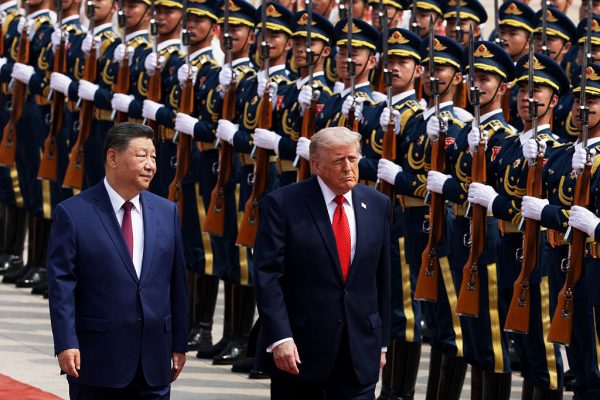
Trump arrives in Beijing to begin China visit
According to Reuters, Trump arrived at Beijing Capital International Airport at approximately 7:51 p.m. Beijing time on Wednesday, May 13, officially beginning his two-day visit to China. During the trip, Trump is expected to hold closely watched talks with Xi Jinping.
After Air Force One landed, Beijing rolled out a red carpet at the aircraft stairs. Around 300 young people dressed in blue-and-white uniforms waved Chinese and American flags in welcome. Chinese Vice President Han Zheng personally attended the airport reception.
According to reports, Han Zheng led the Chinese welcoming delegation under Xi Jinping’s instructions. Han currently plays an important role in Chinese diplomatic affairs and previously represented Beijing at Trump’s 2025 presidential inauguration.
Following the airport ceremony, Trump immediately traveled by motorcade to his hotel. Security measures throughout Beijing were visibly tightened, with traffic controls imposed in some areas.
According to an itinerary previously released by White House spokeswoman Anna Kelly, Trump is scheduled to attend an official state welcome ceremony on Thursday morning before holding talks with Xi. Discussions are expected to focus on Iran, U.S.-China trade, Taiwan, and artificial intelligence regulation.
Trump is also scheduled to visit the Temple of Heaven on Thursday afternoon and attend a state banquet in the evening. Under the current schedule, Trump and Xi will hold a tea meeting and working lunch on Friday before Trump departs China, concluding the summit visit.
This marks Trump’s first visit to China since 2017 and the first face-to-face meeting between the U.S. and Chinese leaders in more than six months.
By Li Xin, Vision Times