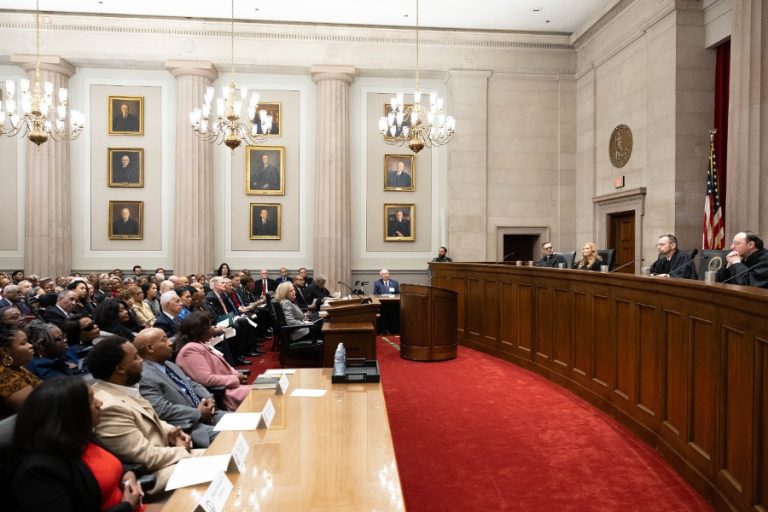
The Virginia Supreme Court has invalidated a Democratic-drawn congressional map that voters approved at the ballot box last month, ruling 4–3 that the Democrat-controlled state legislature violated procedural requirements when it advanced the underlying constitutional amendment. The opinion, handed down May 8, scrambles Democratic plans to gain as many as four additional U.S. House seats in Virginia and ranks as one of the most consequential judicial interventions in the nationwide battle over redistricting ahead of the 2026 midterm elections.
Virginia’s top court throws out the Democratic map
The majority found that the legislature had used an unprecedented procedural arrangement when it submitted the constitutional amendment for a public referendum, and that this irregularity fatally compromised the integrity of the vote.
Justice D. Arthur Kelsey, who wrote the majority opinion, zeroed in on timing: the legislature gave the amendment its initial approval only after early voting for the 2025 state elections had already begun, in violation of the state constitution’s procedural requirements for amendments touching redistricting. “This violation irreparably undermines the integrity of the resulting referendum vote and renders it null and void,” Kelsey wrote. “For this reason, the congressional district maps issued by this Court in 2021 pursuant to Article II, Section 6-A of the Constitution of Virginia remain the governing maps for the upcoming 2026 congressional elections.”
The numbers behind the map made the stakes plain. Virginia’s 11-member congressional delegation currently splits six seats for Democrats and five for Republicans. The new map, according to the majority, could have handed Democrats 10 of those 11 seats, despite roughly 47 percent of Virginia voters having backed Republican congressional candidates in 2024. The majority opinion made no effort to conceal its discomfort with that arithmetic.
Democrats had counted on Virginia to offset Republican gains elsewhere
Virginia had been central to a carefully constructed Democratic strategy. Party operatives had hoped a redrawn map would neutralize Republican-friendly maps enacted in Texas, Florida, and several other states in recent months, where GOP-controlled legislatures have redrawn congressional boundaries to strengthen Republican incumbents and squeeze out Democratic seats.
Success
You are now signed up for our newsletter
Success
Check your email to complete sign up
The map Democrats championed in Virginia would have consolidated five heavily Democratic-leaning districts in the Northern Virginia suburbs of Washington, D.C., carved up the Richmond area, reshaped districts around Hampton Roads, and grouped three Democratic-leaning college towns in western Virginia into a single seat to dilute Republican voters in that region. One proposed district drew particular criticism for what opponents described as a shape resembling a lobster claw, stretching into rural, Republican-leaning territory to absorb favorable precincts.
A national redistricting war, conducted state by state
Virginia’s court fight sits inside a broader, accelerating conflict over congressional maps that has broken from the traditional ten-year rhythm tied to the U.S. Census. By convention, states redraw their congressional districts after each decennial census; the last round ran from 2021 to 2022. In its place, a wave of mid-decade redistricting has taken hold, pursued aggressively by both parties, turning state legislatures and courts into front lines of the 2026 election campaign.
Texas moved first among Republican-controlled states, redrawing its map to consolidate GOP advantages. Florida, Ohio, North Carolina, Missouri, and Tennessee followed. Democrats responded in California, pushing through a revised map favorable to their candidates. Utah’s state supreme court separately approved a new congressional map that analysts assessed as more favorable to Democrats.
Alongside these state-level moves, the US Supreme Court has handed down rulings narrowing the scope of the Voting Rights Act of 1965, the federal law that for decades protected minority voters from discriminatory district drawing. Those decisions have given Republican-controlled legislatures additional latitude to reshape maps in ways that dilute minority voting power, intensifying redistricting battles heading into the midterms.
According to a May 8 statement, Richard Hudson, the chairman of the National Republican Congressional Committee, the party organization responsible for winning and holding House seats, declared after the Virginia ruling that Republicans had seized the initiative. “We’re on offense, and we’re going to win,” Hudson said.
Virginia House Speaker Don Scott, a Democrat, said his party respected the court’s decision but maintained that the majority had overridden the will of voters. Suzan DelBene, the chair of the Democratic Congressional Campaign Committee, accused the court’s majority of disregarding voter intent while warning that the ultimate verdict would come from voters in November.
The court ruled that an election begins when early voting opens, not on election day
The case turned on a procedural question with significant constitutional weight: does an election begin on Election Day, or does it begin when early voting opens?
Virginia’s constitution requires that any amendment related to redistricting pass the legislature in two separate legislative sessions, with a statewide election held in between, before being put to a public referendum. The dispute centered on whether the legislature’s first approval of the amendment came before or after the 2025 state election had begun.
According to KCRA3, Matthew Seligman, the attorney representing the state legislature in defense of the amendment, argued for a narrow reading: an election, in constitutional terms, commences on the official voting day. Under that interpretation, the legislature had acted in time.
Thomas McCarthy, arguing for the plaintiffs challenging the map, took the opposing view: early voting is an integral part of the election, and Virginia’s early voting period typically runs for several weeks before Election Day. By the time the legislature first approved the amendment, McCarthy contended, the election was already underway and the procedural window had closed.
The court sided with McCarthy. The majority opinion documented that more than 1.3 million Virginians, representing approximately 40 percent of the final turnout, had already cast ballots by the time the legislature gave the amendment its initial approval.
Chief Justice Cleo E. Powell dissented, warning that the majority’s definition of when an election begins would create what she called an “infinite loop” of interpretive confusion. “The majority opinion appears unable to define when an election begins,” Powell wrote in her dissent, “only that it ends on Election Day.”
The ruling gives opponents of new maps an additional procedural tool in court
By establishing that procedural irregularities in how a legislature advances redistricting amendments can invalidate a subsequent voter-approved referendum, the ruling hands opponents of new maps a legal avenue that previously went untested. With both parties pressing the boundaries of mid-decade redistricting across the country, that precedent is likely to be invoked in future challenges.