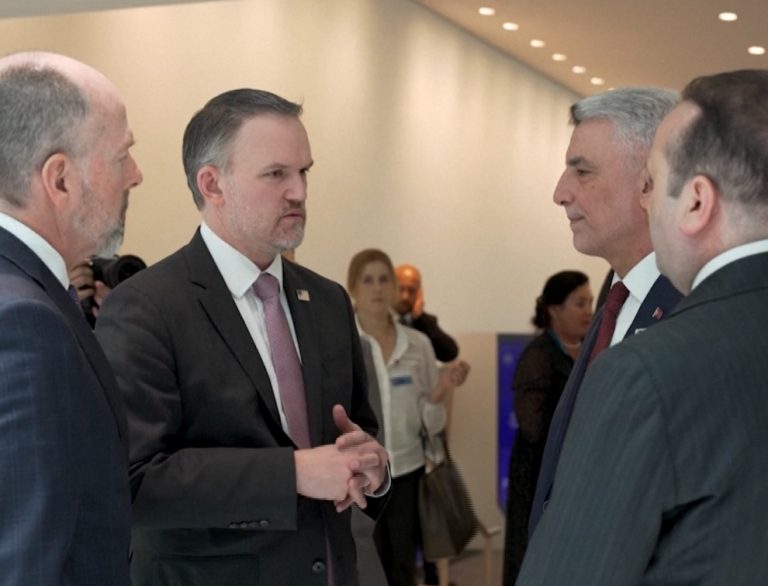
Taiwan is a “model ally,” not a bargaining chip, said retired U.S. Rear Admiral Mark Montgomery in an article, arguing and warning that trading Taiwan’s security for empty promises from Beijing would constitute an unprecedented strategic mistake.
Montgomery published the article, titled “Taiwan is a ‘model ally,’ not trade bait,” on the website of the Washington think tank Foundation for Defense of Democracies (FDD).
He wrote that Taiwan possesses all the qualities that Trump describes as those of an ideal ally. Taiwan is investing unprecedented sums to strengthen its own defense, including spending billions of dollars on U.S.-made weapons. It is also the world’s leading manufacturing hub for the most advanced semiconductor chips, which support both American commercial products and cutting-edge weapons systems, including the Lockheed Martin F-35 Lightning II stealth fighter.
He noted that as Donald Trump travels to Beijing this week for a summit with Xi Jinping, the key question is whether the U.S. president will recognize Taiwan as a “model ally” — a term the Trump administration has already applied to countries such as Israel and South Korea — and reject Beijing’s trade-related promises if they are offered in exchange for Taiwan’s security.
Such promises, he wrote, could include increasing imports of American goods or allowing U.S. companies to purchase critical minerals over which China holds a near-monopoly supply position. He warned these would amount to hollow promises from Xi.
Success
You are now signed up for our newsletter
Success
Check your email to complete sign up
Ideal ally
Montgomery wrote that Taiwan demonstrates the successful outcomes that U.S. partnerships can achieve. Taiwan, with a population of 23 million people, is a free and democratic society that holds free and fair elections, carries out peaceful transfers of power, maintains an independent judiciary and a free press, and sustains a vibrant civil society.
It continues to choose self-governance rather than incorporation into China’s political system. He pointed out that, by contrast, China’s rule over Hong Kong has already shown what unification could look like, making the contrast especially stark.
At a time of global competition between free nations and authoritarian regimes, Taiwan represents the kind of world order the United States hopes to build and sustain.
Economic contribution to US
Montgomery also stated that, economically, Taiwan’s contribution to American prosperity is critical. Losing Taiwan would severely impact multiple sectors of the U.S. economy. Together, Taiwan Semiconductor Manufacturing Company(TSMC) and United Microelectronics Corporation (UMC) account for nearly three-quarters of the global semiconductor foundry market, with TSMC alone producing about 90 percent of the world’s most advanced logic chips.
He further argued that the Chinese Communist Party is eager to force Taiwan into submission because Taiwan’s very existence symbolizes that Chinese people can enjoy both freedom and prosperity simultaneously.
The People’s Liberation Army pressures and provokes Taiwan’s military and coast guard on a daily basis, yet Taiwan continues to respond professionally without demanding U.S. military intervention in every incident.

China wants concessions on Taiwan!
Chinese diplomatic officials have reportedly made clear before the Trump–Xi summit that they want Donald Trump to make concessions on the Taiwan issue.
They emphasized that Taiwan is one of China’s “core interests” and that U.S. adherence to the “One China” policy is a prerequisite for stable relations.
Xi Jinping may offer trade agreements and cooperation on rare earth minerals in exchange for U.S. restrictions on arms sales or statements opposing Taiwanese independence.
Montgomery argued that Trump should recognize that Taiwan offers the better deal. Taiwan, he said, has fulfilled America’s expectations of an ally.
Trading Taiwan’s security for Beijing’s empty promises would be an unprecedented strategic mistake. America’s allies watching this summit — from Tokyo and Seoul to Warsaw and Tallinn — would remember such a decision for generations.
By Li Ming, Vision Times