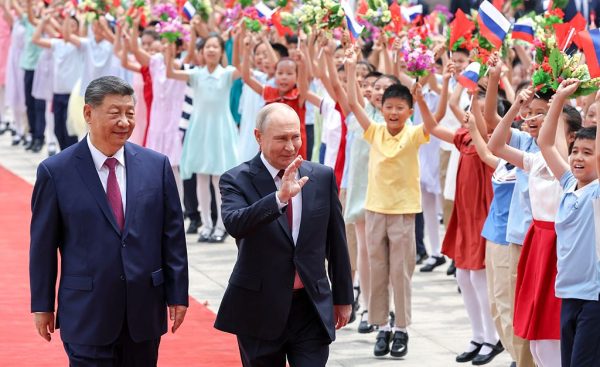
Russian President Vladimir Putin left Beijing on May 20, 2026, after a two-day state visit and a meeting with Chinese leader Xi Jinping, carrying more than forty signed agreements but without the energy deal Moscow had spent months pre-positioning as the centerpiece of the visit. Approval for the Power of Siberia 2 (POS-2) natural gas pipeline, a 2,600-kilometer project that would carry 50 billion cubic meters of Russian gas annually from the Yamal Peninsula through Mongolia to China, did not come. According to The Washington Post, the failure handed Putin a public setback in his effort to deepen Beijing’s energy dependence on Russian exports.
Kremlin spokesman Dmitry Peskov told reporters after the talks that the two sides had reached “general understanding of the main parameters” of POS-2, including route and construction method, but acknowledged that “some details still need to be finalized.” Xi made no public mention of the pipeline at all. While Xi told Putin that energy cooperation should be the cornerstone of the China-Russia relationship, no joint announcement or signed contract emerged from the summit.
China expert and author Gordon Chang told Fox Business host Maria Bartiromo on May 21 that the missing pipeline approval was the only outcome that actually mattered.
“The most important point of Putin’s meeting with Xi Jinping is that Putin did not get approval for the Power of Siberia 2 pipeline, which is the one you just mentioned. This was the most important item on his agenda, far more important than anything else,” Chang said. “So he leaves Beijing with 40 agreements, yes, but those don’t mean anything. He didn’t get what he really needed, which was approval for this pipeline.”
Bartiromo agreed with Chang’s reading. “China has long tried to weaken and overtake the United States to become the number one superpower,” she said. “But with President Trump sitting in the Oval Office, things are not so easy.”
Success
You are now signed up for our newsletter
Success
Check your email to complete sign up
The principal obstacle to the deal is pricing. According to Bloomberg, sources close to Gazprom say the Russian company has offered what it considers an “extremely attractive” price for POS-2 gas. Beijing has not shown willingness to advance the project on those terms. Chinese negotiators are holding out for a delivered price close to the heavily subsidized Russian domestic price, which runs around $50 per thousand cubic meters.
That figure is approximately one twelfth of current European gas prices and roughly one fifth of the $258 per thousand cubic meters that China currently pays under the original Power of Siberia 1 contract. UPI reported that Beijing’s effective ceiling for POS-2 is in the range of 12 to 13 cents per cubic meter, in line with the cost in the Russian domestic market.
Putin refused to sign
The Financial Times, citing people familiar with the negotiations, reported that Russia has refused to sign because Chinese demands on supply volume and unit price are, from the Russian standpoint, close to unreasonable. Russia wanted a deal modeled on POS-1, which industry analysts have projected would price the gas at roughly double Beijing’s current asking figure.
The pricing standoff reflects the underlying shift in the Russia-China relationship since Moscow’s full-scale invasion of Ukraine in February 2022. Western sanctions cost Russia most of its European gas customers, and Gazprom’s shipments to Europe reportedly fell 44 percent in 2025 to their lowest level in decades. POS-2, which would lock in a Chinese customer for what would have been European gas, is therefore much more important to Moscow now than it was when negotiations first opened in 2008.
Chinese negotiators have used Russia’s weakened position to push for prices Moscow would have rejected immediately a decade ago. Michael Feller, chief strategist at Geopolitical Strategy, told CNBC that a POS-2 deal at this scale would leave Russia dangerously exposed to a single customer, while Beijing would be trading Strait of Hormuz maritime vulnerability for dependence on Russian-controlled pipeline gas. A deal, Feller said, “would signal not just trust, but a decision that codependency is safer than the alternative.”
Negotiations have stalled before for the same reasons. A binding memorandum signed in September 2025 between Gazprom and Chinese counterparts was portrayed by Russian officials as a major breakthrough, but it left the central commercial terms unresolved. Russian delegations have, before each of Putin’s recent Beijing visits, briefed media that an agreement was imminent, but Chinese officials have remained silent.
The U.S.-Israeli campaign against Iran, which began on Feb. 28, 2026, has disrupted global energy markets and put pressure on Strait of Hormuz shipping. Russian negotiators had hoped that the resulting Chinese exposure to Gulf supply risk would push Beijing to value Russian pipeline gas more. Beijing instead showed greater patience, holding out for terms Moscow has been unwilling to accept.
Putin’s Beijing reception was also structurally similar to the welcome Beijing rolled out for Trump six days earlier. Beijing offered both leaders the same upgraded protocol, a diplomatic message about the symmetry Beijing now perceives between two visiting heads of state who occupy very different positions in the global hierarchy. For a Russian president whose European customer base has collapsed, who arrived in Beijing seeking the energy deal that would underwrite the post-sanctions Russian economy, and who left without it, the parity with a U.S. president negotiating from strength is itself the message.
Beijing’s calculation now includes the May 14 Trump summit and the prospects for a U.S.-China trade and security accommodation. A locked-in Russian gas dependency would constrain Beijing’s options at a moment when it sees value in keeping them open. Eighteen years into talks about POS-2, the same pattern has held since 2008: Russia wants the deal more than China does.
By Jian Yi, Vision Times