According to Taiwan News, Taiwan’s foreign ministry released the results of a commissioned public opinion survey on Wednesday, May 27, covering voter assessments of the Lai Ching-te administration’s two-year foreign policy record, the effectiveness of major diplomatic initiatives, and the direction of the island’s international relations. 54.7 percent of respondents said they were satisfied with Lai’s overall foreign policy performance since taking office.
Taiwan public backs foreign ministry’s diplomatic push and defense buildup
The survey asked respondents about two signature foreign ministry programs. The first, a policy framework the ministry calls “comprehensive diplomacy,” draws on coordinated efforts across multiple government agencies rather than relying on the foreign ministry alone. The second, the “Glorious Nation Plan,” is a related initiative focused on deepening practical ties with Taiwan’s remaining formal diplomatic allies. Support for both exceeded 65 percent: 66.5 percent of respondents backed the comprehensive diplomacy framework, while 65.6 percent supported the Glorious Nation Plan. A further 77.8 percent said they supported the foreign ministry’s establishment of a “dual-ministers meeting” mechanism, which brings together foreign ministry officials with counterparts from ten other cabinet departments, including health, sports, and culture.
On international priorities, 59.3 percent of respondents said Taiwan should focus on strengthening economic and trade cooperation with the United States, reflecting how firmly the American anchor holds in Taiwan’s strategic calculations, particularly as cross-strait tensions have remained elevated and Washington has deepened its security commitments to Taipei. 67.1 percent backed increasing Taiwan’s defense budget to build what the government calls the “Taiwan Shield,” a layered defense architecture of asymmetric capabilities and fortified infrastructure designed to raise the cost of any military move by Beijing. 52.6 percent said Taiwan’s external diplomatic relationships mattered more than cross-strait relations with Beijing, while 36.2 percent said the reverse.
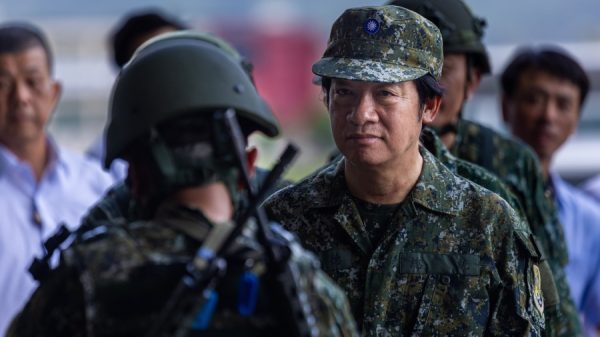
Taiwan’s president won two-thirds public approval for Africa visit Beijing opposed
The survey asked specifically about President Lai’s recent state visit to Eswatini, Taiwan’s only remaining formal ally on the African continent. The trip was seen in Taipei as a direct challenge to Beijing’s diplomatic encirclement strategy, which has over the years peeled away the majority of Taiwan’s formal allies through a combination of financial inducements and political pressure. 60.3 percent of respondents said they were satisfied with that visit, and 69.2 percent said they supported Lai continuing to travel to allied nations to deepen bilateral cooperation.
The survey also addressed two recent disputes over how foreign governments officially categorize Taiwanese nationals, a category of diplomatic friction that Beijing actively encourages by pressuring third countries to treat Taiwan as a province of China. The first involved South Korea’s electronic arrival card system, which classified Taiwanese travelers in a way Taipei considered offensive to its national identity. The second concerned Denmark’s residency permit system, which had listed the nationality of Taiwanese residents as “China.” In both cases, Taiwan’s foreign ministry lodged formal protests and demanded corrections. 82.3 percent of respondents said they were satisfied with how the ministry handled the South Korea dispute. 77 percent said they supported the ministry’s countermeasures against Denmark’s classification.
Success
You are now signed up for our newsletter
Success
Check your email to complete sign up
83.8 percent of respondents backed the foreign ministry’s ongoing effort to open new overseas representative offices, the functional equivalent of embassies that Taiwan operates in countries that do not maintain formal diplomatic relations with Taipei. 93.9 percent supported the ministry’s push to add more direct international flights from Taipei.
70 percent of respondents said that visits abroad by Taiwan’s senior officials increased their sense of pride in being Taiwanese. When asked to choose between the “democratic Taiwan” identity framing advanced by President Lai and a “Chinese Taiwan” framing favored by those who prioritize closer alignment with Beijing, 73.4 percent chose the democratic Taiwan position against 16.5 percent for the alternative.
Ruling party’s separate survey also puts Lai’s approval above 50 percent
The foreign ministry survey was conducted by Qiuzhen Public Opinion Research Co. and used both landline and mobile phone interviews, with respondents drawn by stratified random sampling from all 22 counties and municipalities in Taiwan, including the outlying islands. A total of 1,524 valid responses were collected. The margin of error is plus or minus 2.4 percentage points at a 95 percent confidence level.
The results come alongside a separate poll released on May 18 by the Democratic Progressive Party, Taiwan’s ruling party, which put Lai’s overall governance approval rating at 56.4 percent, with a trust rating of 51.8 percent.
That party-commissioned survey also identified Lai’s eight highest-rated policy areas. Approval was strongest on measures to ease the public’s financial burden, where 74 percent expressed satisfaction against 17.2 percent dissatisfied, and on social welfare, at 70.7 percent satisfied. Price stability drew 64.5 percent satisfaction. Sovereignty protection registered at 59.9 percent. Economic growth, national defense, foreign affairs, and cross-strait policy all came in between 53 and 56 percent satisfied.