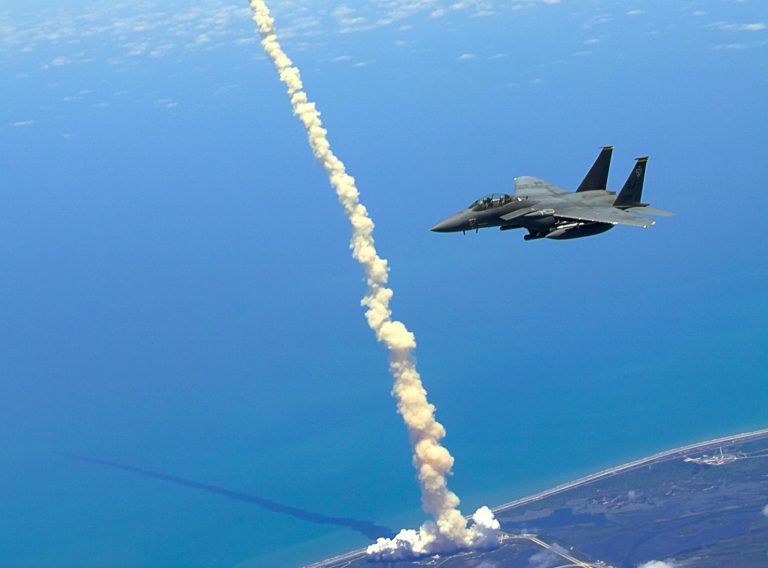
U.S. officials are investigating whether a Chinese-made shoulder-fired missile was used to shoot down an American F-15E Strike Eagle during combat operations over southwestern Iran earlier this year, according to an NBC News report citing multiple people familiar with the investigation.
The incident, which occurred during the opening phase of the U.S.-Iran conflict in April, marked the first known combat loss of a U.S. Air Force F-15 to enemy fire in decades. While the investigation remains ongoing, preliminary intelligence assessments have reportedly led investigators to focus on a Chinese-manufactured man-portable air defense system (MANPADS) as the likely weapon involved.
RELATED: Iran Secretly Acquired Chinese Satellite Equipment Via UAE Network: Report
F-15 crew survived shootdown
According to Pentagon accounts, both crew members successfully ejected after the aircraft was hit. The pilot was rescued within approximately seven hours, while the weapon systems officer evaded capture in Iran’s Zagros Mountains for nearly two days before being recovered by U.S. forces.
U.S. President Donald Trump previously stated publicly that the aircraft had been struck by a shoulder-fired missile. Such weapons, commonly known as MANPADS, are relatively inexpensive but can pose a significant threat to low-flying aircraft. Similar systems have played important roles in conflicts ranging from Afghanistan to Syria.
Success
You are now signed up for our newsletter
Success
Check your email to complete sign up
NBC News reported that investigators currently believe the missile was likely Chinese-made, though officials have not determined whether it came from a recent transfer or from older Iranian stockpiles.
Radar questions draw scrutiny
Beyond the missile itself, U.S. intelligence agencies are reportedly examining whether Iran deployed a Chinese-made YLC-8B early-warning radar during the conflict.
The YLC-8B is designed to detect aircraft at long range and is often described by Chinese defense analysts as part of a broader counter-stealth radar network. U.S. officials are evaluating whether such systems may have enhanced Iran’s air-defense awareness during the conflict.
However, NBC reported that investigators have found no evidence that any Chinese radar system directly contributed to the F-15 shootdown, nor have officials confirmed that the radar was operational during the engagement.
The reported intelligence findings arrive at a sensitive moment in U.S.-China relations. Washington has recently sought to stabilize the Middle East following the conflict with Iran, while also encouraging Beijing to use its influence with Tehran to help reduce regional tensions.
Longstanding security concerns
China remains Iran’s largest purchaser of oil and one of its most important economic partners. Secretary of State Marco Rubio recently said that all major powers have an interest in preventing further escalation in the region, noting that rising energy prices affect countries around the world.
At the same time, President Trump has said Chinese leader Xi Jinping assured him that Beijing would not provide weapons to Iran. The missile investigation follows other recent disputes involving alleged Chinese support for Iran. The two world leaders met for a high-profile summit in mid May.
Earlier this month, the U.S. government sanctioned several Chinese satellite companies accused of providing imagery and related services to Iran. Beijing has denied those allegations.
Defense analysts note that China supplied significant quantities of military equipment to Iran during the 1980s and 1990s, including missile technology, naval systems, armored vehicles, and aircraft. Though large-scale weapons sales declined following international sanctions, security experts say cooperation has increasingly shifted toward dual-use technologies, components, and technical assistance.
Craig Singleton, senior fellow and China program director at the Foundation for Defense of Democracies, has argued that China has long served as both an economic and technological lifeline for Iran, helping sustain key sectors of the country’s defense and surveillance capabilities.
While U.S. officials stress that any Chinese support identified thus far does not appear to have fundamentally altered the outcome of the conflict, the investigation into the F-15 shootdown is likely to further sharpen Washington’s focus on the evolving relationship between Beijing and Tehran.