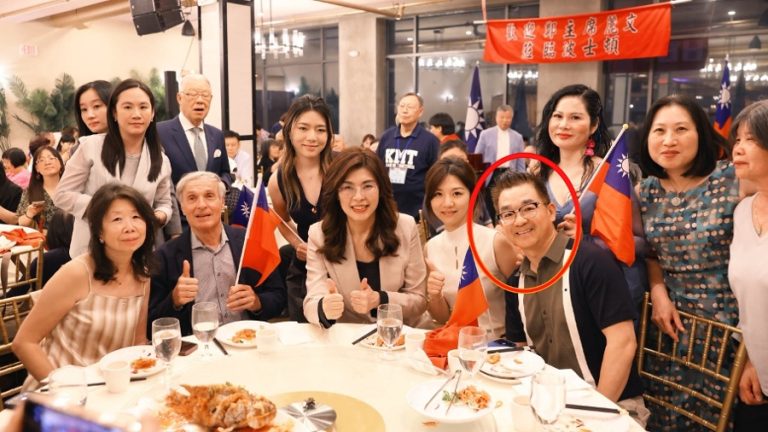
During a visit to the United States, Cheng Li-wen posted photos on Facebook from a banquet with the overseas Chinese community in Boston. Observers noticed that she was seated at the same table as Gary Yu, who has been identified as an official associated with an organization under the United Front Work Department of the Chinese Communist Party (CCP), reported Mirror Media.
The images sparked controversy. Taiwan’s ruling Democratic Progressive Party criticized the incident in a Facebook post, asking whether Cheng was acting as a “messenger for China” or a “bridge-builder for united front work.” The Kuomintang moved quickly to contain the fallout, saying it did not know the individual and that his name was not on the guest list.
Cheng Li-wen photographed dining with alleged United Front official
Cheng posted a group photo from the Boston banquet on Facebook. Outside observers subsequently noted that Gary Yu, who is described as holding a position in an organization affiliated with the CCP’s United Front system, was seated at the same table.
In response, the DPP said in a Facebook post on June 8 that Cheng had only recently drawn criticism at a San Francisco overseas Chinese community banquet after making a series of remarks perceived as complimentary toward Chinese leader Xi Jinping. The party said it was therefore surprising to see photos from the Boston event showing Cheng seated at the same table as Gary Yu, whom it characterized as a Chinese united front figure.
The DPP said that while the name Gary Yu may be unfamiliar to many people in Taiwan, he is not unknown in the United States. The party noted that Yu was mentioned in a U.S. investigation report released last year concerning alleged Chinese interference in local elections in Boston. According to Chinese state media reports and other publicly available information, Yu has also been listed as being affiliated with organizations within the Chinese Communist Party’s United Front Work Department system and has maintained close ties with overseas Chinese organizations and China’s overseas united front networks.
Success
You are now signed up for our newsletter
Success
Check your email to complete sign up
“In other words, Gary Yu is not simply a member of the overseas Chinese community,” the DPP said. “He is widely regarded as a figure with close connections to China’s united front system.”
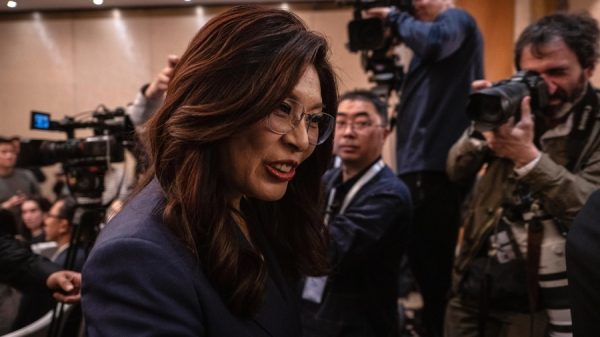
DPP: US media portray Cheng Li-wen as carrying Beijing’s message
The DPP further stated that during a discussion of Cheng Li-wen’s U.S. visit on Mornings with Maria, a program on Fox Business, the host remarked: “Obviously she is a China person and she’s Beijing’s person.”
The party also cited a report by The Wall Street Journal, which ran under the headline: “Taiwan’s Opposition Leader Comes to U.S. With a Message Straight Out of Beijing.”
According to the DPP, these portrayals in major U.S. media outlets suggest that Cheng’s cross-strait messaging is viewed as being closely aligned with Beijing’s position.
The party argued that, in the eyes of many American observers, Cheng appears less like a representative of Taiwan and more like a representative of the Chinese Communist Party and Chinese leader Xi Jinping.
‘A messenger for China’ or ‘a bridge-builder for united front work?’
The DPP further argued that Cheng Li-wen had told attendees at the Boston overseas Chinese community banquet that the Kuomintang was committed to safeguarding the Constitution of the Republic of China and would serve as a “bridge-builder” across the Taiwan Strait.
However, the party noted that the same politician had previously described Xi Jinping as “the last Chinese leader who has feelings and goodwill toward Taiwan.” It argued that Cheng was now also being linked to a figure alleged to have close ties to China’s united front system. The DPP therefore questioned whether the bridge she sought to build was “a bridge for peace” or “a bridge for the CCP’s united front efforts toward Taiwan.”
According to a report by France 24, Cheng’s U.S. trip lasted two weeks—roughly twice the length of similar visits in the past. The report said the extended itinerary had fueled speculation that she was seeking to reassure U.S. interlocutors, raise her political profile, and position herself for a potential run in Taiwan’s 2028 presidential election.
The report quoted a KMT insider as saying that Cheng’s popularity and ability to energize supporters had significantly overshadowed Lu Shiow-yen, making it understandable that anti-Cheng factions within the party would closely watch for any signs of presidential ambitions.
According to a late-May survey by My-Formosa ePaper, only 23.8 percent of respondents said they trusted Cheng, down 7.7 percentage points from a previous poll, while 51.7 percent said they did not trust her. Among pan-blue supporters, however, trust outweighed distrust, with 62.7 percent expressing trust and 21.1 percent expressing distrust.

KMT moves quickly to defuse the controversy
Responding to questions about Gary Yu’s attendance at the Boston banquet, the KMT on June 8 sought to downplay the matter.
The party said Yu had attended as a guest invited by members of the Taiwanese expatriate community who were present at the event, reported Taipei Times.
It added that Zhang Yunlan, a standing committee member of the KMT’s Boston overseas branch and one of the organizers of the banquet, did not know Yu personally, and that neither his name nor his affiliated organization appeared on the official guest list.
The KMT further stated that Yu was photographed with Cheng only when she was moving from table to table to offer toasts and take group photos with attendees. Contrary to earlier reports, the party said, Yu did not dine at the same table as Cheng during the banquet.