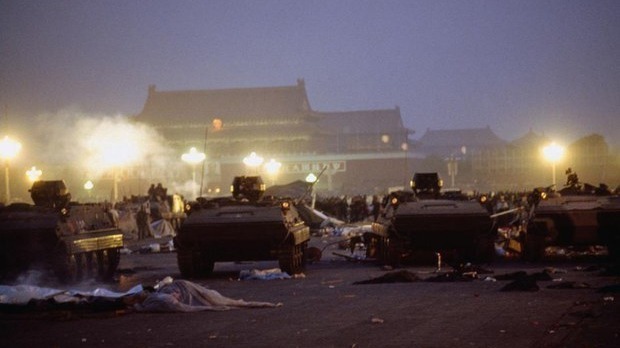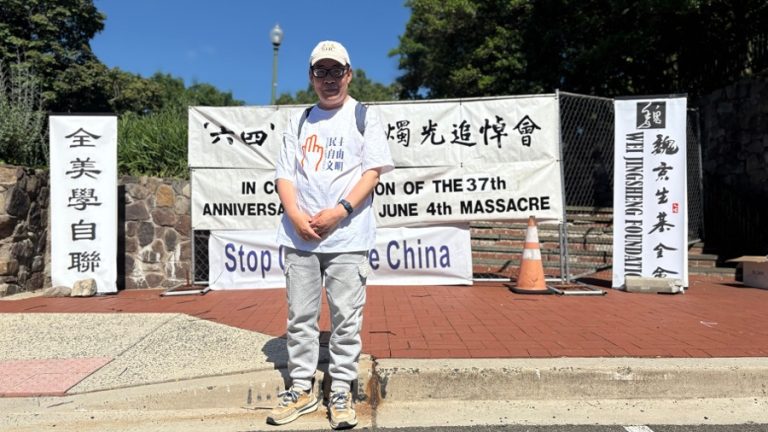
Thirty-seven years have passed since June 4, 1989. Discussion surrounding this historical event has never ceased, yet efforts to fully uncover the truth have consistently faced obstacles.
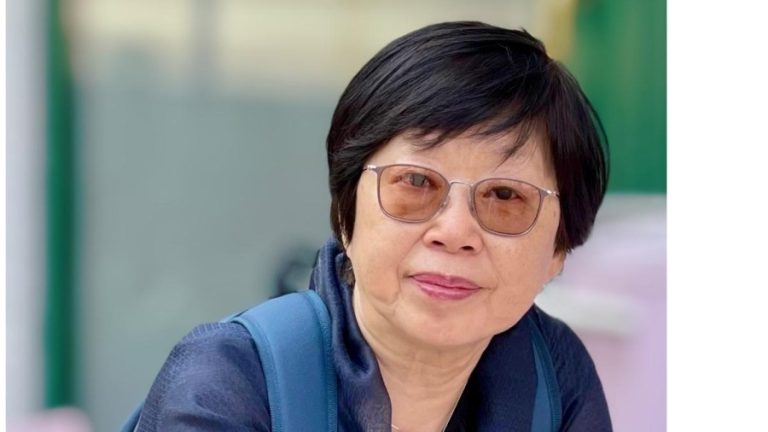
On this occasion, Jiang Lin, a former roving correspondent for the PLA Daily, was interviewed by media commentator Xiao Ping.
Speaking as a firsthand witness, she revealed a number of little-known historical details from within the military and sharply questioned several prevailing interpretations of the June Fourth Incident.
Military control of the media: one voice dominating the narrative for thirty years
Jiang Lin served as a roving correspondent for the PLA Daily, specializing in coverage of leaders of the Central Military Commission (CMC) and major military emergencies. This unique position gave her access to internal information that was unavailable to most journalists during the political turmoil of 1989.
In the interview, she first pointed out that following the June Fourth crackdown, all of China’s major central media outlets—including the People’s Daily, Xinhua News Agency, and China Central Television (CCTV)—were swiftly placed under military control. According to Jiang, only one official channel remained authorized to communicate with the outside world: the News Office of the Martial Law Troops. She noted that this detail has long remained largely unknown to the public.
Success
You are now signed up for our newsletter
Success
Check your email to complete sign up
“This news office was staffed by three reporters seconded from our PLA journalists’ corps and was located in Li Peng’s office at Zhongnanhai. All copies came from Yang Baibing’s office,” Jiang Lin said. According to her, the material released by the office amounted to a systematic reversal of historical facts. The army fired first and civilians then resisted, but in the version distributed by the news office, everything was transformed into a narrative of “rioters attacking the military” and the military being “forced to act in self-defense.”
She noted that the original video footage submitted to the news office accurately recorded events as they occurred, but during editing the sequence of events was deliberately rearranged, completely reversing cause and effect. Subsequently, the editorial titled “Take a Clear-Cut Stand Against the Turmoil”, published under the name of the PLA Daily, became a key piece of propaganda that defined the official characterization of the entire incident.
However, Jiang said the editorial had nothing to do with the PLA Daily editorial department itself.
“It was delivered overnight from Yang Baibing’s office, and we were ordered to publish it within a specified deadline. The editor on duty insisted that it must bear Chairman Yang’s handwritten signature; otherwise, it would not be typeset. Only after the signed approval was returned could it be published.”
According to Jiang, everyone at the newspaper understood what had actually happened, but under such intense political pressure they had no choice but to comply.
Jiang argued that this carefully constructed propaganda apparatus shaped the basic understanding of the June Fourth Incident among China’s 1.4 billion people over the following three decades. After arriving in Canada, she said she witnessed young people from the generation associated with the White Paper Movement who had only recently left China react with disbelief when they saw foreign media footage showing tanks crushing civilians and casualties in hospitals.
“In China, June 4, 1989, is as if it disappeared. It’s a blank page.”
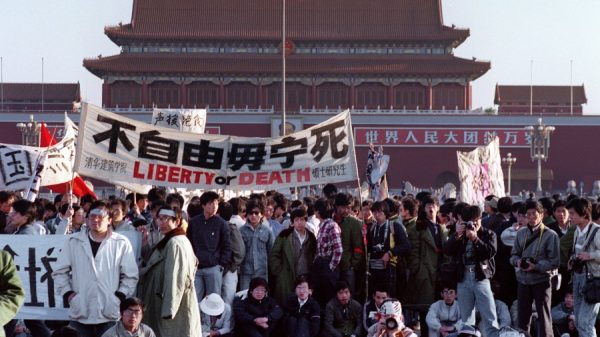
‘A palace coup’: two hundred thousand troops were not sent primarily to suppress students
Jiang devoted particular attention in the interview to her interpretation of the nature of the June Fourth Incident. Citing the memoirs of Zhao Ziyang, Prisoner of the State: The Secret Journal of Premier Zhao Ziyang,
she argued that the deployment of troops and subsequent crackdown was, in essence, an internal power struggle—a “palace coup” within the Chinese Communist Party—rather than an operation directly aimed at student protesters.
“Think about it: there were only several tens of thousands of unarmed young students in the square. Why would Deng Xiaoping mobilize nearly 200,000 field troops?” she said. “From a military standpoint, a student movement of that scale could have been suppressed by a single regiment with ease. Deploying 200,000 troops simply does not make sense in military terms.”
Jiang argued that, based on basic military logic, the mobilization of such a large force was disproportionate to the task of dispersing student demonstrators and therefore raises questions about the broader objectives behind the deployment.
The real reason: Xu Qinxian’s refusal to obey orders
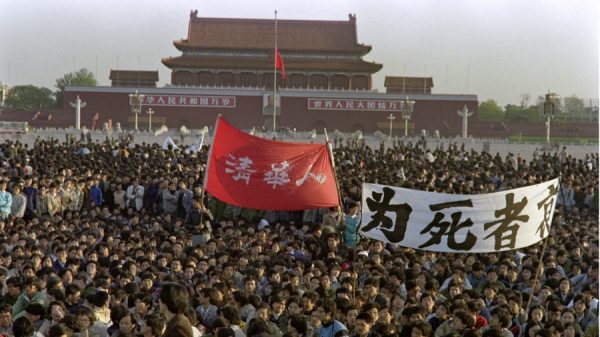
Jiang argued that the real reason for the massive troop deployment was the defiance of Xu Qinxian, commander of the 38th Group Army. According to her account, when units of the 38th Army arrived near Tiananmen Square under orders to enter Beijing, they were quickly surrounded by students.
She said she personally witnessed friendly exchanges between students and soldiers.
“The students would tell them which school they were from and explain why they had come here.”
The atmosphere, she recalled, resembled a conversation among friends rather than a confrontation.
Faced with this situation, Xu allegedly refused to carry out orders to suppress the demonstrations. Jiang said that at a military tribunal he stated clearly that the issue should not be resolved by the military but should instead be handled through legal and political processes.
According to Jiang’s interpretation, Deng Xiaoping subsequently reinforced Beijing with troops from multiple military regions, not only to suppress the protests but also to prevent further acts of disobedience within the armed forces by having different units monitor and balance one another.
“He did not fully trust his own troops, so he used one force to keep another in check.”
The joint letter of seven generals and the report that never ran
Jiang also disclosed a little-known episode from the period. She said that Zhang Sheng personally drafted a joint letter and drove from house to house collecting signatures from seven senior generals.
The letter’s core message, she recalled, consisted of only three points:
- The People’s Liberation Army is the people’s army.
- The army must not fire on civilians.
- The army must not enter the city.
After the signatures were collected, the letter was delivered to the General Office of the Central Military Commission. According to Jiang, staff members there reacted enthusiastically, saying:
“This has arrived at exactly the right time. The Central Military Commission is discussing this issue.”
Jiang said she immediately relayed the contents of the letter to an editor at the People’s Daily, who considered it important enough for front-page publication that evening. However, when the newspaper sought to verify the identities of the signatories, one of the generals reportedly objected, arguing that the letter was an internal communication to the Central Military Commission and should not be made public.
As a result, the article was withdrawn, and what Jiang described as a potentially historic intervention never reached the public.
She further claimed that after the crackdown, military leaders told internal Party committee meetings that reports of a “joint letter signed by seven generals” were merely rumors and that no such document existed.
“You can see how fearful they were—they had to debunk their own rumor within their own system.”
‘Heroes among heroes’: a rebuttal to claims about student leaders
Another major theme of the interview was Jiang’s criticism of contemporary commentators who dismissed the student leaders of 1989.
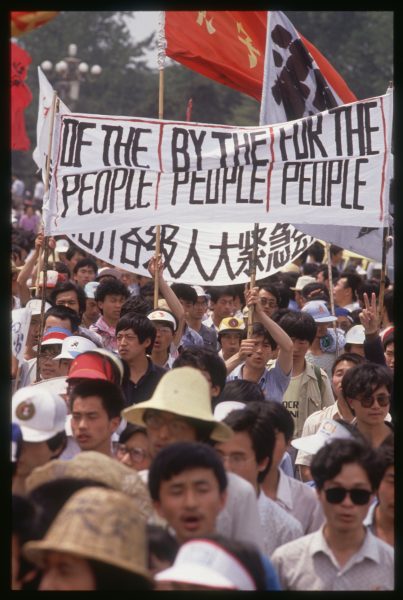
She rejected claims that the movement lacked democratic procedures or that its leaders were not properly elected. According to Jiang, organizations such as the Beijing Students’ Autonomous Federation, the Beijing Association of College Students, and the Joint Federation of Patriotic Constitutional Organizations in the Capital all operated through formal election mechanisms.
She noted that Wuer Kaixi was elected chairman of the Beijing Students’ Autonomous Federation, while Chai Ling was appointed commander-in-chief of the Tiananmen Square movement by a joint conference of participating organizations. She also said that Wang Dan held elected leadership positions within the movement.
“It wasn’t that there was a lack of democratic procedures. If anything, there were too many democratic procedures, which sometimes made it difficult to move things forward.”
Responding to accusations that student leaders ‘profited from June Fourth’
Addressing accusations that student leaders have been “living off the legacy of June Fourth,” Jiang responded:
“That is not an easy ‘bun’ to eat. Do you have the courage to do what they did—to give up everything, live in exile overseas for more than thirty years, and spend your own time and money advocating for political prisoners back home?”
She ultimately offered a three-part assessment of the student leaders:
“They were heroes then, they are still heroes today, and they are heroes of an extraordinary kind.”
The beginning of the search for truth, not the end
On the 37th anniversary of June Fourth, Jiang said the message she most wanted to convey to young people today was that they should no longer place their hopes for China’s future in reform from within the Chinese Communist Party.
“I waited for thirty years and never saw that day arrive.”
She argued that the truth about June Fourth remains far from fully known. According to her, the killings that unfolded along miles of Beijing streets can only be understood in fragments by individual witnesses, while comprehensive casualty figures and complete historical archives remain inaccessible.
“This is not the time to draw final conclusions. This is only the beginning.”
The former military journalist, who once believed that the Communist Party was capable of correcting its own mistakes, said that after leaving China and settling in Canada, she reached her final judgment on this chapter of history.
Reflecting on the young people who gathered in Tiananmen Square in 1989, Jiang concluded that history still owes them a fair and just name.