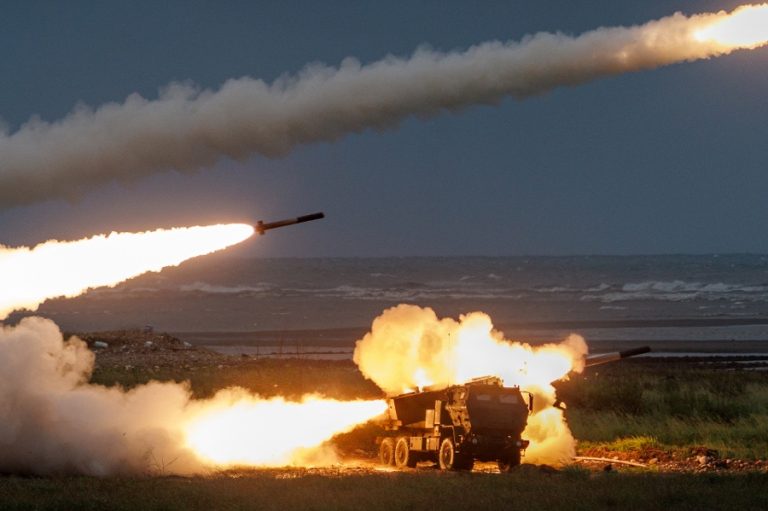
According to Reuters, Taiwan’s military conducted a key live-fire exercise on June 10 near the mouth of the Dajia River in Taichung. The drill marked the first public exercise of the U.S.-made High Mobility Artillery Rocket System (HIMARS) on Taiwan’s west coast combat zone facing the Taiwan Strait since the system was delivered to Taiwan, drawing significant international attention.
The exercise was carried out by the Army’s 58th Artillery Command. Multiple HIMARS launch vehicles were deployed to coastal positions in Taichung and, according to the exercise plan, fired several rockets at designated offshore target areas in a simulated strike. The training included position relocation, target acquisition, rocket launches, and rapid withdrawal after firing, with the goal of fully testing the HIMARS system’s rapid deployment, long-range strike, and maneuver warfare capabilities.
Reuters highlighted the use of the “shoot-and-scoot” tactic during the drill. This tactic requires launch vehicles to quickly relocate immediately after completing a firing mission to avoid enemy counterattacks and is regarded as a key survival strategy in modern mobile warfare.
The live-fire exercise was also an important component of Taiwan’s recent anti-amphibious invasion training series. On June 9, Taiwan’s military had already conducted a large-scale simulated anti-landing exercise along the central coast, employing Thunderbolt-2000 multiple-launch rocket systems, self-propelled artillery, anti-armor weapons, and mortars to practice suppressing a hypothetical amphibious assault force.
The Dajia River estuary, where the exercises were held, is characterized by relatively flat terrain and has long been designated by Taiwan’s military as a critical defensive area due to its suitability for amphibious landings.
Success
You are now signed up for our newsletter
Success
Check your email to complete sign up
HIMARS officially enters Taiwan’s combat arsenal
Produced by Lockheed Martin, the HIMARS system gained international prominence during the Russia–Ukraine war for its ability to precisely strike troop concentrations, logistics hubs, and command centers. In recent years, Taiwan has continued to advance its “asymmetric warfare” strategy, emphasizing highly mobile and efficient weapons systems to strengthen its defense resilience.
Technical specifications indicate that the precision-guided rockets used by HIMARS have a range of up to 80 kilometers (50 miles). If paired in the future with the Army Tactical Missile System (ATACMS), Taiwan’s defensive strike radius could be extended to approximately 300 kilometers (186 miles).
The first group of Taiwanese military instructors trained in the United States has already returned to Taiwan and begun teaching operational procedures and tactical applications of the system throughout the armed forces, according to 2023 reporting by Taiwan News.
According to Army Recognition, Taiwan’s military stated that the successful completion of the live-fire test not only marks the formal integration of HIMARS into Taiwan’s operational forces but also validates the effectiveness of the new system under realistic combat conditions. Going forward, Taiwan plans to conduct additional joint exercises integrating drones, shore-based anti-ship missiles, air-defense systems, and artillery units. The results of the latest test will be incorporated into future training, readiness planning, and operational assessments to further strengthen the island’s overall defense capabilities.