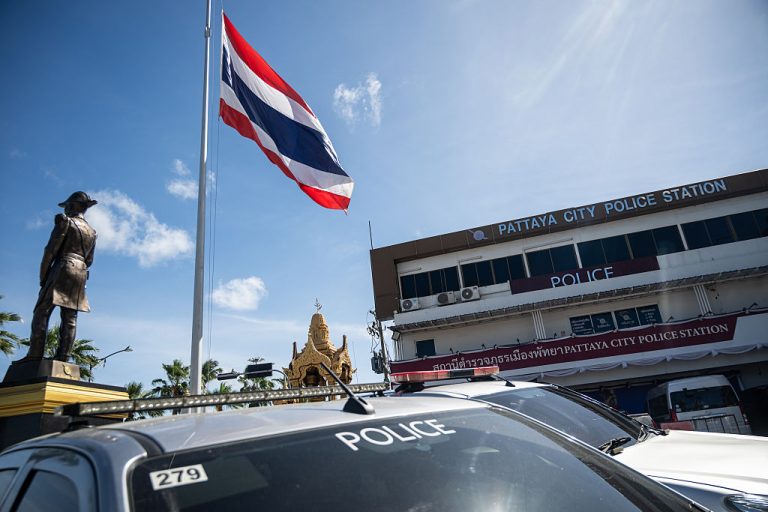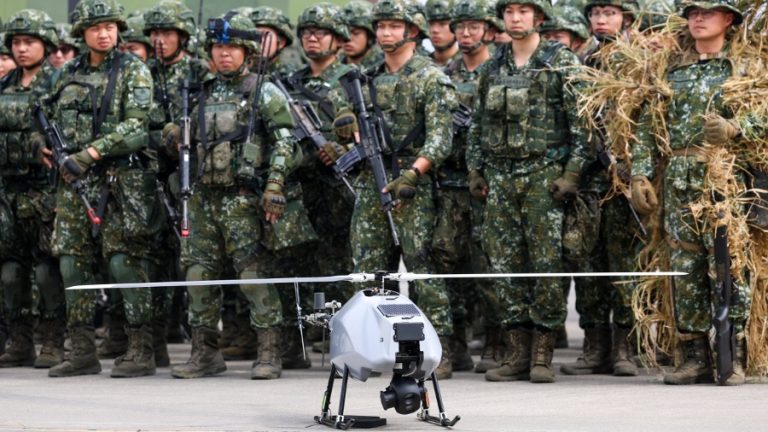
Taiwan’s Legislative Yuan, equivalent to the island’s Parliament blocked a proposed draft bill on June 5 meant to develop the island’s drone industry, according to local media reports.
Taiwan’s ruling, Democratic Progressive Party (DPP) legislator Chung Chia-pin and several colleagues recently proposed a draft bill called the Special Act for the Development of the Unmanned Vehicle Industry,Taiwan News reported.
However, the bill was blocked by the joint efforts of the Kuomintang (KMT) and the Taiwan People’s Party (TPP) in the Legislative Yuan and was sent back to the Procedure Committee. The DPP criticized the move as stifling industry development and described it as irrational.
The bill was blocked amidst growing discussion on the need for Taiwan to build its own defense and deterrence capability to face increasingly aggressive China.
Raymond Greene, director of the American Institute in Taiwan (AIT), said in a defense forum in Taipei on June 6 that investing in unmanned systems is the smartest way for Taiwan to rapidly establish a credible deterrent capability, Reuters reported.
Success
You are now signed up for our newsletter
Success
Check your email to complete sign up
Meanwhile, Palmer Luckey, founder of Anduril Industries, a leading American defense technology company, said in an interview with Taiwan’s Central News Agency (CNA) that there are only a limited number of areas in which Taiwan can make the world dependent on it. He said he would welcome Taiwan becoming an exporter of defense products, not merely an exporter of microelectronic components.
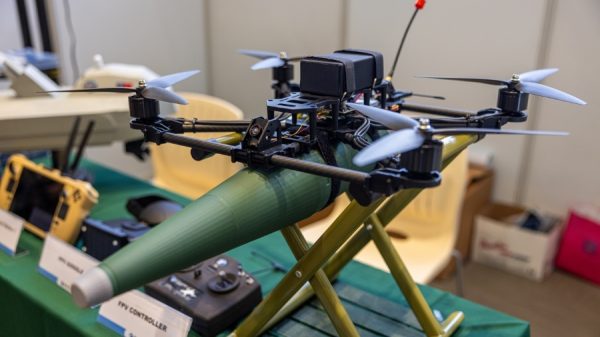
KMT and TPP block ‘drone industry’ proposal
Supporters of the bill said that a separate bill for unmanned vehicles was needed because the previously passed National Defense Special Act didn’t include it. The blocking has further spurred the need for discussion between the ruling and the opposition parties in Taiwan.
According to a report by Liberty Times, Chen Kuan-ting, convener of the Legislative Yuan’s Foreign Affairs and National Defense Committee, said that the National Defense Special Act previously passed by the legislature did not include provisions from the Executive Yuan’s version concerning unmanned vehicles and counter-drone systems. Therefore, supporters hoped to use a dedicated law to fill the gap.
He added that if the KMT and TPP believe the draft requires revisions, they should promptly submit their own versions so that both the ruling and opposition camps can work together to advance the legislation.
In an interview, Chung Chia-pin said that the unmanned vehicle industry is growing rapidly worldwide and that American companies have come to Taiwan seeking supply-chain cooperation. However, Taiwan’s development of unmanned systems continues to face obstacles, including insufficient airspace and maritime testing areas, as well as regulatory restrictions. He said the purpose of the bill was to remove regulatory barriers and facilitate industry development.
Chung also noted that Lu Shiow-yen had previously expressed a desire to develop Taichung into a major hub for the drone industry, and that several KMT legislators had publicly voiced support for expanding the sector. Therefore, he said, it was difficult to understand why the KMT and TPP would block the proposed legislation.
The Liberty Times reported that DPP legislator Lin Chu-yin criticized the opposition parties, saying they were “completely irrational and devoid of logic.”
“The Kuomintang says it wants to secure a position in the industry, yet turns around and undermines the establishment of a domestic industry and Taiwan’s self-defense capabilities. It is clearly treating drones as a political tool for partisan gain.”
As for why the proposal was blocked, KMT caucus secretary-general Lin Pei-hsiang explained that the KMT supports the development of the drone industry, but does not support promoting it through a special act.
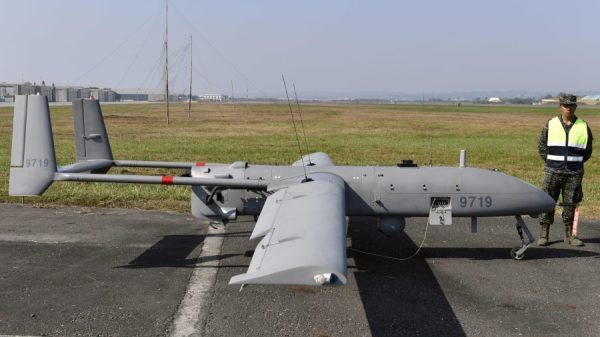
US–Taiwan cooperation on an unmanned systems supply chain can help lead the world
According to a report by TVBS News, Raymond Greene, director of the American Institute in Taiwan (AIT), attended the DSET 2026 Annual Forum – International Summit on Supply Chain Resilience Strategy on Saturday, where he discussed U.S.–Taiwan cooperation on supply chains.
Greene said that Taiwan not only needs to increase spending to strengthen its self-defense capabilities, but also needs to use its resources more intelligently. In his view, investing in unmanned systems is the smartest way for Taiwan to rapidly establish a credible deterrent capability.
He noted that the wars in Ukraine and the Middle East have demonstrated how drones are transforming the nature of warfare, creating opportunities for Taiwan in maintaining the military balance across the Taiwan Strait. Many American companies, he said, are coming to Taiwan to share technology, procure key components, and jointly develop the next generation of AI-enabled asymmetric warfare capabilities, particularly applications designed for maritime environments.
Greene further stated that the United States is working closely with Taiwan’s Industrial Technology Research Institute(ITRI) and industry partners on standards and certification systems to ensure the security and effectiveness of the U.S.–Taiwan unmanned-systems supply chain.
In addition, he said Taiwanese companies could create more manufacturing opportunities in the United States to meet rapidly growing demand for drones.
According to Greene, following cooperation in artificial intelligence and semiconductors, the United States and Taiwan can work together in drones and other next-generation technologies to help lead the world while benefiting the economies and security of both sides.
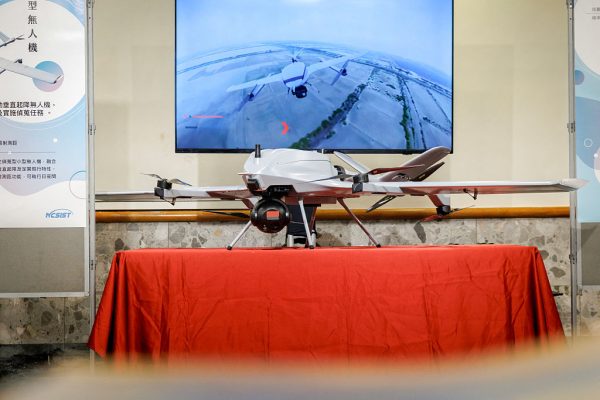
Anduril founder: welcomes Taiwan becoming a weapons exporter
According to a report by the Central News Agency (CNA), Taiwan has purchased the Altius-600M attack drone, produced by U.S. defense technology company Anduril Industries, through its military procurement program with the United States. The drones have already been delivered to Taiwan’s armed forces and are being used in live-fire training exercises.
During a recent visit to Taiwan, Palmer Luckey, founder of Anduril, told CNA that the weapons of the future will resemble today’s automobiles and smartphones in that they can receive software upgrades while in operation. Hardware, he said, must also be modular. For example, instead of building an entirely new drone, operators should be able to replace the drone’s seeker, allowing for the development of new communications modules or new types of warheads.
Many people believe Taiwan cannot compete with China militarily. Luckey argued that Taiwan does not need to match the strength of the Chinese military. Rather, it only needs to develop the capability to prevent Chinese forces from crossing the Taiwan Strait, projecting military power, and sustaining an occupation.
“Taiwan only needs to focus on developing asymmetric warfare systems. With less funding and manpower, it can prevent China from achieving its tactical objectives. Autonomous-system weapons will make this even easier, enabling asymmetric warfare through low costs and mass production.”
Luckey noted that countries such as the United Kingdom, Germany, and Canada cannot independently manufacture 100 percent of the components required for drones or weapons systems.
“Taiwan is one of the very few countries in the world with the industrial and technological capacity to independently manufacture every component needed for advanced weapons,” he said.
Luckey believes Taiwan must expand its defense-industrial supply chain.
“The ideal scenario is not only exporting advanced semiconductors and chips, but also exporting complete weapons systems to countries around the world.”
He said this would bring three major benefits–It would support economic development. It would encourage other countries to maintain cooperative relationships with Taiwan and in wartime, export production capacity could be redirected to domestic needs.
For these reasons, he said he hopes Taiwan will become an exporter of defense products, not merely an exporter of microelectronic components.
When asked whether Taiwan could evolve from possessing a “Silicon Shield” into a “Drone Shield,” Luckey said he would welcome such a development.
“Many countries pay attention to Taiwan because they are highly dependent on Taiwan’s semiconductors. What if those countries were also dependent on Taiwan’s weapons?”
He added: “There are not many areas in which Taiwan can make other countries dependent on it, but it can become a supplier of defense materials, consumer electronics, and advanced semiconductors.”
Luckey concluded that if he were in charge of Taiwan, he would do everything possible to make Taiwan an indispensable part of the world in every respect, including in the defense industry.