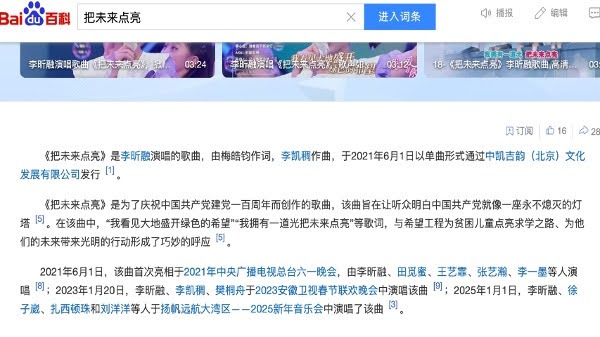
As schools across Taiwan prepare for June graduation ceremonies, a parent sparked controversy after posting on Threads that the kindergarten graduation song “Light Up the Future” (《把未来点亮》), which their child had been practicing at home, was originally composed to commemorate the 100th anniversary of the founding of the Chinese Communist Party (CCP), according to Liberty Times.
A separate post cited by FTV News said the child came home saying they needed to practice the graduation performance song “Light Up the Future.” After researching it, the parent said they discovered it was created for the CCP centenary and described its intended message as to “help listeners understand that the Chinese Communist Party is like an eternal beacon, guiding people through the course of history.”
The parent criticized the school’s choice, writing: “Is it really appropriate for kindergarten children to sing this kind of song? Isn’t this indoctrination?”
Taiwan’s Mainland Affairs Council (MAC) responded that the teacher may not have known the song was associated with CCP centenary celebrations and should not be blamed, adding that it had asked the Taipei Department of Education to investigate the matter.
The post quickly attracted attention
The post quickly attracted widespread attention and concern from other parents. Some of them commented: “What’s going on with these kindergarten principals and teachers?”
Success
You are now signed up for our newsletter
Success
Check your email to complete sign up
“What?! My son was singing this recently too. Oh my goodness! Didn’t the school know?” someone else said.
Another said, “If parents don’t object, the school is still at fault. How could they not know?”
Many parents also called for the kindergarten to be publicly identified so that other families could avoid it, posting comments such as:
“Which kindergarten is it? I’ve read so many reports and none of them say [anything].”
“Can we know which kindergarten it is?”
Some parents also claimed that similar situations had occurred in other parts of Taiwan, posting comments such as: “Kindergartens in Taoyuan are singing it too. Parents, please pay attention.”
Some said, “There were kindergartens in Taoyuan singing it as early as last year.”
“In Taichung, we’ve even seen decorations using simplified Chinese characters!” said another.
“Keelung has it too,” commented another netizen on Threads.
Another highlighted, “Is it Taichung? My daughter’s kindergarten has been using this song for two graduating classes already.”
“Kindergartens in Taichung are using it too. It’s actually been happening for quite a while,” said another netizen.
Mainland Affairs Council: ‘The teachers shouldn’t be blamed’
According to Liberty Times, Liang Wen-chieh, spokesperson for Taiwan’s Mainland Affairs Council (MAC), addressed the controversy during a press conference. He said the MAC had asked the Ministry of Education to refer the matter to the Taipei Department of Education for investigation and follow-up, adding that no definitive response had yet been received.
Liang said kindergarten teachers were likely unaware of the song’s origins. He noted that the lyrics appear innocuous at first glance, but argued that their intended meaning is different.
“The lyrics say, ‘With you there is warmth, with you there are sweet dreams.’ At first glance, they don’t seem problematic. But in fact, the ‘you’ refers to the Chinese Communist Party.”
He continued: “The line ‘Happiness is having you by my side’ is also referring to the Chinese Communist Party.”
Liang said the song was written to commemorate the CCP’s centenary, but that ordinary kindergarten teachers would not be expected to know that. He stressed that the MAC was not blaming the teachers. However, he said that if members of the public or parents raise concerns and provide evidence regarding the lyrics, the kindergarten should respond constructively rather than arguing that the teachers were unaware of the song’s background.
He further explained that some companies produce children’s sing-along videos and provide them to early childhood education providers. Many of these instructional videos use songs from China, partly because of copyright considerations. He said that, in this case, the song had been supplied as part of a children’s sing-along package by an organization identified only as “XX International Education Institution.”
Liang emphasized that he himself would not have known about the song had no one reported it. Since parents had raised concerns and provided supporting evidence, he said, the kindergarten should correct the situation, adding that this would be the appropriate response from an educational institution.
Separately, Shen Po-yang, the Democratic Progressive Party (DPP) candidate for mayor of Taipei, told reporters on June 13 that frontline teachers are already extremely busy and may naturally overlook the origins of songs when selecting them.
He said it would be more helpful if the government clearly informed educators “where the red lines are” and “what issues they should pay attention to,” rather than expecting teachers to identify such concerns on their own.
Using the Taipei City Government as an example, Shen said that the city had recently organized a “Taipei Influencer Festival,” which had already generated considerable controversy during the planning process.
He argued that if the city government itself fails to set a good example in handling such matters, it leaves frontline personnel even more uncertain about what standards they are expected to follow.
Shen concluded that, in his view, the most important thing is for the city government to get its own policies and practices right first.