To understand the evolution of Chinese politics in the post-Mao era and the historic events that led to the Tiananmen square massacre, one must first understand what some scholars have called the Chinese Communist Party’s “Dual-Peak Politics” of the 1980s.
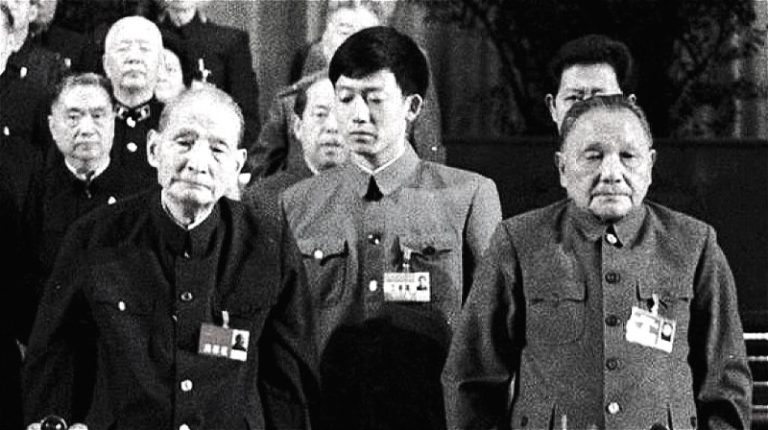
Many people assume that after returning to power following the Cultural Revolution, Deng Xiaoping immediately became China’s undisputed ruler. In reality, however, the Chinese Communist Party (CCP) throughout much of the 1980s was dominated not by a single strongman, but by two political giants as well as rivals: Deng Xiaoping and Chen Yun–Deng was a reformist and Chen a conservative–together they represented China’s “dual peak” politics of the 1980s.
In the 1970s and 1980s the CCP leadership, characterized by “dual-peak politics” was broadly divided between conservatives and reformers–the conservatives were those who supported preserving the CCP’s political system, ideological orthodoxy, and centralized control over rapid political liberalization.
This informal power-sharing arrangement between Deng and Chen helped launch China’s early economic reforms, but it also generated deep ideological conflicts that ultimately contributed to the downfall of two other reform-minded CCP general secretaries—Hu Yaobang and Zhao Ziyang.
Hu was the general secretary from 1982 to 1987 and after Deng’s political comeback managed the rehabilitation of millions of officials and intellectuals persecuted during the cultural revolution. Zhao on the other hand was the general secretary from 1987 to 1989 and is particularly remembered as one of China’s most influential economic reformers as well as the highest ranked leader who opposed military force against the student demonstrators of 1989. Hu and Zhao represented the formal leadership of CCP in the 1980s as they managed the day to day running of the party and the administration.
Success
You are now signed up for our newsletter
Success
Check your email to complete sign up
Two power centers, two competing visions
Chen Yun, fellow revolutionary of Mao and one of the CCP’s most enduring first generation political survivors, played a key role in supporting Deng Xiaoping’s political rehabilitation after the Cultural Revolution. Together, they also helped dismantle Hua Guofeng’s policy of the “Two Whatevers” in the late 1970s and consolidated control over the Party.
Hua was the successor of Mao and the second premier of China. His “Two Whatevers” was a political doctrine introduced shortly after Mao’s death in 1977 and its aim was to maintain Mao’s authority and continue with his policies during the period of uncertainty.
Deng and Cheng gradually stripped Hua of his power by building political cliques within the CCP, controlling important institutions and proving that Hua’s policies hadn’t helped. Yet once Deng and Chen secured power, disagreements between the two men never truly disappeared. Their rivalry continued throughout the decade and ended only when they found themselves united during the 1989 Tiananmen crisis.
Deng Xiaoping’s strategy centered on economic reform under the protection of the Party’s military power. As chairman of the Central Military Commission, Deng controlled the People’s Liberation Army and believed that rapid economic growth was essential for the CCP’s survival.
His reforms decentralized portions of the economy and allowed selected groups—particularly those so-called princelings—the children and relatives of senior CCP officials —to become wealthy first. To implement these policies, Deng elevated Hu Yaobang and Zhao Ziyang, who served as his principal allies within the Party and government bureaucracy.
By doing this Deng wanted to reshape the leadership and the weakened bureaucracy of the CCP after the purges of the cultural revolution.
Deng and Hu had worked together since the 1950s and had both faced purges during the Cultural revolution. They had built strong trust between them. Zhao on the other hand had proven his reformist ability as the Party Secretary of Sichuan where his unique economic and agricultural management had brought in dramatic recovery of Sichuan’s economy. This made Deng believe that Zhao can bring nationwide reforms.

Chen Yun represented a very different vision
Chen was a contemporary of Mao and managed the financial administration of the CCP before 1949. He was the first translator of Mao’s revolutionary ideology into functioning economic systems and was widely regarded as one of the architects of China’s planned economy. He controlled powerful institutions including the Central Commission for Discipline Inspection and the Party’s personnel system. He advocated what became known as the “birdcage economy.”
According to Chen’s famous analogy, the market was the bird, while central planning was the cage. The bird could move freely—but only within limits determined by the Party.
Chen also feared that Deng’s opening to the outside world would inevitably introduce Western democratic ideas and undermine the CCP’s monopoly on political power.
Between 1983 and 1986, Chen and other conservative Party elders and long-time political allies—including Wang Zhen and Deng Liqun—launched a series of ideological campaigns warning against what they described as “bourgeois liberalization” and Western influence.
Hu Yaobang’s relatively tolerant attitude toward intellectuals and political reform soon made him a target of conservative criticism. Tensions between Deng and Hu gradually intensified.
The question obviously is if both Deng and Hu were reformists, then why did Deng oppose Hu? Both Deng and Hu wanted the PRC to reform but they both held different views on how much political openness was acceptable.
While they agreed on economic reform, they differed on political reform. Deng wasn’t tolerant to independent political organizations or challenges to one-party rule while Hu was open to public debate, political enquiry, reduced ideological control and dialogue with students and intellectuals.
The downfall of Hu Yaobang and Zhao Ziyang
The nationwide student demonstrations that erupted in late 1986 provided conservatives with an opportunity to strike against the reformists like Hu and Zhao.
In January 1987, senior Party elders pressured Hu Yaobang during an internal Party meeting, accusing him of failing to control ideological dissent. Deng Xiaoping ultimately approved Hu’s removal as General Secretary, replacing him with Zhao Ziyang, a second generation CCP leader.
The failure of China’s price-liberalization campaign triggered a wave of inflation in 1988–1989, providing Chen Yun’s conservative faction with fresh ammunition against market-oriented reforms. As economic frustration mounted, the Tiananmen student movement soon emerged in 1989 as the most serious political challenge to Communist Party rule since the Cultural Revolution.
Unlike many Party hardliners, Zhao opposed the use of military force against protesters. He visited the hunger-striking students in Tiananmen Square on 19 May 1989 and holding a loudspeaker said, “We have come too late.” That was the last time he was seen.
That position crossed a line for both Deng Xiaoping and Chen Yun. Although they differed sharply on economic policy, both men shared one non-negotiable priority: preserving Communist Party rule.
For the first time in years, the two power centers reached complete agreement. Zhao Ziyang was removed from office and placed under house arrest, where he remained until his death in 2005. He was never formally charged, never put on a trial and expelled from the CCP, yet he was very effectively erased from public life.
Scholars from National Chengchi University’s Institute of International Relations and Academia Sinica’s Institute of Political Science in Taiwan—including researchers such as Kou Chien-wen and Wu Yu-shan—have frequently argued that Hu Yaobang and Zhao Ziyang, despite formally serving as China’s top Party and state leaders, functioned in practice as intermediaries and buffers within the CCP’s “dual-peak” power structure.
Hu and Zhao stood at the forefront of implementing Deng Xiaoping’s reform agenda, but in doing so they inevitably pushed against the limits of the “birdcage” established by Chen Yun. Whenever economic instability emerged—as it did during the inflation crisis of 1988—or when society began demanding greater political openness, as seen in the student movement of 1989, conservative Party elders led by Chen Yun would exert pressure on Deng Xiaoping to rein in the reform process.
Faced with these competing pressures, Deng sought to preserve both internal Party unity and the CCP’s monopoly on political power. Ultimately, he chose what Chinese commentators often describe as “sacrificing a limb to save the body”—removing his own political protégés in order to preserve the broader system. Hu Yaobang and Zhao Ziyang thus became casualties of the balance-of-power struggle between the two dominant centers of authority at the top of the Party.

Institutional weakness and the politics of informal power
The “dual-peak” power structure reflected the fundamentally informal nature of politics within CCP during the 1980s.
Real power did not derive from formal positions such as General Secretary, but from revolutionary credentials, political seniority, and personal prestige accumulated during the Communist revolution. Neither Deng Xiaoping nor Chen Yun held the Party’s highest office, yet both possessed sufficient authority to determine the fate of successive General Secretaries from behind the scenes.
This system of personal rule created an inherently fragile political equilibrium. When the two elder statesmen agreed, the system functioned. When their interests diverged, however, there were few institutional mechanisms capable of resolving conflicts in a legitimate or transparent manner. As a result, major political disputes were often settled through informal Party meetings, elite power struggles, or ultimately the use of military force—as occurred during the 1989 Tiananmen crisis.
American political economists, such as David Bachman, have frequently characterized this period as a struggle between Deng Xiaoping’s decentralizing reforms and Chen Yun’s bureaucratic planning model.
Deng hoped that economic liberalization and decentralization would generate growth and strengthen the Party’s governing legitimacy. Yet greater economic freedom inevitably weakened the Party’s traditional mechanisms of control.
Chen Yun, by contrast, represented a powerful bureaucratic establishment that sought to preserve centralized authority through Party discipline and state planning.
The tragedy of Hu Yaobang and Zhao Ziyang was that both attempted to chart a path between market-oriented reform and political liberalization. Yet that path ultimately crossed the red lines of both men who truly held power: Deng Xiaoping, who opposed political democratization, and Chen Yun, who opposed unfettered marketization (letting the market decide almost everything with minimum state intervention).
READ MORE:
- Hidden for Decades: Restored Tiananmen Footage Offers Unfiltered View of June 4
- Mao Zedong Spent His Final Years in Clinical Paranoia, His Personal Physician Wrote
- Exclusive: The Forgotten Reformer Who Tried to Prevent Tiananmen’s Tragedy
Why did Deng Xiaoping and Chen Yun ultimately choose force?
Despite years of fierce rivalry throughout the 1980s, Deng Xiaoping and Chen Yun stood united when confronted with what they perceived as a threat to the survival of Communist Party rule. Why did Chen Yun so firmly support Deng’s decision to deploy the military in 1989?
Was it simply a matter of ideology? To understand their decision, one must first recognize how the CCP leadership viewed political power.
Critics of the Party argue that the CCP rose to power through a combination of revolutionary violence, political campaigns, intelligence operations, propaganda networks, and coercive methods. Although it eventually came to control the institutions of a modern state, its political culture remained shaped by the logic of revolutionary struggle and power preservation.
From this perspective, many within the Party elite did not regard the state as a neutral public institution serving all citizens equally. Rather, they viewed it as a political order won through decades of conflict and sacrifice—an asset whose survival was inseparable from their own.
Having come to power through mass mobilization and ultimately defeated the Nationalist government, the CCP leadership understood better than anyone the potential force of popular movements. Many feared that even limited concessions to the student movement—such as recognizing its legitimacy or engaging in meaningful dialogue—could unleash a chain reaction that would undermine the Party’s authority and ultimately threaten one-party rule itself.
These fears were compounded by the Party’s historical legacy. Campaigns such as the Suppression of Counter-revolutionaries, the Great Leap Forward, and the Cultural Revolution had left deep political and moral burdens. Many senior leaders believed that if the Party lost power, they and their families could face political retribution, legal accountability, or the loss of the privileges they had accumulated under the existing system.
Within elite circles, a harsh consensus reportedly emerged: bloodshed was preferable to losing power.
From their perspective, the cost of using force was international condemnation and temporary economic disruption. The cost of not using force, however, was perceived as far greater—the possible collapse of Communist Party rule itself.
Human lives became secondary to what leaders regarded as the survival of the regime.
The princelings, corruption, and the defense of privilege
The interests of China’s emerging political elite also played a significant role in the events leading up to Tiananmen.
One of the central grievances fueling the student movement was public anger over corruption and the growing wealth of politically connected families.
During the reform era, Deng Xiaoping introduced the so-called dual-track pricing system, under which many goods were sold at both state-controlled prices and market prices. While intended as a transitional mechanism toward a market economy, the system created enormous opportunities for rent-seeking.
Those best positioned to exploit these opportunities were senior Party officials and their children—the so-called princelings—who could leverage political influence and administrative approvals to obtain scarce goods at state prices and resell them at market rates for enormous profits.
As a result, resentment toward official corruption grew rapidly.
When students took to the streets in 1989, some of their most prominent slogans were not initially calls for democracy but demands to combat corruption and official profiteering. Calls to “oppose official profiteering” and “fight corruption” struck directly at the interests of politically connected families.
For many within the Party elite, this represented more than a political challenge.
Any serious effort to promote political reform, establish an independent judiciary, or create meaningful mechanisms of accountability threatened not only the political system but also the economic privileges enjoyed by elite families. In some cases, it could have exposed them to criminal investigation and prosecution.
Seen in this light, preserving Communist Party rule also meant preserving an entire network of political and economic interests of the party elites and the corruption that manifested through them.
The legacy of June 4
According to several historians and accounts drawn from internal Party sources, Chen Yun reportedly summarized his thinking after the crackdown with a blunt observation:
“Our own children are the most reliable. They will not dig up our ancestors’ graves.”
The remark has often been interpreted as a reflection of the Party elders’ confidence that the next generation of politically connected families would safeguard the interests and legacy of the revolutionary elite.
In the years that followed, China developed a distinctive model of state capitalism in which political power and economic privilege became increasingly intertwined.
The Tiananmen crackdown not only preserved Communist Party rule; it also helped preserve the political and economic advantages enjoyed by many members of China’s ruling elite and their descendants.
In the eyes of the Party elders, preserving the privileges and interests of a small circle of ruling families across generations was worth almost any cost. The deaths of other people’s children became an acceptable price for protecting the political and economic advantages enjoyed by the Communist elite.
Perhaps the greatest tragedy is that, even today, a regime responsible for such bloodshed continues to find defenders—both within China and abroad—who eagerly speak on its behalf. Many fail to distinguish between the Chinese Communist Party and China itself, between the ruling regime and the Chinese people, or between the interests of the Party and those of the Chinese nation.
By conflating the CCP with China, they end up defending a political system rather than the country, the people, or the civilization it claims to represent.
Vision Times is publishing a series “Understanding CCP”–this series is divided into multiple articles categorized under–CCP in 1940s and 1950s; CCP in 1960s and 1970s; CCP in 1980s; CCP in 1990s and 2000s; CCP in 2010s; and Today’s CCP. This article is under the category “CCP in the 1980s”.