On June 18, the Party-controlled State Council released a personnel announcement: Cai Qi, the Politburo Standing Committee member who heads the Party Secretariat and effectively manages the CCP’s day-to-day operations, was appointed concurrently as president of the National Academy of Governance. Chen Xi, Xi Jinping’s longtime chief strategist and the official who ran the Party’s elite cadre-training apparatus for years, was removed from the post.
In March 2018, the Central Party School, which trains senior CCP officials and serves as the Party’s highest-level internal think tank, was merged with the National Academy of Governance, a separate institution that had trained government civil servants. The two bodies were consolidated under a single leadership structure operating under two nameplates, with one person holding both presidencies simultaneously. Chen Xi held both titles. Cai Qi now holds both.
The first signal of Chen Xi’s removal had come two weeks earlier, on June 5, when Cai Qi appeared at the graduation ceremony for the second cohort of the spring 2026 semester at the Central Party School and presented diplomas to graduating officials, performing a role that had formally belonged to Chen Xi. At that point, sources were already saying that Chen Xi had been pushed out mid-term rather than allowed to retire with dignity. As recently as May 15, he had appeared at the opening ceremony of the school’s spring training program and delivered a speech in his capacity as president. The removal was sudden. Chen Xi is 73. His departure leaves him with no remaining official title.
A five-rank demotion: from vice-state level to sub-bureau level
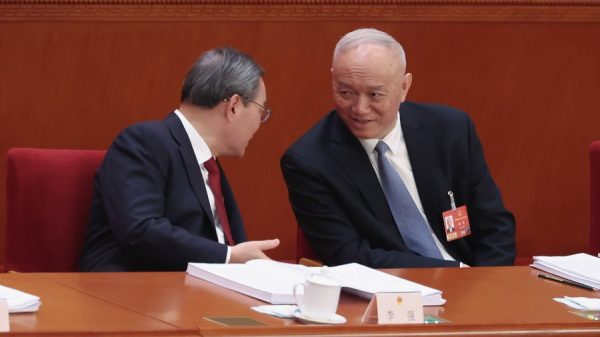
The day after the formal announcement, Cai Shenkun, a U.S.-based independent political commentator who tracks CCP personnel politics, reported on X that Chen Xi had been stripped of his vice-state-level status and demoted to sub-bureau level. Chen Xi had been a college classmate of Xi Jinping’s fifty years ago and, as head of the Party’s Organization Department for over a decade, had controlled senior cadre appointments across the entire system. A drop from vice-state level to sub-bureau level is five administrative grades, equivalent to the rank Chen Xi held roughly twenty-six years ago.
Cai Shenkun characterized the case against Chen Xi as political rather than one of corruption. As the official who oversaw cadre selection and promotion for more than a decade, Chen Xi had recommended and elevated a large number of officials, and Xi Jinping had concluded that many of them were politically unreliable.
Success
You are now signed up for our newsletter
Success
Check your email to complete sign up
The demotion, in Cai Shenkun’s reading, also darkens the prospects of Chen Xi’s protégés. Chen Jining, the Shanghai Party secretary who rose through Chen Xi’s patronage network via the Tsinghua University system, and Li Ganjie, the current head of the Party’s United Front Work Department, could both face further marginalization. Hu Heping, currently executive deputy head of the Party’s Propaganda Department, is likely at the end of his political road. With the 21st Party Congress on the horizon and a broader reshuffle already under way at the top, Xi faces a new round of power restructuring in which Chen Xi’s former clients have lost their principal protector.
Chen Xi’s punishment ranks below Qin Gang’s in the hierarchy of disgrace
Tang Jingyuan, a US-based commentator who analyzes CCP elite politics on his independent media program, argued that if the reported demotion to sub-bureau level is confirmed, Chen Xi’s punishment exceeds that handed to two other figures previously removed under Xi’s so-called anti-corruption campaign: Yang Jing, the former State Councilor who served as State Council secretary-general, and Qin Gang, Xi’s former foreign minister.
Yang Jing was removed in 2018 in what amounted to a political strike against former prime minister Li Keqiang, whose most trusted aide Yang had been. According to a Xinhua dispatch on Feb. 24, 2018, Yang received a one-year probationary Party membership suspension and was administratively dismissed, reduced to minister-level rank. He escaped further investigation, reportedly because Li Keqiang intervened on his behalf, and was eventually allowed to retire at full ministerial rank.
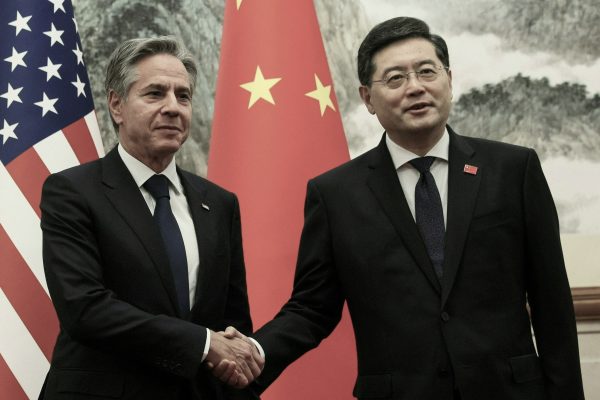
Removed as foreign minister in July 2023 and stripped of his State Councilor position in October of the same year, Qin Gang was, according to a March 8, 2026 report in Hong Kong’s Ming Pao, demoted from national leadership rank to vice-ministerial rank. A demotion to sub-bureau level would place Chen Xi below both men in the formal hierarchy of Party punishment.
Why Chen Xi was irreplaceable as Xi Jinping’s strategist
Tang Jingyuan argued that Chen Xi’s significance to Xi Jinping was unlike that of any other figure in the inner circle. Drawing on a conversation with a former CCP insider, Tang drew a sharp distinction between Chen Xi and the other two dominant figures in Xi’s faction: Cai Qi, who manages the Party’s day-to-day machinery, and Wang Xiaohong, who heads China’s police and security apparatus. Both are known for operating with ruthlessness. Neither has the theoretical depth or strategic capacity to think across the whole political chessboard. Chen Xi had that capacity. He was, in Tang’s characterization, a strategist rather than an enforcer, someone able to plan at the macro level.
Tang compared Chen Xi’s role to that of Wang Qishan, the former head of the Party’s top anti-corruption body, who served as Xi’s principal political fixer during his first term. Wang Qishan did not merely wield the disciplinary apparatus as a weapon; he devised the strategy that allowed Xi to consolidate power step by step. Precisely because Wang combined strategic intelligence with independent institutional weight, he eventually became a potential threat. After Xi secured his designation as the Party’s “core” leader at the 19th Party Congress in 2017, he began systematically dismantling Wang’s network and curtailing his influence.
Chen Xi shared Wang’s strategic intelligence but lacked the independent power base that made Wang potentially dangerous. Wang Qishan is a child of the revolutionary elite, with deep financial-sector connections running back to former prime minister Zhu Rongji, who elevated him; he came to Xi with his own loyalists, his own factional weight, his own territory. Chen Xi had none of that. His only patron, his only factional anchor, was Xi Jinping himself. That made him, in Xi’s eyes, more trustworthy than Wang, and he served accordingly as Xi’s chief confidant and primary strategic mind.
Before Chen Xi’s appointment, the Central Party School’s president had always been a member of the Politburo Standing Committee, the Party’s seven-member apex body. Chen Xi held the post as a mere Politburo member, one rank below Standing Committee level. That exception was a direct measure of the personal trust Xi placed in him.
The Central Party School as a political instrument
The Central Party School is the institution through which virtually every senior CCP official must pass for political training and periodic re-indoctrination. Its faculty are regularly brought into Zhongnanhai, the Party’s Beijing headquarters, to lecture the Politburo and advise the top leadership on policy and strategy. Controlling the school means controlling the intellectual environment in which the Party’s elite circulates and advances.
Every official seeking promotion must complete a course at the school. It therefore functions as a concentration point for political relationships, intelligence on internal alignments, and patronage networks spanning nearly every significant figure in Party politics. Chen Xi’s decade-long stewardship of that institution, in the service of Xi Jinping, was a structural advantage of the first order, and now it belongs to Cai Qi.

Party elders punish Xi’s civilian chief for the Zhang Youxia arrest
If figures like He Weidong, the former vice chairman of the Party’s Central Military Commission, and Miao Hua, the former director of the commission’s Political Work Department, represented the military pillar of Xi’s inner circle, Chen Xi was the head of its civilian pillar. His removal and five-rank demotion amount, in Tang’s analysis, to a deliberate public humiliation.
Chen Xi survived at sub-bureau level rather than being expelled from the Party or prosecuted because Xi Jinping intervened to cushion the blow. The soft landing was the maximum Xi could secure for his ally, and it was meant as a face-saving gesture directed at Xi himself.
The demotion also carries a deliberate signal aimed at Xi’s remaining loyalists: officials who fall in line, acknowledge the new power realities, and refrain from resistance can expect a degraded but survivable exit.
CCP elders consolidating power through an internal coordinating body have systematically dismantled Xi’s inner circle, beginning with the military. They stripped Xi of his military pillar first, removing He Weidong and Miao Hua. Now they have reached the head of the civilian pillar. The public degradation of Chen Xi is simultaneously a reprisal for his role in the arrest of Zhang Youxia, the former Central Military Commission vice chairman whose removal was engineered by the Xi faction.
Cai Qi, Chen Xi, and Wang Xiaohong were the three principal operatives behind that operation. The elders, Tang argued, may have concluded they cannot move directly against Xi himself and his wife, but they are methodically working through the three officials who made the Zhang Youxia arrest possible. Chen Xi was the second.