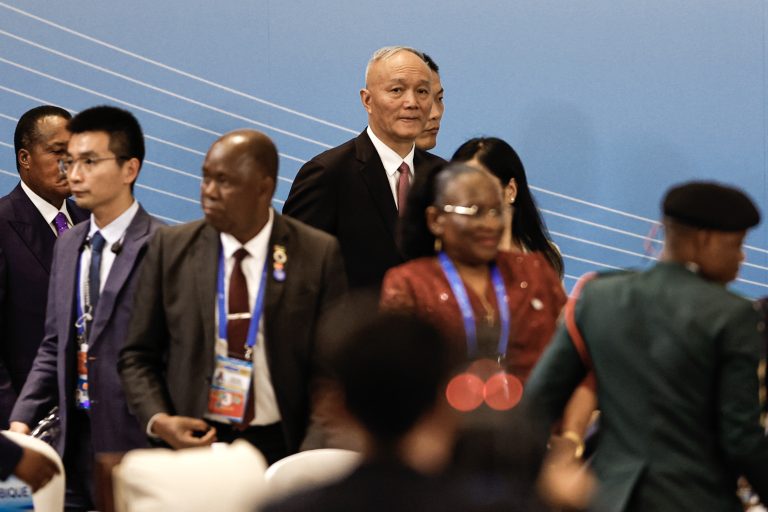
Cai Qi, a prominent Chinese leader made his first public appearance on June 5 in his new capacity as president of the Central Party School of the Chinese Communist Party, drawing widespread attention. The Central Party School is the CCP’s highest institution for training senior party cadres and thus helps shape the PRC’s future leadership as well as sustain its ideology.
Already a member of the Politburo Standing Committee of the Chinese Communist Party and holder of several key leadership positions, Cai’s assumption of another major role appears to be more than a routine redistribution of responsibilities. Instead, it is widely viewed as a carefully considered political appointment.
Personnel decisions at the highest levels of the Chinese Communist Party often reflect the top leader’s approach to selecting trusted officials as well as broader political concerns. The Central Party School has traditionally served as the CCP’s premier institution for training officials and reinforcing ideological discipline, and the selection of its president has historically followed established institutional and organizational practices. In recent years, however, a series of appointments has suggested that the position is being given a more direct political role.
Against the backdrop of the CCP’s current power structure, what does this appointment signify? Why did Xi Jinping ultimately choose Cai Qi for the position despite having a relatively broad pool of potential candidates?
Overseas political commentator Wang Youqun, in an article titled “Why Did Xi Choose Cai Qi as President of the Central Party School?“, argues that there are three main reasons for the appointment.

1. Xi has very few senior officials he truly trusts
Success
You are now signed up for our newsletter
Success
Check your email to complete sign up
Chen Xi—previously a member of the Politburo of the Chinese Communist Party, secretary of the Secretariat of the Chinese Communist Party, and president of the Central Party School of the Chinese Communist Party—stepped down from the Central Committee at the CCP’s 20th National Congress in 2022.
He no longer served as a Central Committee member, Politburo member, or Secretariat secretary, remaining only an ordinary Party member. Under normal circumstances, Chen would also have relinquished his position as president of the Central Party School, with the post expected to be assumed concurrently by Li Ganjie, the newly appointed Politburo member and head of the CCP’s Organization Department.
According to Wang, however, Xi did not trust Li Ganjie enough to give him the additional role. Instead, he allowed Chen Xi—described as one of Xi’s close confidants and Xi’s former roommate at Tsinghua University—to remain as president of the Central Party School despite no longer holding senior Party office.
Li Ganjie is regarded as a key member of Xi’s so-called “Tsinghua faction” and was reportedly recommended to Xi by Chen Xi. Li also served as Party secretary of Shandong, the home province of Xi’s wife, Peng Liyuan. As one of the youngest Politburo members and head of the Organization Department, Li oversaw the selection and appointment of senior Party officials. Wang argues that, under ordinary circumstances, Xi would be expected to place considerable trust in Li, but instead appears to have remained wary of him.
In April 2024, Li Ganjie and Shi Taifeng, then head of the CCP’s United Front Work Department, exchanged positions. Li became head of the United Front Work Department, while Shi assumed leadership of the Organization Department.
Wang notes that Shi Taifeng’s background would have made him a logical choice to concurrently head the Central Party School. After earning a master’s degree from Peking University in 1985, Shi was assigned to teach at the Central Party School, where he worked for 25 years. From 2001 to 2010, he served as executive vice president of the school for nine years before holding senior posts in Jiangsu, Ningxia Hui Autonomous Region, and Inner Mongolia Autonomous Region, and later serving as president of the Chinese Academy of Social Sciences.
Based on Shi’s résumé, Wang argues that after becoming a Politburo member and head of the Organization Department, Shi would have been the most suitable candidate to concurrently serve as president of the Central Party School. However, Xi also did not entrust him with the position, instead continuing to retain Chen Xi in the role.
By 2026, Chen Xi had remained president of the Central Party School of the Chinese Communist Party for nearly four years despite holding only ordinary Party membership, and at the age of 73. According to the article, keeping him in the post any longer would have appeared highly unusual.
Xi therefore began searching for a new president of the Central Party School. After considering candidates across the Party, he ultimately selected Cai Qi.
Cai Qi already holds numerous key positions, including membership in the Politburo Standing Committee of the Chinese Communist Party, first-ranked secretary of the Secretariat of the Chinese Communist Party, director of the CCP General Office, vice chairman of the Central National Security Commission, secretary of the Central and State Organs Working Committee, head of the Central Party Building Leading Group, and director of the Central Cyberspace Affairs Commission.
As the Politburo Standing Committee member responsible for propaganda and ideology, Cai oversees the CCP’s extensive propaganda apparatus. As the top-ranked secretary of the Secretariat, he oversees the administrative body serving the Politburo and its Standing Committee. As director of the General Office, he also manages the day-to-day operations of the Party leadership at Zhongnanhai.
The article argues that these three positions alone would constitute a full workload for Cai, who is 71 years old this year.
According to the author, Xi’s decision to appoint Cai as president of the Central Party School despite his already extensive responsibilities underscores how few senior officials Xi truly trusts.
Although Cai ranks fifth among the Politburo Standing Committee members, the author contends that by assigning him so many important posts, Xi has effectively elevated Cai to the position of the CCP’s de facto second-in-command. The article notes that the British magazine The Economist has likewise described Cai as the second most powerful figure in the Chinese leadership.
Formally, however, the CCP’s second-ranking leader is Li Qiang, a member of the Politburo Standing Committee and Premier of the People’s Republic of China. The author argues that Xi’s elevation of Cai to a de facto No. 2 role also reflects Xi’s lack of trust in Li Qiang.
The article concludes by asking whether Xi truly trusts Cai Qi. It argues that throughout CCP history, second-ranking leaders have rarely enjoyed the full confidence of the top leader because of their proximity to supreme power. Citing the Chinese saying, “Serving the ruler is like living beside a tiger” (伴君如伴虎), the author contends that top leaders have often feared that their deputies might attempt to seize power. Given Xi’s stated emphasis on safeguarding “political security”—which the author interprets as preventing challenges to his authority—the article asks whether Xi can genuinely be free of such concerns regarding Cai Qi.
The author argues that, given Xi Jinping’s reportedly suspicious nature, he is certain to harbor concerns even about close associates. According to the article, as Xi has moved toward greater centralization of power, he has come to see enemies everywhere, leaving him with very few people he truly trusts or considers reliable. As a result, the author contends, Xi has had little choice but to place even greater responsibilities on Cai Qi, whom he appears to regard as relatively trustworthy.
2. Cai Qi is the kind of ‘hardline enforcer’ Xi needs
The article claims that Cai Qi has a poor reputation within the CCP and is often described as a “harsh enforcer” (酷吏).
According to the author, the episode for which Cai is most widely criticized occurred during his tenure as Beijing Party secretary, when authorities expelled large numbers of migrant workers and low-income residents from the capital during the middle of winter in what became known as the “low-end population” (低端人口) clearance campaign.
On the evening of Nov. 18, 2017, a major fire broke out in Xinjian Second Village, Xihongmen Town, in Beijing’s Daxing District. The following day, Beijing’s municipal leadership, headed by Cai Qi, convened a citywide televised meeting to launch a campaign to inspect, clear, and rectify safety hazards.
At the meeting, Cai reportedly declared: “When you get to the grassroots level and to the actual sites, this is real combat. You have to meet the challenge head-on, be willing to confront problems directly, and solve them. If you don’t approach the work with this attitude, sooner or later a similar incident will happen again in your jurisdiction.”
He also reportedly warned that if a similar tragedy occurred again, “everyone will have to chop off their own hands,”an expression emphasizing strict accountability.
On Dec. 13, 2017, an open letter circulated online condemning Cai’s eviction campaign. It described the operation as sweeping in scope, harsh in execution, and unlawful, calling it “the worst administrative abuse in Beijing since the city’s founding 3,062 years ago.”
The letter accused Cai of deploying large numbers of armed police, security personnel, and urban management officers under a “bayonet-drawn” approach to demolish residents’ homes overnight in freezing weather while cutting off water, electricity, and heating. It alleged that these actions violated the CCP Constitution, China’s Constitution, and administrative law by infringing upon citizens’ property rights and personal freedoms. Declaring that “the facts are clear and the evidence overwhelming,” the letter called on Cai to “resign immediately to answer to the public.”
The article also cites Wang Yukai, a professor at the National Academy of Governance, who, in a letter responding to an inquiry from Xinhua News Agency’s Outlook Think Tank, reportedly wrote:
“Whether it was the forceful expulsion of migrants, the removal of storefront signs, or the hastily conceived coal-to-gas conversion policy, all reflected recklessness in public governance and bore obvious signs of administrative overreach.”
Wang reportedly recommended that the central authorities hold the Beijing municipal government accountable for these policy decisions.
According to the author, however, Cai Qi was not held responsible. Instead, he continued to rise through the Party ranks. The article concludes that Xi appreciated what it characterizes as Cai’s uncompromising style.
The author argues that while Cai Qi is known as a hardline enforcer toward subordinates, he is equally known for demonstrating loyalty to those above him.
At the 13th Beijing Municipal Party Congress in June 2022, then-Beijing Party Secretary Cai Qi delivered a report in which he praised Xi Jinping, saying:
“Scene after scene remains vivid before our eyes, and every instruction from the General Secretary still echoes in our ears. The General Secretary’s extraordinary strategic vision, foresight, and leadership style have deeply inspired us. His day-and-night concern and affection for the people have profoundly educated us…”
Cai went on to say that on the new journey ahead, “the one steering and guiding us is the Party’s core leader, General Secretary Xi Jinping,” and described Xi as “our backbone, the pillar that supports us, and the anchor that keeps us on course.”
According to the author, Cai’s effusive praise pleased Xi and is one of the reasons Xi has repeatedly promoted him.

3. Xi is preparing the personnel layout for the 21st Party Congress
The article argues that Xi is already preparing personnel arrangements for the 21st National Congress of the Chinese Communist Party, scheduled for the second half of next year, where he is expected to seek a fourth consecutive term as the Party’s top leader.
The Central Party School of the Chinese Communist Party serves as the CCP’s premier institution for training officials at all levels, from provincial- and ministerial-level leaders to county-level cadres.
Officials being considered for promotion are typically sent to the Central Party School for study, while those who have already been promoted also undergo centralized training there. As a result, the school functions as an important pipeline for identifying and developing senior Party officials.
According to the author, the president of the Central Party School is well positioned to observe officials from across the country during their training, assess their political loyalty and professional competence, and recommend suitable candidates to Xi. For that reason, the article argues, the identity of the school’s president is of particular importance to Xi.
At the 20th National Congress of the Chinese Communist Party, Xi Jinping elevated and promoted a large number of senior officials across the Party, government, and military. Yet shortly after the congress concluded, a series of political setbacks followed.
Beginning with Qin Gang—once regarded as one of Xi’s most promising protégés and the youngest member of China’s top leadership, serving simultaneously as a Central Committee member, State Councilor, and Foreign Minister—a succession of high-ranking Party, government, and military officials whom Xi had personally promoted either disappeared from public view, were removed from office, or came under investigation.
The wave of scandals and purges has raised questions about Xi’s ability to identify loyal and trustworthy personnel, leaving his leadership facing considerable embarrassment.
Against this backdrop, Xi’s decision to appoint Cai Qi as president of the Central Party School appears to carry a deeper political purpose. Beyond its traditional role in cadre education, Xi is likely counting on Cai to help identify, train, and cultivate a new generation of officials whose loyalty to Xi himself is beyond question.
In other words, the appointment may reflect an effort to prevent a repeat of the personnel failures that followed the 20th Party Congress, when many of the officials elevated by Xi later experienced what Chinese commentators have described as a “collapse in domino fashion”—a succession of political downfalls that undermined confidence in Xi’s personnel decisions.
The author concludes by arguing that China is a vast country with an exceptionally large pool of talented people—one that is rarely matched elsewhere in the world. In the author’s view, if China had a system for selecting and promoting officials that aligned with what the author describes as “the principles of justice and the will of the people,” it would never lack capable talent.
According to the author, however, during the 14 years since Xi Jinping came to power, he has progressively moved from consolidating power to centralized rule and then toward authoritarianism, while increasingly reverting to practices reminiscent of the Cultural Revolution. The author argues that Xi has become increasingly distrustful and, in practice, trusts no one completely. As a result, the pool of officials he is willing to select and promote has grown ever smaller, which, in the author’s view, ultimately explains his decision to appoint Cai Qi as president of the Central Party School of the Chinese Communist Party.