Many Westerners may not realize that one of China’s biggest crises is its population crisis. Clearly, the CCP knows this. Therefore, from some central party policies to the propaganda of numerous party media outlets, efforts are being made to encourage people to marry and have children. However, the Chinese are collectively unmoved. Single men, women, and families, as the cells of society, are facing an unprecedented crisis of trust. Then, what are the origins of this crisis?
First, let’s look at a growing phenomenon known as the “dry marriage,” sometimes described as a “roommate marriage.” The defining characteristics of this type of relationship typically include:
Strict financial separation. Finances are kept completely separate, household expenses are split evenly, and clear boundaries are maintained. The relationship functions less as a partnership and more as a practical living arrangement based on convenience.
Little meaningful communication. Beyond routine matters such as childcare, mortgage payments, and household bills, couples have little to discuss. When they are together, they are often absorbed in their phones or television, with almost no emotional interaction.
Emotional stagnation. Physical affection is rare, intimacy has faded, and even eye contact is often avoided. The result is an emotional void, with a widening sense of distance between partners.
Success
You are now signed up for our newsletter
Success
Check your email to complete sign up
This type of empty marriage has recently seen a surge in discussion among urban youth.
A survey conducted by the Shanghai Academy of Social Sciences in the first quarter of 2026 revealed a sobering statistic: in Shanghai, one in every six to seven couples aged 25 to 45 is in this “dry marriage” state, a staggering 15.1 percent. There’s no infidelity, no domestic violence, not even arguments, yet the marriage seems drained of all its vitality, leaving only an empty shell. This trend is rapidly spreading from Shanghai to the rest of the country. The rates in Beijing and Shenzhen are 13.3 percent and 13.5 percent respectively, while Guangzhou reaches 10.7 percent. Nationwide, the average proportion of this “marriage in name only” is approximately 6.8 percent, and it is spreading at a rate of nearly 8 percent annually.
Legally married, but living like familiar strangers, sharing the same marriage certificate yet leading parallel lives.
An overseas Chinese media outlet reported that a Shanghai white-collar worker once lamented online: “It feels like I’m working for my marriage: she and her husband split the mortgage payments, take turns ‘working’ at each other’s parents’ homes on weekends, and even pregnancy and childbirth felt like meeting KPIs, key performance indicators.” This marriage failed to nurture her growth, leaving only exhaustion and resentment.
Competing interests
Under economic pressure, Chinese people have begun to carefully calculate. Many young people who haven’t entered into marriage have the option of not marrying; those who have chosen marriage prioritize their own interests over those of the entire family.
For those who enter into marriage, high housing prices and high divorce costs are the core root causes of “dry marriages.” In first-tier cities like Shanghai, a 90-square-meter condo typically costs between $750,000 and $1.2 Million. The down payment drains the savings of two generations, and the mortgage accounts for 40 percent to 60 percent of the family’s monthly income, with a repayment period of up to 30 years. For ordinary working-class families, divorce is no longer a simple emotional separation, but a devastating economic catastrophe.
The couple lives under the same roof, yet in separate rooms; zero physical contact becomes an unspoken understanding. Daily communication is reduced to just children, mortgage payments, and utility bills; even a sweet word becomes a luxury, and concern is tinged with polite distance. They strictly adhere to a split-the-bill system, managing their salaries separately and keeping household expenses meticulously accounted for. They are undisturbed by each other. After work, one spends time in the living room scrolling on their phone, while the other hides in the bedroom playing games. Despite being the closest legally, they live like roommates.
Especially in Shanghai, even young couples become accustomed to meticulous budgeting. They essentially turn their marriage into a business partnership, using a shared calendar to schedule housework, and Excel to calculate expenses, eliminating all uncertainties except for those for their relationship.
Another reason for the phenomenon of “dry marriages” emerging in Chinese cities, that is largely driven by the excessive exploitation of employees by Chinese companies. The “996” work schedule has been touted in China’s internet industry for years, but few companies have truly fixed it. Finance, real estate, and new energy industries are practically draining their employees. Couples come home, collapse on the sofa, and don’t even want to talk, let alone nurture their relationship.
On the Chinese internet, some bloggers claim that “The China Marriage Quality Report (2024)” indicates that the average daily face-to-face in-depth communication time for Chinese couples has decreased by nearly 40 percent compared to 2020. More specifically, 67 percent of couples have less than 10 minutes of truly meaningful emotional communication each day. Dual-income couples have an average of only 12 minutes of truly effective communication time each day, mostly revolving around trivial matters.
Men are worn down by their bosses at work, and then they are required to provide emotional support to their wives at night—not many could handle that.
These chaotic phenomena in Chinese marriage and relationships have deep social roots: under the deliberate guidance of the CCP, the norms of traditional Chinese family culture have been broken. Basic human relationships and morals are constantly being pushed to the limit. Traditional concepts of marriage, love, and family affection are all shattered. The CCP’s internet and its films and television dramas teach women how to profit from marriage. Many Chinese women view marriage as a highly profitable business deal, expecting men not only to provide financial security but also emotional support.
Similar stories are common on China’s Douyin
Similar stories and comments abound on Douyin, a Chinese video platform. “Many women are single not only because of toxic motivational quotes, but also because of current TV dramas. Many TV dramas are about ‘a domineering CEO falling in love with an ordinary me,’ ‘a domineering CEO falling in love with a brain-dead me,’ ‘a domineering CEO falling in love with an older me,’ ‘a domineering CEO falling in love with a divorced me,’ ‘a domineering CEO falling in love with a mother of two,’ ‘a domineering CEO falling in love with a menopausal me,’ ‘a domineering CEO falling in love with a person with Alzheimer’s.’ This isn’t a domineering CEO, this is a brain-dead CEO! Wake up!”
Another account named “Honghe Prefecture Lele Says” said, In a video, “Starting in 2010, Valentine’s Day, Qixi Festival, May 20, May 21—these romantic holidays became incredibly popular. Boys buying gifts for girls on these holidays became standard practice. Whether the gifts were expensive or good became a topic of conversation among girls. Gradually, many women prioritized spending over relationships, looking for a partner based primarily on their financial situation.”
A man who appears to be a marriage matchmaker says in the video, “One of my clients, a 1995-born girl from Northeast China, 168cm tall, has a face that would rank in the top three at any matchmaking agency in Shanghai. She told me, ‘I really believe in fate and love’, but she’s only willing to meet elite men with assets of over 30 million, and even some wealthy middle-class men. ’’
The blogger said this young woman went on a lot of blind dates, but either she didn’t find the other person attractive, or they thought she was too materialistic, so none of them worked out. The blogger lamented that young women shouldn’t be overly idealistic when choosing a partner, nor should they waste their precious youth on repeated selections.
Chinese Confucian tradition places great emphasis on family. Under the conscious promotion of the CCP, money has become the sole measure of your worth. Traditional family values in China are crumbling.
In the eyes of the younger generation, “dry marriage” isn’t even considered shameful. Not getting a divorce is already a great achievement; they’ve already been very responsible. When Gen Z talks about this topic, their frank attitude makes the older generation shake their heads. In their view, marriage is simply a life mission, something to complete; whether there’s love or compatibility is left to fate. The meaning of traditional marriage models is no longer understood by these young people. The narrative of love above all else has faded in the face of high housing prices, intense internal competition, and high uncertainty, becoming a luxury.
Skyrocketing divorce rates
An account named “Amateur Feng Xiaoman” complained on Douyin, “Can you believe that people in their twenties and thirties are getting divorced en masse? You think it’s because they can’t get along? Wrong! It’s because they’ve run out of money from their parents.
What’s the marriage model for young people these days? The groom’s parents empty their life savings to make a down payment on a house and borrow money for the bride price. The bride’s parents, on the other hand, use their retirement savings to prepare the dowry and pay for the wedding ceremony.
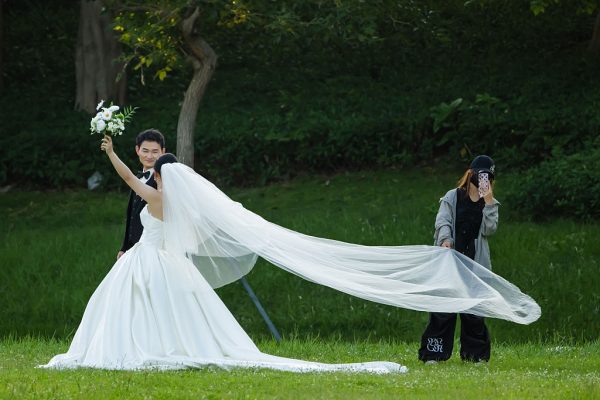
What do the two young people do? Nothing. They wash their faces, put on makeup, walk the ceremony, take tens of thousands of yuan worth of wedding photos, strike a few arrogant poses, and with both sets of parents exhausted from running around, the wedding is considered over.”
The blogger says that many young people today simply don’t have the concept of “responsibility” in their minds. After getting married, the young couple finds they have a condo, a car, and two or three hundred thousand yuan in savings. They didn’t realize the weight of this sum—it is their parents’ hard-earned money, painstakingly earned on an assembly line.
But all they think about is whether to go to the Maldives or Sanya for a vacation. When the money ran out, even food became a problem, and that’s when conflicts arose: arguments, cold wars, and even divorce. She lamented that this was the reality for many young couples.
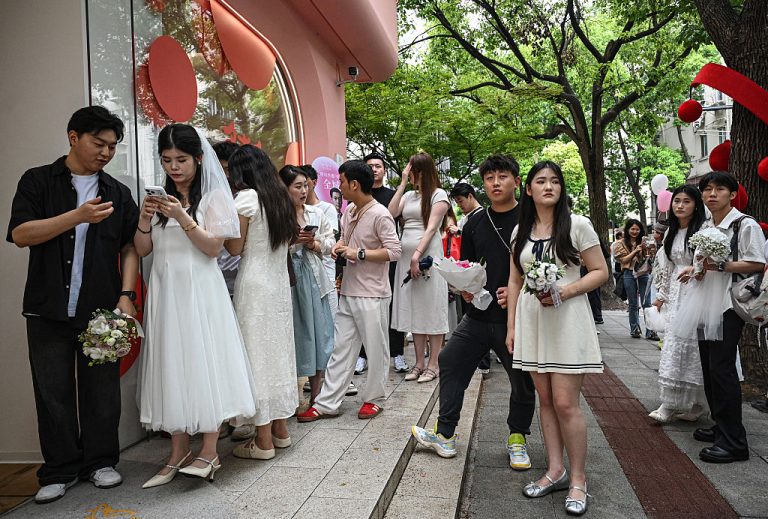
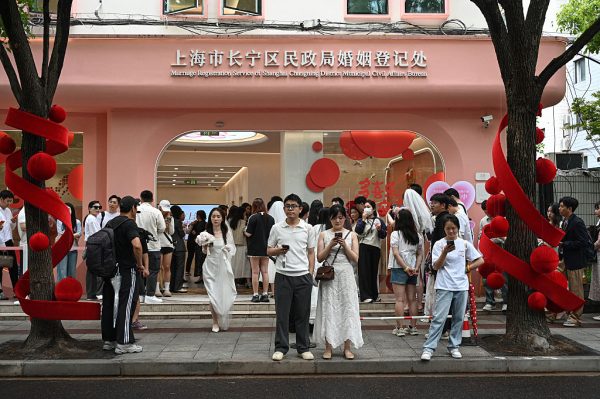
Data released by China’s Ministry of Civil Affairs on May 9 this year showed that in the first quarter of 2026, 1.697 million couples registered for marriage nationwide, a decrease of 113,000 couples compared to the same period last year, a drop of 6.24 percent.
According to the China News Agency (CNA), this figure is the lowest level for the same period since records began in 2013, indicating that even during the peak wedding season, the willingness of young Chinese people to marry remains low. Nowadays, Chinese people are used to seeing news like this: older leftover women in cities can’t get married, and bachelors in rural areas can’t find wives.
After peaking in 2013, the number of marriages in China has been declining steadily since, from 13.469 million couples in 2013 to 6.835 million couples in 2022. On the other hand, in the first quarter of 2026, 622,000 divorces were registered nationwide in China, roughly the same as in recent years. This widening gap between marriage and divorce registrations highlights the demographic pressures currently facing China.