A beam of light shoots up from a thundercloud and darts across the sky as if it were alive. Months later, over a frozen polar winter, a sheet of cloud glows with the soft sheen of mother-of-pearl. Both look like special effects. Both are real, and most people will never see either one.
Crown flash: a light show above the storm
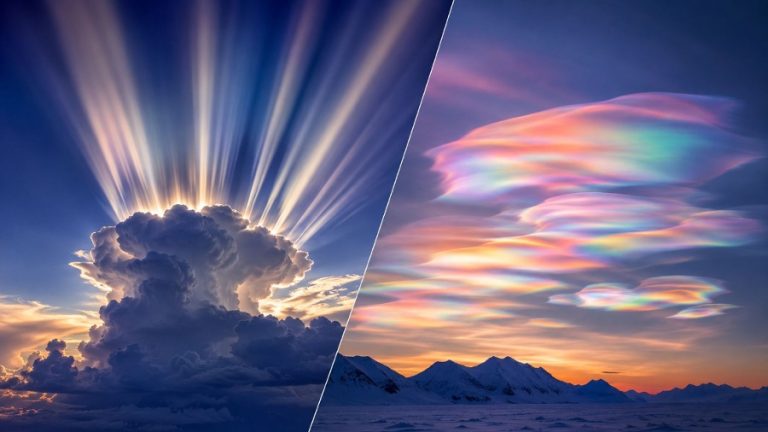
Crown flash is one of the rarest sights in the sky. It appears near the top of a cumulonimbus cloud, the tall, anvil-shaped storm cloud that brings thunder and lightning.
Straight or slightly curved beams of light shoot upward from the cloud, looking like searchlights or streaks of aurora. They do not hold still. Within seconds they swing, shift, and change shape, darting across the sky as if a switch were being flipped on and off.
The cause is tiny ice crystals sitting above the storm. Sunlight bounces off them, which is what makes them visible. The storm’s powerful, fast-changing electric field keeps forcing the crystals to line up in new directions. Every time the cloud charges up or throws a lightning bolt, the crystals snap into a new position and the beams appear to leap.
It even has a nickname: the “leaping sundog.” A regular sundog is the bright spot you sometimes see beside the sun. Crown flash is different in one key way. It flickers and moves within seconds, and it sits right above the storm rather than off to the side.
Success
You are now signed up for our newsletter
Success
Check your email to complete sign up
Good records are scarce. The first scientific description dates to 1885, Nature noted it twice in 1971 (here and here), and it stayed obscure until someone posted video online in 2009. Clips have surfaced from around the world ever since.
Nacreous clouds: pearls that glow after dark
Where crown flash is gone in seconds, nacreous clouds put on a slow show that can last most of an hour.
They form only over the winter poles, extremely high up, around 15,000 to 25,000 meters (50,000 to 82,000 feet). That part of the atmosphere is so dry that clouds almost never form there, which is what makes these so rare. Sky watchers in Scandinavia, Iceland, Alaska, and Antarctica are among the few who catch them.
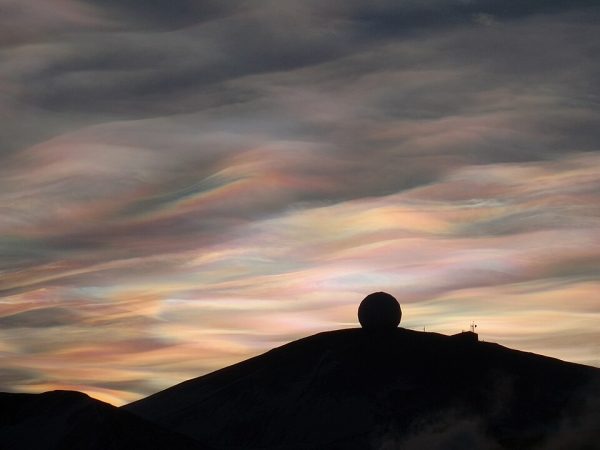
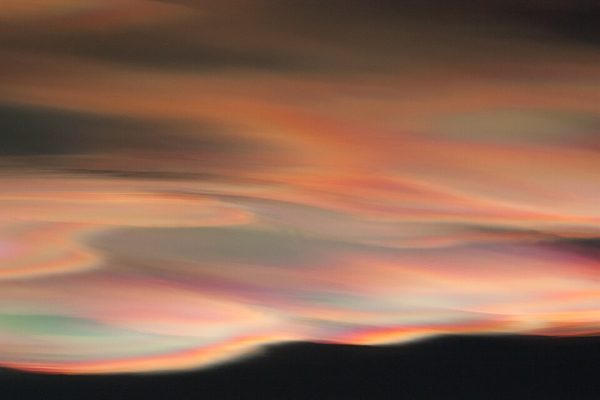
The best time to look is just before dawn or just after sunset. The sun has already dropped below the horizon for people on the ground, but these clouds are so high that they still catch its light and reflect it back down. Against a dark sky, they glow. When the cloud is thin, the light splits into soft pinks, greens, blues, and violets, like a giant pearl overhead.
The classic nacreous cloud is made of pure water ice, and it produces the brightest colors. A related, more layered type also forms up there and plays a part in ozone loss, but it is the icy kind that gives the famous pearly glow.
These clouds need brutal cold to form, so they show up more often in the Antarctic winter than in the Arctic. Farther north it usually takes an extra push, like the waves of air that rise over mountains and chill the upper atmosphere a little more. That rarely lines up, which is why a sighting is such a prize.