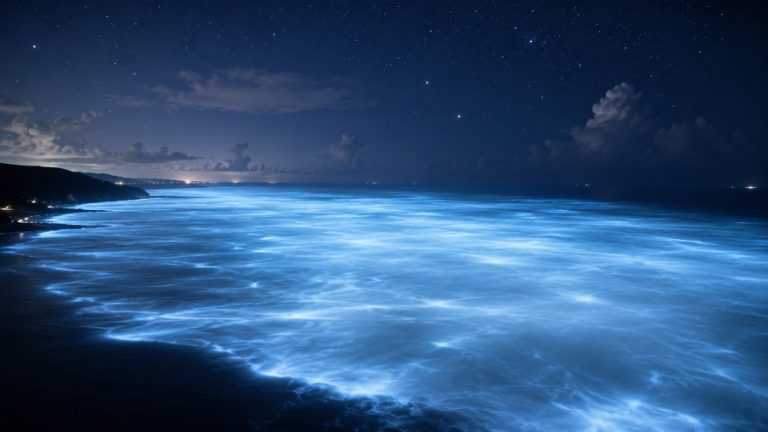
Ask anyone who has witnessed a milky sea and the story is remarkably similar. A moonless night. Water darker than the sky. Then, without any change in the wind or weather, the entire ocean begins to glow with a soft, pale light that stretches to every horizon and lasts until dawn.
This is not the familiar blue sparkle left by breaking waves or a ship’s wake. Nothing flashes or flickers. The light appears steady, as though the sea itself has become luminous.
Sailors have described this phenomenon for more than 400 years, yet for much of that time many scientists remained skeptical. The earliest surviving account comes from Captain William Keeling of the British East India Company, who encountered one off the coast of Somalia sometime between 1615 and 1617. Mistaking the glowing water for a shallow sandbank, he ordered a sounding line dropped—only to discover there was no bottom.
Today, those centuries-old reports have been vindicated. Modern satellites have repeatedly detected these mysterious glowing seas, and a database compiled from more than 400 historical and modern observations has narrowed the search enough that researchers believe the phenomenon may eventually become predictable.
The phenomenon is known as a milky sea, and one characteristic sets it apart from every other form of marine bioluminescence: its extraordinary scale. One event detected south of Java in 2019 covered roughly 100,000 square kilometers—about the size of South Korea—and remained detectable for more than six weeks across two lunar cycles.
Success
You are now signed up for our newsletter
Success
Check your email to complete sign up
Scientists believe luminous bacteria are the most likely cause for milky sea
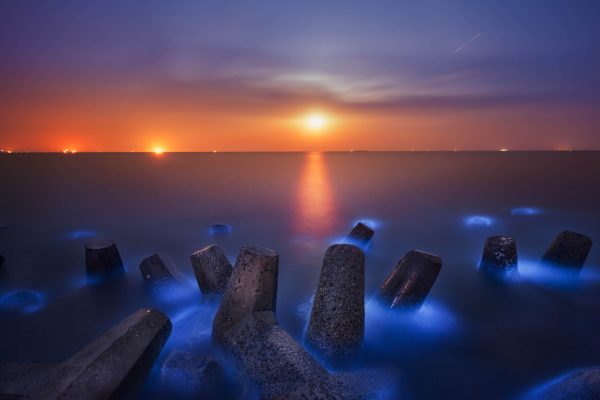
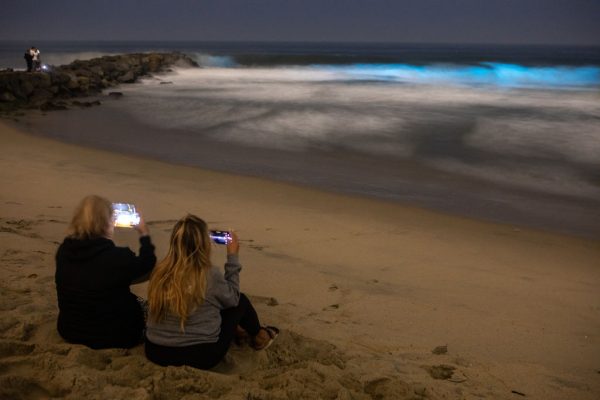
Most people have seen a much smaller form of ocean bioluminescence. Blue flashes appear beneath footsteps on wet sand or trail behind breaking waves. That glow comes from tiny plankton called dinoflagellates, which emit light only when disturbed. Once the water becomes still, the flashes disappear.
A milky sea behaves very differently. The light remains steady even on calm, glasslike water.
The strongest evidence for its cause came largely by chance. In July 1985, a research vessel crossing the western Arabian Sea sailed directly into a milky sea while carrying equipment capable of sampling the water. Scientists found enormous concentrations of Vibrio harveyi, a marine bacterium capable of producing its own light. No research expedition has successfully sampled another confirmed milky sea since then, making that single encounter the foundation of much of today’s understanding.
Although scientists regard luminous bacteria as the leading explanation, they caution that the evidence is still indirect because no comparable field samples have been collected in the decades since.
The biology behind the glow is equally remarkable. Individual Vibrio harveyi bacteria do not shine continuously. Instead, they monitor the density of neighboring bacteria through chemical signaling. Only when the population reaches a critical concentration do they switch on their light simultaneously—a phenomenon known as quorum sensing.
Creating a glow visible from space would require roughly 10²² bacteria, an almost unimaginable number working in perfect synchronization.
READ MORE:
- A Century of UFO Sightings in Albania, From Mountain Guerrillas to Fighter Jets
- ‘The Third Eye’ Mystery Rekindled By New Brain Research
- US Declassified UAP Files Reignite Mystery Over Unexplained Aerial Phenomena
Satellites transformed sailors’ stories into scientific evidence
Colorado State University atmospheric scientist Steven Miller wondered whether one sailor’s report could be matched with satellite observations.
His test case came from the SS Lima, a British merchant ship that crossed a milky sea off Somalia in 1995. When Miller examined archived low-light satellite images, he found a glowing region almost exactly where the ship’s crew had reported it. The illuminated area covered approximately 15,400 square kilometers and persisted for three nights. The findings were published in the Proceedings of the National Academy of Sciences in 2005.
Improved satellite instruments later revealed many more events. Miller and his colleagues documented 21 confirmed milky seas between 2012 and 2021, including the enormous 2019 event south of Java. By coincidence, a private yacht named Ganesha sailed directly through that event without realizing what it had encountered. After returning to port, the crew’s photographs became the first known images taken from within a confirmed milky sea, matching satellite observations night for night.
Satellite images often make the phenomenon appear white, but the light itself is actually blue. Marine biologist Steven Haddock, a co-author of the 2005 study, has explained that Vibrio harveyi naturally emits blue light. Satellites record only brightness rather than color, while human vision under extremely dim conditions relies primarily on rod cells, which detect light intensity but have little ability to distinguish color.
A database of more than 400 sightings may eventually make milky seas predictable
The most ambitious recent research did not begin at sea but in the archives.
Justin Hudson, a doctoral researcher at Colorado State University, reconstructed the historical record by combining centuries of ship logs, mariners’ journals, published accounts, and modern satellite observations into a database containing more than 400 reported sightings dating back to the early seventeenth century.
The resulting map revealed a striking pattern. Nearly 60 percent of all recorded milky seas occurred in a relatively small region of the northwestern Indian Ocean near Somalia and the Yemeni island of Socotra.
Statistical analyses suggest that the appearance of milky seas is linked to large-scale climate patterns such as the Indian Ocean Dipole and El Niño, which influence sea surface temperatures, ocean circulation, and nutrient availability. When these conditions align, researchers believe the chances of a milky sea increase.
That finding raises the possibility that one day the phenomenon could become forecastable. Such forecasts would save enormous amounts of time and money because milky seas occur far from shore and may not appear in the same region for many years. Without guidance, research vessels can spend weeks searching empty ocean.
Scientists are interested for reasons that extend beyond the spectacle. Vibrio harveyi is a well-known pathogen in marine aquaculture and has been responsible for disease outbreaks affecting shrimp and fish farms around the world. Milky seas also tend to occur in productive fishing grounds, leading researchers to investigate whether these events influence marine ecosystems or commercial fisheries. At present, however, no direct connection has been established.
More than four centuries after Captain William Keeling lowered a sounding line into glowing water and found only deep ocean beneath it, many questions remain unanswered. The difference today is that scientists no longer doubt the phenomenon exists—and, for the first time, they have a much better idea of where and when to begin looking for it.