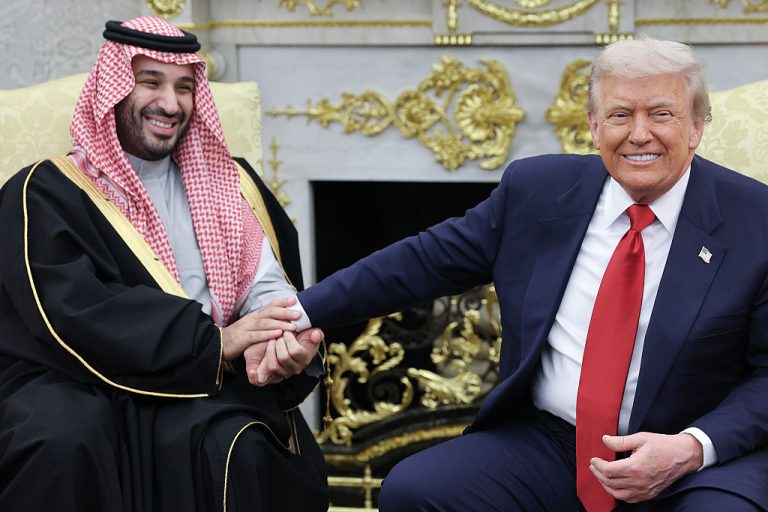
The US and Saudi Arabia signed a decade-long, multi-billion dollar peaceful nuclear agreement called the “123 agreement” along with a bilateral safeguards agreement on Wednesday, July 22. The deal was inked between U.S. Secretary of Energy Chris Wright and Saudi Minister of Energy. His Royal Highness Prince Abdulaziz bin Salman.
“These agreements reflect our two nations’ shared commitment to strengthening U.S.-Saudi commercial relations, delivering prosperity at home and security to our allies abroad,” Wright said in a statement on Wednesday.
Experts told Vision Times that the signing of the agreement in the midst of the U.S.–Iran war while the two sides have repeatedly failed to reach a peace deal sends a strong message to Iran about the stakes of US and its allies in the Gulf.
“In politics, timing is always a critical factor, and there are no doubts that the Trump Administration was determined to send a signal to Iran with the signing of a ‘123 agreement,’” said Joseph A. Kéchichian, a noted author and a senior fellow at the King Faisal Center for Research and Islamic Studies in Riyadh, Saudi Arabia.
“Washington telegraphed its intentions to Tehran that any Iranian efforts to continue with the quest to acquire a military nuclear capability—and thereby dominate the Arab Gulf region—would be ‘balanced’ with the presence of similar nuclear capabilities in the Kingdom of Saudi Arabia.”
Success
You are now signed up for our newsletter
Success
Check your email to complete sign up
Two days after the signing of the U.S.–Saudi nuclear deal, the Saudis launched air strikes on Iranian backed Houthi targets in the Yemeni port city of Hodeida and a nearby island on July 24 and in retaliation Houthis claimed a missile attack on the Saudi state oil giant Aramco in the coastal cities of Jizan and Yanbu the following day.
The Houthi movement controls the majority of northern and western Yemen, including its capital, Sanaa. Escalation between Saudi Arabia and the Houthis came after 13 consecutive nights of the renewed U.S. attacks on Iran.
The Saudi administration said in an official release issued by the Saudi Press Agency on Thursday that the nuclear agreement builds on the historic strategic partnership between Washington and Riyadh. It also follows the announcement made during last year November’s visit of bin Salman to the U.S. which had concluded the bilateral negotiations on the peace deal.
The “123 agreement” builds on the bilateral cooperation in energy and advanced technology sectors.
Analyst Burzine Waghmar, a member of the Centre for Iranian Studies, School of Oriental and African Studies (SAOS), London told Vision Times in an email that the US-Saudi nuclear agreement is a corrective force to the ongoing US-Iran war.
“Riyadh spent years threatening to bypass Washington to buy nuclear technology from Russia’s Rosatom or China’s CNNC [China National Nuclear Cooperation]. Washington pushed the deal through now to lock in American companies (like Westinghouse) for the next 30 years and retain regulatory oversight,” Waghmar said. “It is definitely a counterweight to the ongoing US-Iran war.”
Saudis allowed to enrich their own uranium
While the nuclear deal aligns with Prince bin Salman’s Vision 2030 economic diversification strategy and initiates the establishment of greater independence from U.S. security guarantees — the biggest discussion it has raised during the persisting U.S.–Iran war is whether Riyadh will eventually enrich its own uranium and develop the capability to build a nuclear weapon, potentially triggering a regional arms race.
The question of uranium enrichment has gained prominence because of Iran’s longstanding pursuit of uranium enrichment and its disputed nuclear ambitions. Kéchichian said the agreement is intended for peaceful energy generation and that Saudi Arabia plans to rely on its domestic uranium deposits to develop a civilian nuclear fuel cycle. However, he added that if Iran were ever to acquire a nuclear weapon, Riyadh would likely pursue one as well.
Kéchichian, who studies Saudi strategic thinking, said it is technically feasible for Saudi Arabia to enrich uranium domestically and eventually develop a nuclear weapon. However, he added that if such a scenario were ever to arise, “various safety measures will be adopted to effectively control fuel production cycles.”
“There is no mystery that Heir Apparent Muhammad bin Salman is on the record for stating that Saudi Arabia would acquire nuclear weapons … but only if its regional primary rival, Iran, acquired it first,” he said.
RECENT COVERAGE
- Iran Exported $6 Billion Worth of Oil to China During Truce via Ship-to-Ship Transfers: Report
- Trump Accuses China of 2020 Election Interference; Expert Cites Prior Documentation of Beijing’s Cyber Intrusions
- Japan’s Intelligence Reform Linked to 2022 National Security Strategy: Experts
Waghmar said Washington’s decision to allow Riyadh to enrich its own uranium would establish a new precedent in global nuclear energy policy. Historically, he said, the United States pursued a “gold standard” for civilian nuclear agreements, such as its 2009 deal with the United Arab Emirates, which prohibited domestic uranium enrichment. Saudi Arabia, however, “flatly” rejected that condition, and the Section 123 agreement was ultimately signed after the Trump administration agreed to a framework allowing a two-year study of a U.S.-monitored enrichment facility on Saudi soil.
“For decades, U.S. non-proliferation policy relied on Section 123 of the Atomic Energy Act to enforce a strict rule: if a country wanted U.S. nuclear technology, it had to legally renounce domestic enrichment and reprocessing [1] (as the UAE did in 2009). By bypassing this rule for Riyadh, Washington can no longer credibly demand it from others,” he said, emphasizing that future U.S. partners will illustrate the “Saudi precedent” to seek their own enrichment rights. He said this will severely weaken the American non-proliferation leverage.
According to Waghmar, Saudi Arabia’s determination to develop its uranium resources and establish a complete domestic nuclear fuel cycle is not solely an economic objective but also a long-term national security strategy.
“In the nuclear world, possessing domestic enrichment infrastructure means a state has achieved latent nuclear capacity,” he said. “If a future geopolitical crisis causes Riyadh to break the treaty, it would only be a short technical step away from enriching that same domestic uranium to weapons-grade levels.”
Trump: Agreement conditional on Israel ties
After the signing of the agreement, President Donald Trump wrote on his Truth Social that the success of the “123 agreement” will rely on Saudis recognizing the State of Israel. However Kéchichian quoted a Saudi official in exclusive statements made to him denying any negotiations of that nature.
Trump wrote on his Truth Social account on July 23:
“The Civil Nuclear Deal (There will be no enrichment of material!)… which pertains only to non-military use… will be approved, but is totally subject to Saudi Arabia joining the very respected and successful Abraham Accords.”
Kéchichian said Riyadh would not recognize Israel unless it committed to the creation of an independent Palestinian state. He noted that bin Salman has repeatedly expressed support for establishing diplomatic relations with Israel but has also maintained that recognition is not possible without “a credible and irreversible path to a Palestinian state.”
He emphasized that there is nothing in the U.S.–Saudi agreement about any such condition demanded by the Trump administration.
“In the words of a reliable senior Saudi official ‘there is nothing to renegotiate.’ Beyond usual Washington theatrics that will entertain global audiences for months if not years, the deal will most likely go through, as long as 27 senators approve it, since only a two-thirds majority in the Senate can cancel a presidential veto,” Kéchichian said.
Waghmar said that Riyadh cannot appear to aspire for normal relations with Israel while the entire Gulf region is embroiled in conflict.
“It would create a dent in the Kingdom’s and MBS’s prestige as the House of Islam. Saudi analysts believe Trump is using this public demand as political cover to appease Israel and neutralize fierce domestic opposition,” he said.
The statutory process under Section 123 of the U.S. Atomic Energy Act of 1954, which determines major U.S. civilian nuclear cooperation agreements with foreign countries, makes it mandatory for any deal to face a 90-day congressional review period.
Waghmar said lawmakers from both the Republican and Democratic parties “are horrified” by the prospect of the United States helping Saudi Arabia establish a domestic uranium enrichment capability.
“Analysts note that Trump’s post claimed there would be ‘no enrichment of material’ under the deal, directly contradicting his own Energy Department’s framework. Riyadh interprets this as a sign that Trump may not fully understand the technical nuances of the deal his team negotiated or is intentionally obfuscating them to manage U.S. media blowback,” he said.