Published with permission from LuxuryWeb Magazine
In the heart of the Mediterranean Sea — south of Sicily, north of Libya, and east of Tunisia — lies Malta, a small archipelago with a 7,000-year-old history evidenced by stunning ancient structures. The first people to arrive on the Maltese Islands were thought to come from southern Sicily, its closest neighbor.
However, the megalithic structures and artifacts unearthed by archaeologists bear no resemblance to Sicilian culture. This raises questions about the true origins of these Neolithic travelers. Whether this mystery will be unveiled in our lifetime remains to be seen, but all who visit Malta and marvel at these ancient creations cannot help but be awed by the legacy left behind.
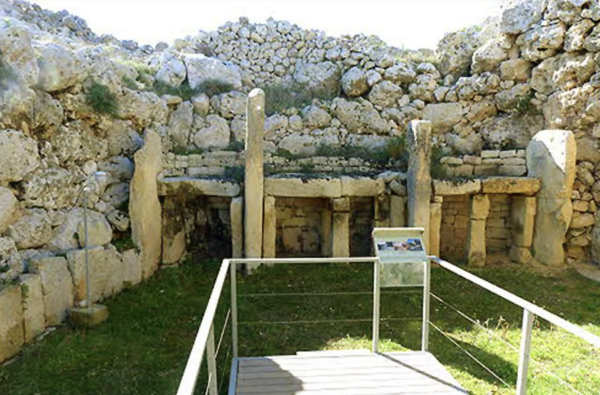
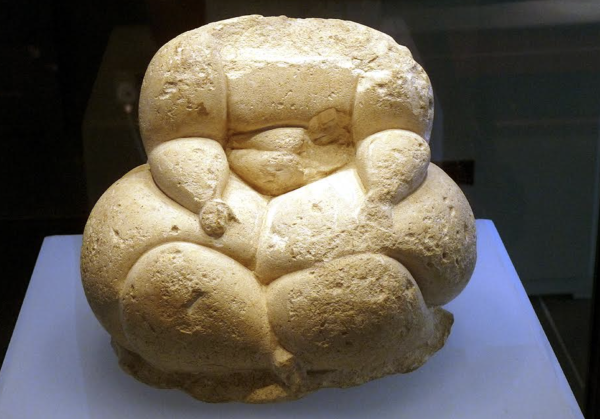
Considered one of the oldest surviving free-standing structures in the world, the Ġgantija megalithic temple site is on Gozo, the second island in the archipelago, dating back to about 3,800 BC. Local legend claims a female giant built it. From the artifacts found, it is possible to deduce that the temple complexes on both Gozo and the main island of Malta were dedicated to the Goddess of Fertility, though their exact beliefs remain shrouded in mystery.
RELATED: Celebrating Robert Burns: A Night of Tradition, Scrumptious Eats, and Poetry
Success
You are now signed up for our newsletter
Success
Check your email to complete sign up
While Ġgantija is the oldest UNESCO World Heritage site in Malta and the first to be rediscovered in modern times, it has not yet revealed all its secrets. Ongoing excavations constantly unearth new information, which may one day disclose who these people were and what they believed. The Maltese have taken great care to protect their national treasures, and all the megalithic sites are well-organized for visitors.
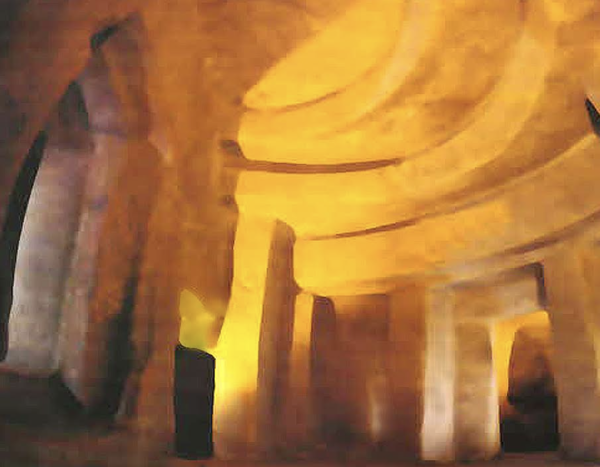
The Ħal Saflieni Hypogeum on the Island of Malta is the only known example of a subterranean structure from the Bronze Age. Due to its underground location, access is limited and must be arranged in advance. Unlike other catacombs, it is a fascinating city of the dead, constructed with pathways and chambers, and at the center, a large vaulted cathedral-like room—all carved underground. The ceiling in the cathedral features a series of ascending carved circles, while the passageways are adorned with red ochre spiral paintings.
The stones show no evidence of how the area was illuminated or any signs of smoke or fire from torches. How did these ancient people create such intricate architectural details without light? Recent evidence suggests that when sound is introduced, possibly from drums or flutes, the room vibrates at a specific tone that can alter consciousness. Human bones and votive figurines of the Fertility Goddess have been unearthed, but the bones were heaped there after decomposition, adding to the mystery.
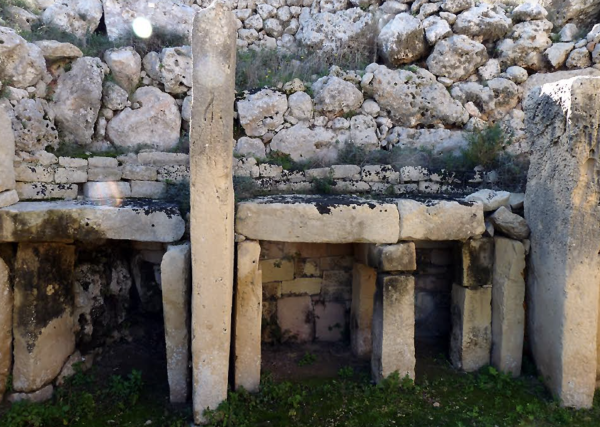
My schedule did not permit visiting all 20 megalithic temples discovered so far, but I did visit Ħaġar Qim (pronounced jar im). The site is extensive and well-defined, almost evoking the presence of the people who built and used these structures. Constructed from naturally honey-tinted limestone native to the islands, their purpose remains unclear.
Ħaġar Qim was built on a ridge overlooking the sea to the south and a broad plain to the north, an effective defensive position more suited to a settlement than a temple site. All of the “temples” were built from the native limestone, a soft porous rock used in both ancient and modern construction. It is a mystery why a relatively small population would expend so many resources to build such an extensive temple complex.
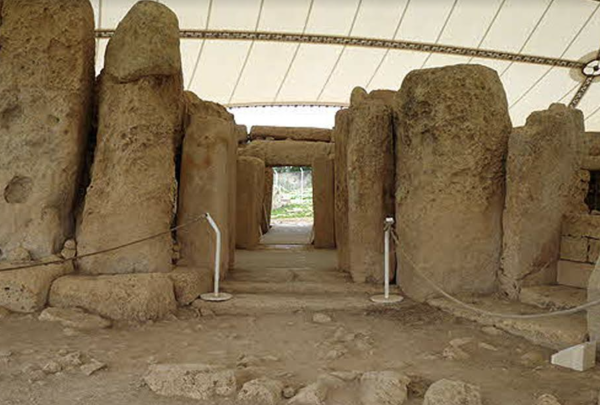
The mystery deepens with Mnajdra, another “temple complex” located less than 500 meters down the hill to the west. Excavations have unearthed decorated clay vessels, flint tools, and a representation of a human head fashioned in clay, but no evidence of habitation. Both sites are referred to as an Archaeological Park and are accessed after passing through a museum featuring an informative video and many artifacts.
Construction of these temples ceased around 2500 BC, and the temple builders mysteriously disappeared, leading to the theory that the islands were considered sacred and used only for worship and religious practices by prehistoric nations. This could explain the numerous temple complexes, but since stone cannot be carbon-dated, we do not know when these structures were created or by whom.
There is no evidence of a natural catastrophe that damaged the sites, so it is conjectured that they were abandoned due to changing religious beliefs, war, or climatic changes, as happened with many ancient populations.
Once the temple builders departed, other cultures quickly occupied Malta. The modern Maltese cultural mosaic is enriched by the diverse influences of the Phoenicians, Greeks, Romans, Arabs, Castilians, the Knights of St. John, the French, and the British. All have left their mark with monuments, works of art, religious beliefs, language (with English as the second official language after Maltese, which is Semitic in origin), agriculture, and cuisine.
For more information, please visit: visitmalta.com or tourism.gov.mt.
Visit LuxuryWeb Magazine to see the original article and more.