Markets around the world have reacted strongly to Trump’s re-election as U.S. President on Nov. 5 and expectations that he will continue the “America First” agenda of his first administration (2017–2021) upon resuming office in January.
The three major U.S. stock indices all hit record highs; Japan’s Nikkei average rose by more than 2.5 percent, and European markets gained 0.9 percent. The dollar index, which measures the strength of the U.S. dollar against other currencies, climbed 1.4 percent. Additionally, Bitcoin surged significantly as Trump had previously expressed support for the cryptocurrency.
Trump’s return to the White House is likely to have great impact on the mainland Chinese economy, which has been struggling with a long-term deflationary trend and growing unemployment since the beginning of the novel coronavirus pandemic.
- Desperate Times: China’s Youth Take to Social Media to Lament Skyrocketing Unemployment
- Night Biking Becomes China’s Latest Youth Craze, Sparking Excitement and Concerns
The first Trump administration’s approach to China included imposing tariffs and other restrictions, criticizing Beijing’s economic practices, and countering the Chinese Communist Party (CCP) on matters such as espionage, human rights, and political ideology.
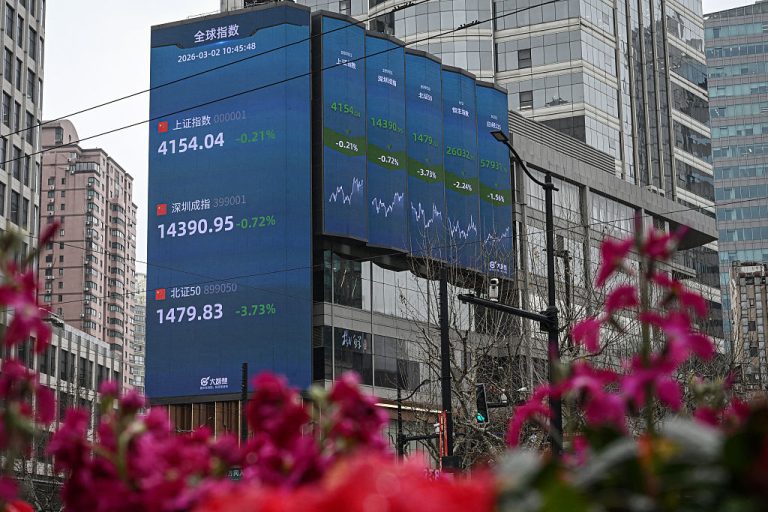
In stark contrast to U.S. and aligned stock markets, the Chinese market reacted negatively to Trump’s victory. Stock and currency prices fell simultaneously. The offshore yuan dropped about 1.3 percent, marking its largest decline in 24 months. The three main indices of China’s A-share market all declined, while Hong Kong’s Hang Seng Index fell by 2.23 percent.
Tariffs on the horizon
Success
You are now signed up for our newsletter
Success
Check your email to complete sign up
Mainland Chinese businesses exporting products to the U.S. are concerned about the potential imposition of high tariffs. Trump, whose administration previously put 10- and 25-percent tariffs on hundreds of billions of dollars’ worth of Chinese goods, has proposed a 60-percent tariff across the board on all products imported from the People’s Republic.
James Cheng, the owner of a lighting equipment company in Foshan, Guangdong Province, produced over 2,000 LED bathroom mirrors for a Las Vegas hotel. When Trump imposed additional tariffs on Chinese goods in 2018, many of Cheng’s products faced a 25 percent tariff.
In an interview with NPR, Cheng said there was “nothing I can do but worry” about Trump’s second administration.
Starting in 2019, in response to the beginning of the U.S.-China trade war in 2018, Cheng had relocated parts of his production line to Bangkok, Thailand, to avoid the tariffs on China — as did many other Chinese manufacturers.
Cheng expects the trend of Chinese producers relocating to Southeast Asia to accelerate if Trump follows through with his 60-percent tariffs. He said he would move even more of his own business to Thailand in that event.
In addition to China, Trump has proposed a 10-percent tariff on all imported goods.
Economics and geopolitics
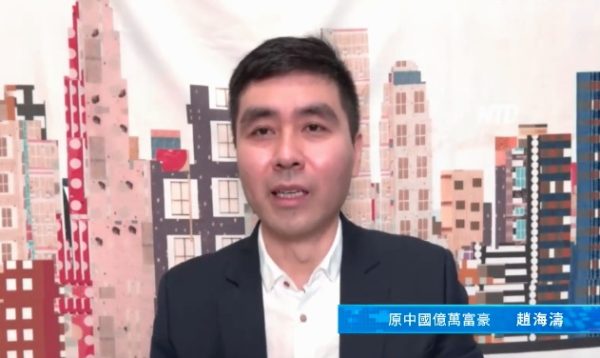
Speaking on the “Pinnacle View” program hosted by NTD Television, an overseas Chinese-language broadcaster, businessman Zhao Haitao (趙海濤) said on Nov. 8 that Trump’s policies would, taken in aggregate, strengthen trust in the U.S. dollar.
Zhao, who was a billionaire while in China, noted that the combination of tax cuts, tariffs, stricter border control, and increasing pressure on Communist China would encourage investment to flow back to the United States and strengthen the American economy.
- Taiwan Considering $15 Billion Purchase of US Weapons From 2nd Trump Administration: Sources
- Once the ‘World’s Factory,’ Closing Businesses and Decaying Industrial Parks Litter Dongguan, China
He added that while the Chinese yuan has been challenging the status of the U.S. dollar as the world’s reserve currency, Trump’s policies will likely counter that trend.
Due to the increasingly risky nature of doing business in mainland China, foreign investment there often emphasizes short-term gains, Zhao said, while putting money in the U.S. promises longer-term benefits.
Yuan Hongbing (袁紅冰), a Chinese dissident and legal scholar based in Australia, recently told Dajiyuan, the Chinese-language edition of The Epoch Times, that Trump’s approach to international diplomacy could put further pressure on Beijing.
He noted that on Nov. 7, Russian President Vladimir Putin quickly extended greetings to Trump upon his reelection, hinting at hope for U.S.-Russian rapprochement despite the ongoing Russian invasion of Ukraine.
Yuan, citing a report by a Chinese think tank, said that the incoming Republican administration would likely continue to shift America’s geopolitical focus from Europe to Asia.
Meanwhile, if Trump is successful in negotiating an end to the Russo-Ukrainian war, Moscow could eventually become a geostrategic partner of the U.S., he said.
With reporting by Vision Times Japan.