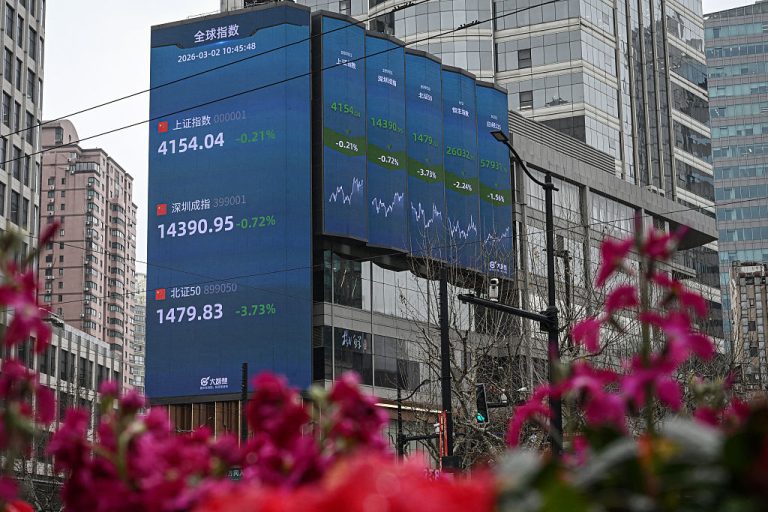
In early June, Chinese regulators delivered a clear message to investors seeking access to overseas markets.
The China Securities Regulatory Commission (CSRC) launched a new crackdown on several major online brokerages, including Futu Holdings and Tiger Brokers, firms that have long served as gateways for mainland Chinese investors seeking exposure to U.S. and global stocks.
The official justification was regulatory compliance. The underlying concern was something much larger: Beijing is increasingly worried about a historic wave of capital leaving China.
Yet the crackdown highlights a dilemma that Chinese authorities have struggled with for decades. The tighter the controls become, the stronger the incentives are for investors to find alternative routes.
According to estimates from the Institute of International Finance (IIF), Chinese households, corporations, and financial institutions are expected to move a record $807 billion overseas in 2025.
Success
You are now signed up for our newsletter
Success
Check your email to complete sign up
Bloomberg reported that total capital outflows—including official, private, offshore, and shadow channels—could approach $1 trillion, making it the largest annual outflow since comparable records began in 2006.
The numbers point to a deeper reality: a growing share of China’s private wealth no longer sees its future inside China.
A crisis of confidence
Capital flight is often portrayed as a financial phenomenon. In reality, it is usually a confidence indicator.
When citizens trust the future of their economy, they invest at home. When they become uncertain about the future, they diversify abroad.
China’s current wave of outbound capital reflects a profound shift in sentiment among entrepreneurs, professionals, business owners, and middle-class families.
For years, Chinese households accumulated wealth primarily through real estate. Property prices appeared destined to rise indefinitely. Apartments became investment vehicles, retirement plans, and family savings accounts all at once.
That model has broken down.
Since 2021, China’s property sector has experienced its most severe downturn in modern history. Major developers have defaulted. Home prices have fallen across many cities. Consumer confidence remains weak.
At the same time, China’s broader economy faces persistent deflationary pressures, slowing growth, and declining private-sector investment.
Many wealthy Chinese are also increasingly concerned about political risk.
President Xi Jinping’s emphasis on “common prosperity,” tighter state oversight of private enterprise, and repeated regulatory campaigns against major industries have reinforced fears that political priorities may outweigh market considerations.
For many investors, preserving wealth has become as important as growing it.
And that search for security is increasingly leading them overseas.
Why America remains the preferred destination
Increasingly, Chinese capital is flowing to the United States, and the reasons are not difficult to understand.
The U.S. dollar remains the world’s dominant reserve currency. American financial markets remain the deepest and most liquid in the world. The United States continues to lead globally in artificial intelligence, advanced technology, biotechnology, and innovation.
Even amid political polarization and economic challenges, the United States continues to offer something investors value above all else: predictability.
Property rights are relatively secure. Financial disclosures are transparent. Capital can move freely.
For Chinese investors accustomed to regulatory uncertainty at home, these advantages are highly attractive.
This trend can be seen across multiple investment channels.
Assets under management in China’s cross-border exchange-traded funds (ETFs)—one of the primary legal channels for investing abroad—surpassed one trillion yuan in early 2026, more than doubling from the previous year.
Demand became so intense that some funds tracking U.S. indexes such as the Nasdaq 100 and S&P 500 imposed strict purchase limits. Several traded at significant premiums as investors competed for scarce overseas exposure.
Meanwhile, Hong Kong has emerged as another major conduit.
According to Boston Consulting Group’s 2026 Global Wealth Report, Hong Kong surpassed Switzerland for the first time to become the world’s largest offshore wealth center.
The city now manages approximately $2.95 trillion in cross-border wealth.
Roughly 60 percent of that wealth is linked to mainland Chinese assets.
A significant portion ultimately finds its way into U.S. dollar assets, American equities, and global investment portfolios.
Taken together, the evidence suggests that Chinese capital flowing toward the United States has become a trillion-dollar phenomenon.
The six escape routes
Officially, Chinese citizens are limited to transferring the equivalent of $50,000 overseas each year.
In practice, however, a vast ecosystem has emerged to help investors bypass those restrictions.
1. Legal channels: QDII funds
Qualified Domestic Institutional Investor (QDII) funds remain the primary legal vehicle through which Chinese investors gain exposure to U.S. equities.
In 2025, China’s total QDII quota stood at $170.8 billion. By the second quarter of 2026, the State Administration of Foreign Exchange (SAFE) had approved a cumulative QDII quota of $176.169 billion. Although regulators allocated an additional $5.3 billion in quota to 78 financial institutions in late March 2026, the new capacity was quickly exhausted amid surging demand for overseas investments.
Between 2025 and 2026, investor appetite for products linked to the Nasdaq 100 and S&P 500 grew so rapidly that SAFE-issued quotas were consumed almost immediately. Several popular U.S.-focused QDII funds were forced to impose extraordinary subscription limits—as low as 10 yuan ($1.40) or 50 yuan ($7) per investor per day—in an effort to control inflows.
The imbalance between demand and available quota became so severe that some Nasdaq-tracking ETFs traded at persistent premiums of up to 10 percent in the secondary market.
The episode offered a rare market signal: even under strict capital controls, Chinese investors were willing to pay a significant premium simply for access to U.S. markets. If Beijing were to fully liberalize overseas investment, current QDII quotas would likely prove insufficient, with a substantial share of the capital expected to flow into U.S. stocks and dollar-denominated assets.
2. Offshore brokerage networks
One of the most significant channels for outbound capital involves offshore brokerage networks. Wealthy individuals and institutions often use offshore accounts, overseas brokers, and Hong Kong-based financial intermediaries to move assets beyond mainland China’s borders and gain direct access to U.S. financial markets.
Given the enormous demand for overseas diversification, the volume of capital flowing through these channels is believed to be immense. However, because many transactions fall into a legal and regulatory gray zone, Beijing has increasingly viewed them as a loophole in its capital-control regime. As a result, overseas brokerage platforms have become a major focus of recent regulatory crackdowns. Analysts estimate that capital transferred through these channels may total several hundred billion dollars, making them one of the largest conduits for Chinese money flowing into foreign markets.
3. Underground banks and cryptocurrency networks
This is perhaps the most discreet and difficult-to-detect channel for moving capital overseas.
The use of underground banking networks to transfer funds has long been common in China. In a 2021 case reported by Chinese state media, authorities in Gansu Province uncovered an underground banking operation that controlled assets totaling 75.6 billion yuan (approximately $10.5 billion), highlighting the enormous scale of these unofficial financial networks.
In recent years, however, the system has evolved technologically.
Under the upgraded model, a domestic client deposits renminbi with an underground bank inside China. The network then releases an equivalent amount of Tether (USDT) on the blockchain to a designated offshore wallet. In effect, the U.S. dollar-pegged stablecoin serves as a form of “digital offshore dollar.”
The recipient can subsequently convert the USDT into U.S. dollars outside mainland China and use the funds to purchase U.S. stocks, American real estate, private investments, or even pay overseas tuition fees.
The mechanism is particularly attractive because it bypasses traditional cross-border fund transfers. As industry participants often describe it, “the renminbi never leaves China, and the dollars never leave the United States.” Cryptocurrency functions as the settlement layer that balances the ledgers on both sides of the transaction without requiring physical capital movement across borders.
According to blockchain analytics firm TRM Labs, Chinese-language cryptocurrency networks processed more than $103 billion in crypto-related transactions in 2025. The figure includes a broad range of offshore capital-transfer activities, including underground banking operations and escrow services. Not all of these funds ultimately flowed into the United States, but the data underscores the growing role of digital assets in facilitating cross-border wealth transfers from China.
4. Trade misinvoicing and fictitious transactions
Another long-established channel for moving capital out of China involves the manipulation of international trade transactions.
Companies engaged in import-export business have for years exploited trade-finance mechanisms, particularly letters of credit and overseas settlement arrangements, to quietly transfer capital abroad. In some cases, firms manipulate import contracts that require offshore payments; in others, they fabricate transactions entirely.
A common method is to deliberately overstate the value of imported goods and arrange for overseas suppliers to return the excess funds to designated offshore accounts. Through this process, money that appears to be legitimate payment for trade is effectively converted into overseas assets.
Because such transactions are often embedded within ordinary commercial activity, they can be difficult for regulators to detect. Analysts estimate that capital transferred through trade misinvoicing and related schemes may amount to hundreds of billions of dollars, making it one of the largest channels for covert capital outflows from China.
5. Cross-border refund schemes
Some Chinese investors have turned to cross-border consumer refund schemes as a means of moving money overseas.
Under this method, individuals use mainland Chinese bank cards to purchase high-priced goods or services from overseas merchants. After the transaction is completed, the purchase is subsequently canceled, and the refund is settled through channels outside the formal banking system.
As a result, funds that originated in mainland China can ultimately be converted into assets held abroad, effectively bypassing official capital-control restrictions.
6. Cash smuggling and quota pooling
The most straightforward method remains one of the oldest: physically moving cash across borders.
Money is concealed in suitcases, vehicles, or boats and transported to destinations such as Hong Kong or Macau. Although relatively unsophisticated, the method continues to be used by individuals seeking to move funds beyond mainland China’s capital-control system.
Another common practice involves recruiting mainland residents who have not yet used their annual $50,000 foreign-exchange quota. By pooling the quotas of large numbers of individuals, organizers can transfer substantial sums overseas through transactions that appear compliant with official regulations.
According to enforcement records released by China’s State Administration of Foreign Exchange (SAFE), the mobilization capacity behind these so-called “ant-moving” schemes can be surprisingly extensive. The term refers to the practice of breaking large transfers into numerous small transactions conducted by multiple individuals.
In one case uncovered in Gansu Province, a single organizer reportedly recruited 102 participants to facilitate the targeted transfer of approximately CAD 6.8 million overseas within just a few months. The case illustrates both the scale and sophistication of grassroots networks that have emerged to circumvent China’s foreign-exchange restrictions.
READ MORE:
- China’s Economy Is Structurally Broken and Beijing Knows It
- Unemployment and Public Discontent Put China’s Stability Apparatus to the Test
Beijing’s growing concern
For Chinese authorities, the issue extends far beyond individual investors.
Large-scale capital outflows create pressure on the renminbi, reduce domestic investment, and weaken confidence in China’s economic future.
This helps explain the increasingly aggressive regulatory response.
According to the China Securities Regulatory Commission, between 2025 and 2026, Chinese regulators imposed roughly $330 million in penalties on multiple cross-border brokerage firms and ordered extensive account reviews aimed at restricting unauthorized overseas investments.
The campaign against online brokerages is widely viewed as part of a broader effort to tighten oversight of outbound capital flows.
The strategy may slow the pace of capital flight.
It is unlikely to eliminate it.
History suggests that when investors become determined to move money abroad, financial innovation tends to outpace regulation.

What it means for America
The movement of Chinese capital into the United States carries important implications beyond financial markets.
At a time when many global investors remain cautious, Chinese wealth is effectively casting a vote of confidence in the American economic system.
The trend supports demand for U.S. equities, dollar-denominated assets, real estate, and private investments.
It also reinforces the dollar’s central role in the global financial order.
Ironically, while Beijing continues promoting alternatives to dollar dominance, many of China’s own investors appear to be making the opposite bet.
Their actions suggest that when private wealth seeks safety, liquidity, and long-term opportunity, America remains difficult to replace.
The bottom line
The recent crackdown on overseas brokerages illustrates Beijing’s determination to slow capital outflows.
But the forces driving money abroad appear far stronger than the regulations attempting to contain them.
China’s property downturn, slowing growth, political uncertainty, and desire for diversification continue to push capital outward.
Meanwhile, America’s financial markets, technological leadership, and institutional stability continue to pull that capital inward.
The result is one of the largest private wealth migrations in modern financial history.
The exact number may be debated.
The direction is not.