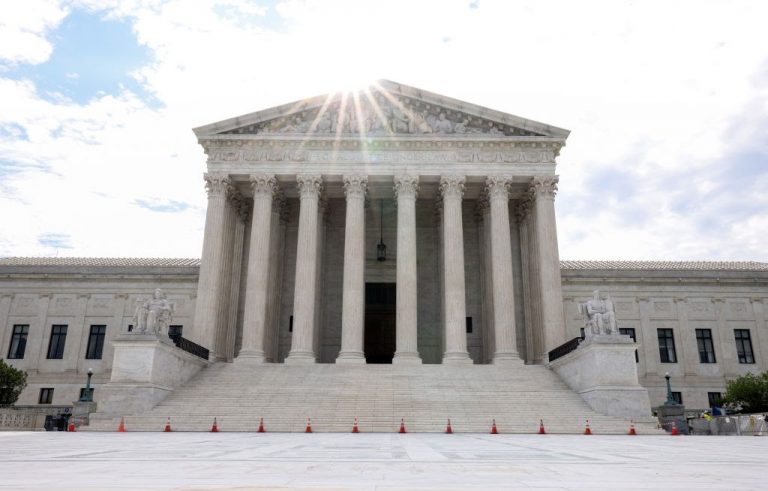
According to a number of legal experts, it’s unlikely that the U.S. Supreme Court will overturn Tennessee’s ban on transgender medical procedures for minors following last week’s deliberations. Proponents for the controversial procedures have been arguing that the ban violates the Equal Protection Clause of the 14th Amendment, however legal experts are saying that this argument “will fail.”
Thomas Jipping, a senior legal fellow for the conservative think tank, Heritage Foundation, told Fox News Digital, “The argument opposing the law has to create a parallel between the puberty blocker Tennessee law and previous Supreme Court precedent that involved a higher or tougher legal standard. That’s what they’re trying to do because the U.S. Court of Appeals for the Sixth Circuit upheld the [Tennessee] law under a very deferential standard. If that’s where it stays, Tennessee will win in the Supreme Court.”
On Dec. 4 the Supreme Court heard arguments in the U.S. vs. Skrmetti case, a case that could influence more than two dozen other state laws banning transgender medical procedures for minors.
Core to the issue is Tennessee’s SB1, a law prohibiting medical procedures for minors for the purpose of helping the minor “identify with or live as a purported identity inconsistent with the minor’s sex or treat purported discomfort or distress from a discordance between the minor’s sex and asserted identity.”
Mathew Rice, Tennessee’s Solicitor General, argues that these procedures can cause “irreparable” harm and have “unproven” benefits.
READ MORE:
- US Tariffs on Chinese Chips Set to Persist Amid Global Semiconductor Showdown
- Chinese Crew Suspected of Sabotaging Undersea Baltic Telecom Cables
- Desperate Times: China’s Youth Take to Social Media to Lament Skyrocketing Unemployment
Success
You are now signed up for our newsletter
Success
Check your email to complete sign up
An odd comparison
The oral arguments did not last long, just two-and-a-half hours, however it was enough time for Justice Ketanji Brown Jackson, who previously went viral for being unable to define what a woman is, to draw an odd comparison between this case and historical laws banning interracial marriage.
“Interesting to me that you mentioned precedent, because some of these questions about sort of who decides and the concerns and legislative prerogatives, etc., sound very familiar to me,” Jackson said. “They sound in the same kinds of arguments that were made back in the day—50s, 60s—with respect to racial classifications and inconsistencies. I’m thinking in particular about Loving v. Virginia, and I’m wondering whether you thought about the parallels, because I see one as to how this statute operates and how the anti-miscegenation statutes in Virginia operated.”
The Loving v. Virginia case, heard in 1967, struck down laws banning interracial marriages based on the 14th Amendment.
However, in general, the Supreme Court sounded reluctant to overturn Tennessee’s transgender laws which went into effect in July 2023.
Justice Brett Kavanaugh noted that several European countries are “pumping the brakes” on transgender drug treatment for children and have imposed heavy restrictions.
He said that medical standards are “evolving” and that should mean a “heavy yellow light, if not a red light” for the court when making a decision.
The decision is expected to be issued in July of next year.
READ MORE:
- China Strikes Back With Fresh Sanctions on US Military Firms Over Taiwan Arms Deal
- Lockdown of Pakistani Capital Over After Police Cracks Down on Protests
- The Number of Federal Workers Showing Up to the Office Full-time Will Shock You
‘Deeply sinister’
As arguments were made, two groups of protestors rallied on the steps of the U.S. Supreme Court in Washington, D.C., one group in support of “transgender rights” and another vehemently opposed to transgender medical procedures for children.
Speaking on the steps of the court house, Chloe Cole, a young woman who has detransitioned after undergoing life altering medical procedures, said Tennessee’s law was a necessary step in protecting young people from irreversible medical interventions.
Cole was joined by popular conservative pod caster, Matt Walsh, who was instrumental in bringing the case to the U.S. Supreme Court.
Speaking through shouts of support and ridicule, Cole said, “What an absolute honor to be here on the steps of the Supreme Court speaking, surrounded by so many of my friends, my colleagues, and all the other brave souls who have pushed this battle forward.”
She said she was confident that the nation’s highest court would “do the right thing.”
“The transitioning of children is so awful and horrific,” she said, adding that the practice has “managed to create this massive movement that has unified Democrats, Republicans, Christians, atheists, and really just about everybody to fight for the safety of our children.”
“I’m grateful that the state of Tennessee has listened to the stories of victims like me, that they have pumped the brakes hard on this practice, that the Supreme Court is willing to listen so soon and set a precedent that will allow most of the nation to protect children,” she added.
Also speaking was Matt Walsh, who is responsible for the documentary “What is a Woman?” who insisted that biology was the driving force behind his advocacy against these types of procedures for children.
“Biology is real. It is immutable. It is not subject to the whims of any individual or government or medical organization,” he said.
He is on record describing gender ideology as “deeply sinister” and that so-called “gender affirming care” is “one of the greatest and most incomprehensible evils ever visited upon children in the whole history of the human race.”
“These are the truths that bring us to this spot on this day, that biology is a fact, that we have a duty to protect our children, that the trans agenda denies the fact of biology. It is a distinct threat to our children — we affirm these truths [and] we call [on] the Supreme Court to affirm them, too,” he said.