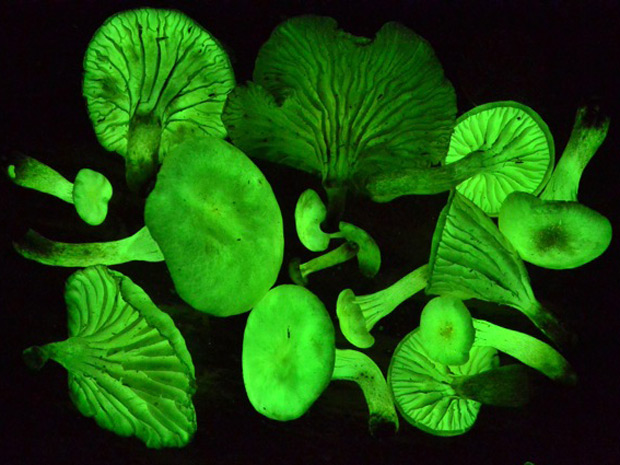
There’s nothing like an eerie glow to kindle curiosity and ignite the imagination, especially when its source is a mystery. Fungal bioluminescence has fascinated nature-lovers since around 350 BC, when Greek philosopher Aristotle documented a “cold fire” emanating from the forest. Similar sightings nurtured cultural myths and legends around the world, often linking them with the unknown and giving them spiritual significance.
Also known as “fairy fire” and “foxfire,” with “fox” likely derived from faux (false) in Old French, these green-glowing mushrooms puzzled the scientific community for centuries. The source was not determined until 1823.
Having gradually gained better understanding of the phenomenon, researchers are now in hot pursuit of practical uses for this low-energy light source.

What is bioluminescence
The ability of living organisms to produce light is called bioluminescence. It is a chemical process fairly common among deep-sea creatures, although they are seldom seen. Fireflies and glow worms offer terrestrial examples from the animal kingdom, and among some 120,000 identified species of fungi, nearly 100 feature bioluminescence.
Bioluminescence is an internal chemical reaction that occurs when the catalyst luciferase interacts with the substrate luciferin to create oxyluciferin. This process releases both oxygen and light, and can be seen in many fungi within the temperate regions of the world.
Success
You are now signed up for our newsletter
Success
Check your email to complete sign up
With some fungi, bioluminescence manifests in the stem or gills of the fruiting bodies (mushrooms), while others exhibit the trait only in their underground mycelium. Some display continuous luminescence, while others light up only at night — with a circadian clock governing the timing of the peak concentrations of luciferin and luciferase.
Function of bioluminescence
Bioluminescence serves a variety of purposes in nature. In fireflies, it is used as communication and to attract a mate. For many sea creatures, it lures prey to come within reach. In mushrooms, it seems to attract nocturnal insects to feed on the mushroom, thereby dispersing the spores. This is particularly useful in a deep forest where wind is not a reliable carrier.
Examples of fungal bioluminescence
Yakoh-take
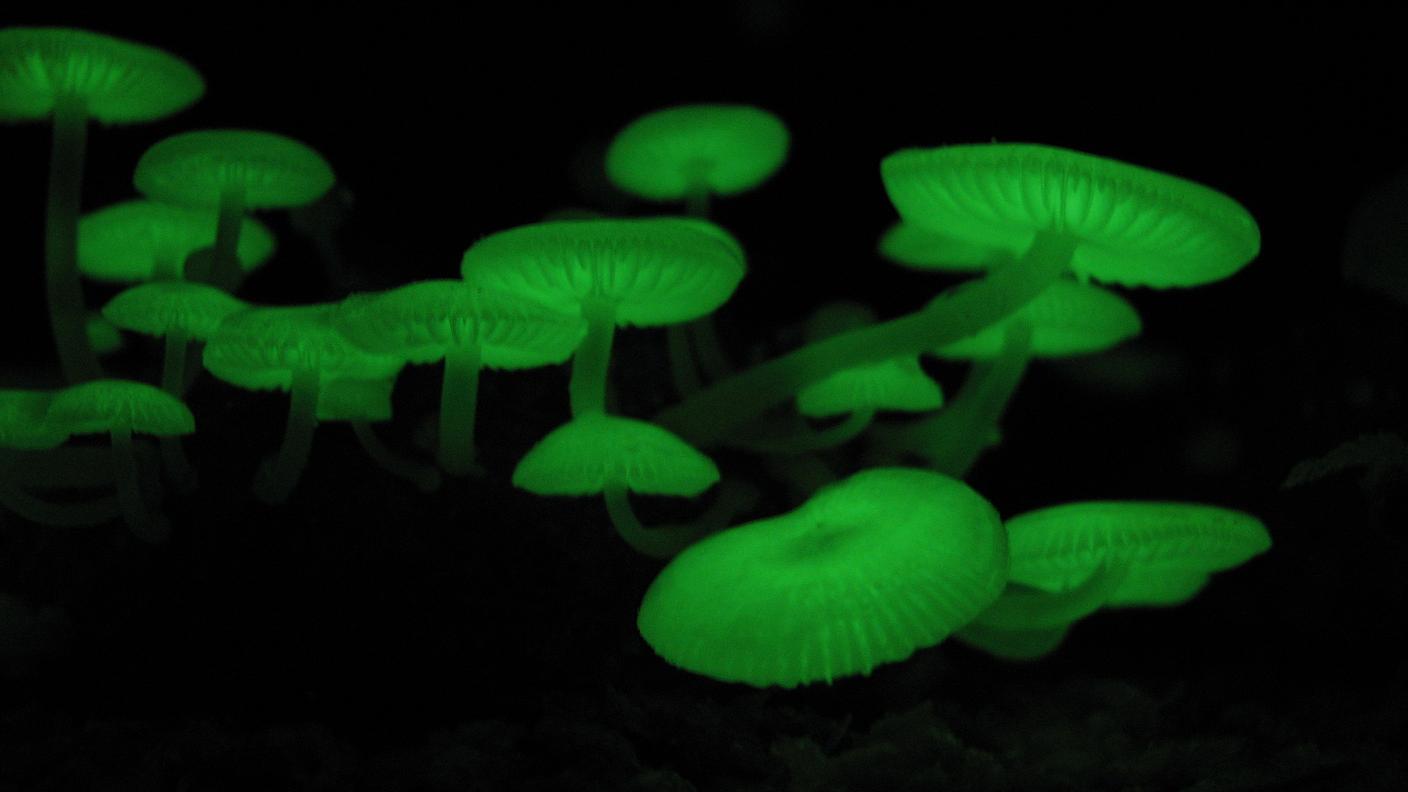
Mycena chlorophos is a saprophytic fungus — meaning it feeds off dead and decaying wood. It emits a green glow at night, earning the name yakoh-take, or “night-light mushroom” in Japan. This mushroom is easily grown in laboratory conditions and has contributed to a deeper understanding of fungal bioluminescence.
Jack-o-lantern
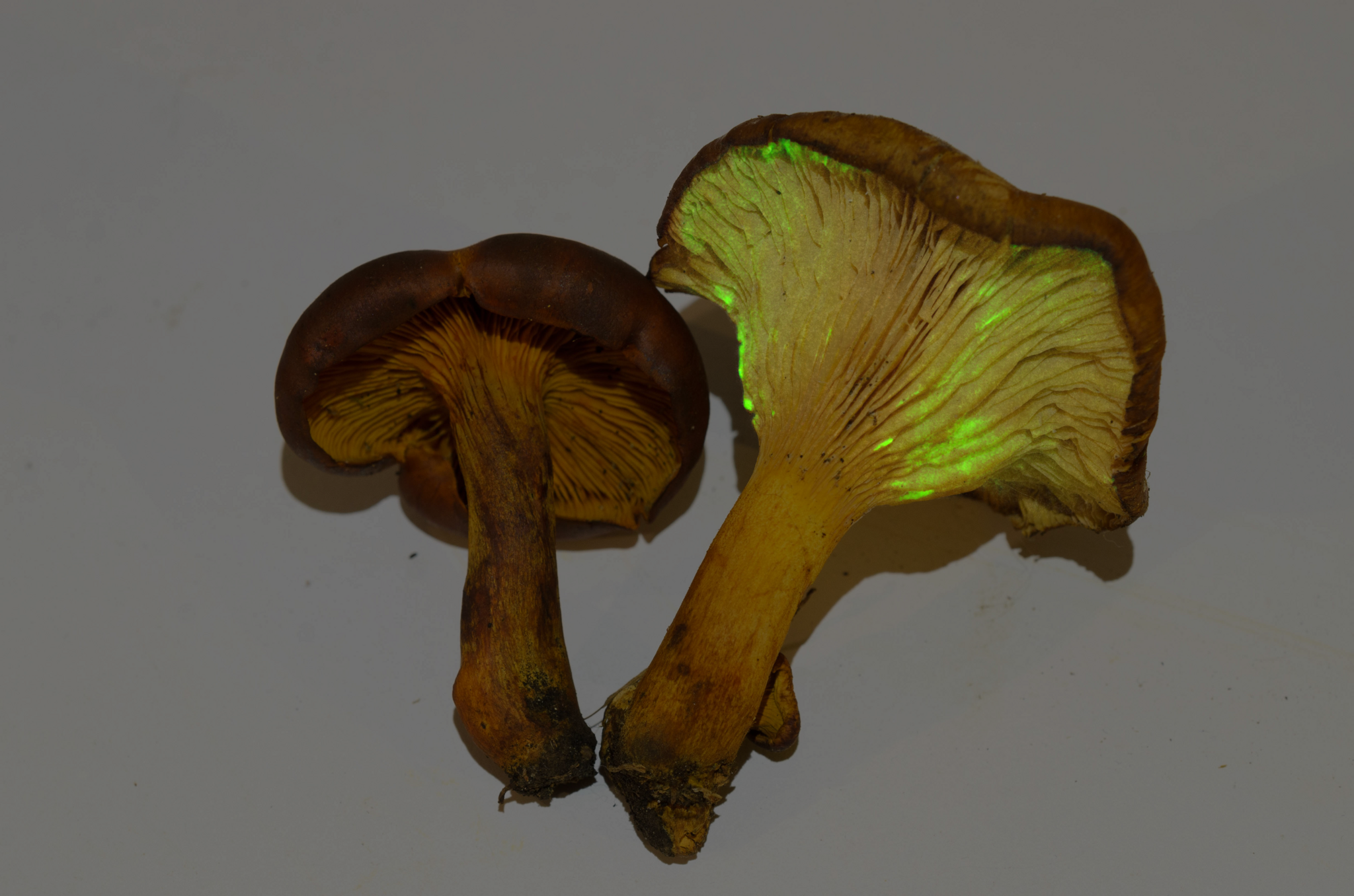
The Jack-o-lantern mushroom, native to North America, is commonly found clustered around tree stumps, as it also feeds off dead wood. This mushroom is poisonous to consume, but contains cancer-killing compounds which are the subject of medical research.
Honey fungus
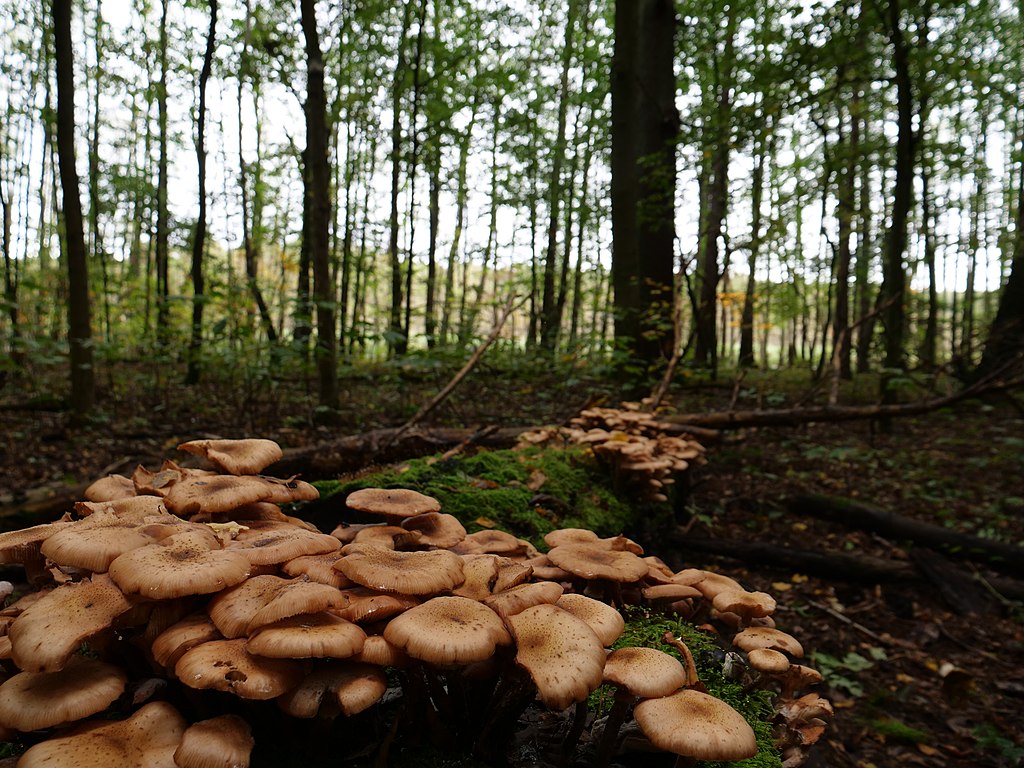
Honey fungus (Armillaria mellea) is both saprophytic and parasitic, feeding on dead and living woody material alike. It produces prolific stands of medium brown mushrooms, but they don’t emit light. This fungus has glowing mycelium, which may serve to deter subterranean critters, like insects and small rodents, from consuming it.
Ghost mushroom

The ghost mushroom, found in southern Australia, Tanzania, and parts of India, is especially noted for its extraordinary bioluminescence. Like other Omphalotus species, the ghost mushroom is quite poisonous; but certain extracts exhibit promising cytotoxic activity towards cancer cells, and others exhibit anti-inflammatory, antitumor and antimicrobial activity.
Eternal light mushroom

As its name suggests, the eternal light mushroom is always aglow, although you’d be hard-pressed to perceive it during the day. This diminutive mushroom only lights up along its thin, fragile stems. It is extremely rare — found only in the rainforest of Sāo Paulo, Brazil. It has no known medicinal value and is too tiny and rare to consider for food, but it is a beauty to behold.
Harnessing fungal bioluminescence
The future for fungal bioluminescence is bright, with a broad range of potential uses on the horizon.
Wellness
Having a natural source of unheated light is very useful when it comes to detecting certain conditions in the human body — such as bacteria, cancer cells, stem cells and viruses. The sensitive bioluminescent bacterium can be used to detect environmental hazards as well, such as contaminants in drinking water and soil toxicity.
Agriculture
Through genetic modification, these detection capabilities could also be extended to plants, enabling them to signal when they need water or nutrients, or are suffering early stages of illness or insect infestations.
Low-energy lighting
Imagine if, instead of glaring street lights, the nightscape was lit with a subtle glow provided by living plants. With successful genetic engineering already achieved in smaller plants — like tomatoes, roses, petunias and periwinkle — researchers are hoping to create bioluminescent street trees. This energy-neutral solution would provide the shade and beauty of a tree during the day, and the soft light needed for safety at night — without once changing a bulb.
Interior landscapes and green architecture, likewise, could benefit from luminous plantings, as they would add visual interest for evening activities, and improved surveillance possibilities for non-active hours.
Military
Since bioluminescent light is created without heat, mimicking this technology for military endeavors would offer security from enemy forces’ heat-seeking sensory devices.
New interfaces for communication
Bioluminescent sensitivity may also provide the foundation for the type of high-level communication interfaces thus far only seen in science fiction.

For now, I’ll be satisfied to bask in the glow of any fungi who happen to shine my way.