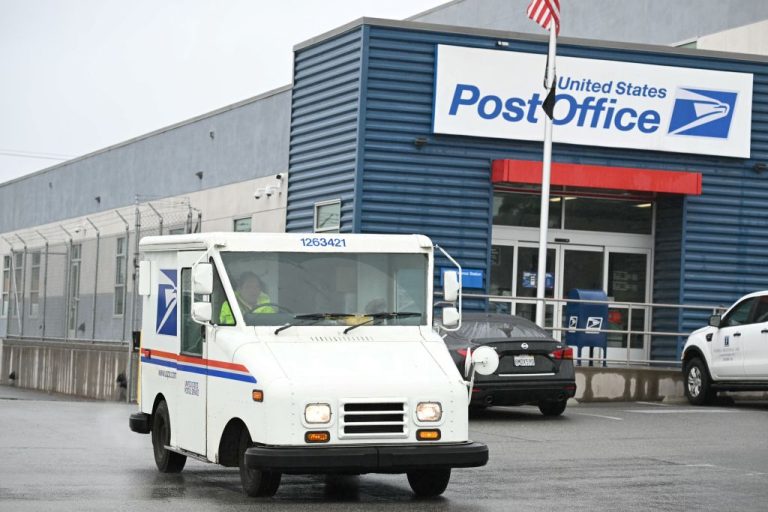
On Feb. 4, the U.S. Postal Service (USPS) announced that it would not accept parcels from China and Hong Kong following a tariff on Chinese goods. However, only a day later, that ban was lifted.
On Wednesday, the USPS said it would “continue accepting all international inbound mail and packages from China and Hong Kong,” AP News reported. However, the brief ban did not apply to letters and flats — mail that is up to 15 inches (38 cm) in length or three quarters of an inch (1.9 cm) thick.
The ban was made after the U.S. imposed a 10 percent tariff, and ended a “de minimis” customs exemption that allowed retailers like Temu, Shein and Amazon to ship packages valued at under $800, duty free, to the United States.
The end of the exemption was made to stop the flow of fentanyl and unsafe consumer products into the United States.
The USPS did not provide any reason for the reversal of the ban, only stating that it would cooperate with Customs and Border Protection (CBP) for a collection process for the tariffs on China to prevent delivery disruptions.
Success
You are now signed up for our newsletter
Success
Check your email to complete sign up
The USPS also did not clarify if the suspension was connected to the cancellation of the “de minimis” exemption.
“The problem is not with the Postal Service. The problem is with Customs. They are not prepared for what’s happening,” a postal industry expert said. He also said “the trillion-dollar question” would be who would collect the duties, and who would pay them.
This move caused utter confusion among retailers and express shipping firms over handling the Trump administration’s new tariff on Chinese imports. The suspension would also have caused shipments delays and high costs for companies that need the convenient pricing.
Kate Muth, executive director of the International Mailers Advisory Group (IMAG) — which represents the U.S. international mailing and shipping industry — stated that implementing the change through the usual federal rule-making process would have given impacted parties the opportunity to provide feedback and prepare during the months leading up to its execution.
“We don’t have that luxury. Everything’s happening immediately without preparation,” Muth said.
Data from the CBP shows that approximately 1.36 billion shipments entered the U.S. under the de minimis provision — a 36 percent increase from 2023. Reuters has also reported that drug traffickers have exploited this exemption to bring fentanyl and its precursor chemicals into the country without screening.
READ MORE:
- Trump Delays Tariffs on Canada and Mexico, Agrees to Joint Border Security Efforts
- Ending the Russo-Ukrainian War: A Major Test for Trump’s 2nd Term
- China’s DeepSeek AI Raises Alarms Over Privacy Breaches and Censorship
Confusion in the mail
While major international shippers assured they would continue deliveries, disruptions could still happen as the USPS figures out how to collect tariffs on small packages with the CBP.
FedEx, on the other hand, has suspended its money-back guarantee on international shipments due to ongoing disruptions in the supply chain. In fact, a logistics executive mentioned that CBP at New York’s John F. Kennedy (JFK) International Airport is holding all incoming shipments from China until further notice.
“We’re all running around like headless chickens at this moment in time, trying to second-guess what’s going to happen,” Martin Palmer, co-founder of e-commerce data provider Hurricane Commerce, said. “And in two weeks’ time we may be back to normal.”
Maureen Cori, co-founder of Supply Chain Compliance, based in New York, said that there was “absolutely zero time” to prepare for the confusion, emphasizing the importance of the government’s direction.
Customs officers informed Ram Radhakrishnan, CEO of Silq — which monitors quality control, logistics and customs clearance — that shipments from China and Hong Kong would be held at JFK until further notice. Silq is facing delays on sweaters for clients, even though duties have been paid.