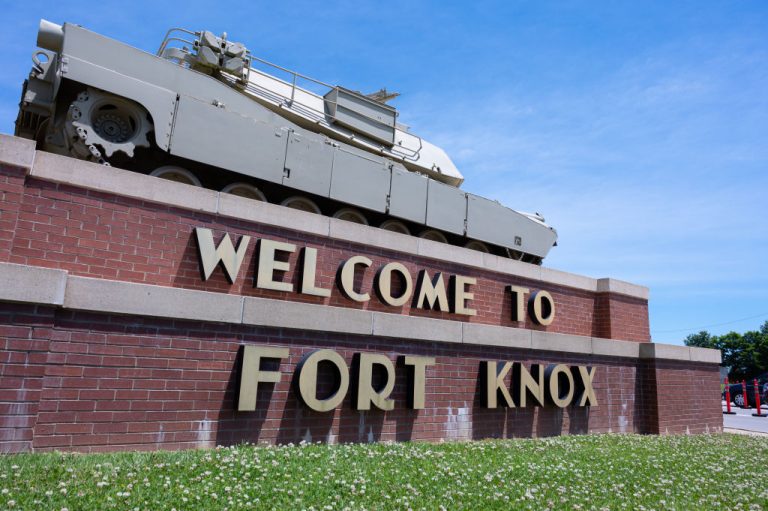
On Feb. 17, Elon Musk, as part of his work with the Department of Government Efficiency (DOGE) floated the idea that Fort Knox, one of America’s most secure military facilities and home to much of the nation’s gold reserves, should be audited.
“Who is confirming that gold wasn’t stolen from Fort Knox? Maybe it’s there, maybe it’s not. That gold is owned by the American public! We want to know if it’s still there,” Musk posted to his social media platform, X on Monday.
Speculation and rumors have swirled for decades about the facility over exactly how much gold is stored there. Theories range from billions of dollars worth of bullion being housed there to not a single ounce.
Musk even suggested live broadcasting a walk through of the facility, so that Americans can see first hand just how much gold is there, or how much is not.
Musk’s idea appears to have been partially inspired by a post on X by U.S. Senator Mike Lee (R-Utah), who wrote, “As a U.S. senator I’ve tried repeatedly to get into Fort Knox….” but was always denied access.
Success
You are now signed up for our newsletter
Success
Check your email to complete sign up
Appearing to be joking, the senator said the only reason he has been given as to why he can’t tour the facility is “because, you can’t”
RELATED:
An enduring mystery
Last week, Musk inquired on X about just how often the gold reserves at Fort Knox are reviewed, “Surely it’s reviewed at least every year?” Musk asked, to which senator Ron Paul (R-Ky) replied, “Nope. Let’s do it.”
The last comprehensive audit of Fort Knox was in 1953. However, there was a notable event in 1974 where members of Congress and journalists were allowed a brief glimpse into one of the vaults, which is often referred to as an “audit” but was more of a public reassurance rather than a thorough examination. Since then, the U.S. government has conducted what it calls “vault seal checks” annually, but these do not involve a full audit of the gold reserves.
However, during the last Trump administration, in 2017, the vaults were opened to allow Treasury Secretary Steve Mnuchin to view them.
Officially called the U.S. Bullion Depository, Fort Knox was established in 1918 and was named after Maj. Gen. Henry Knox, America’s first U.S. secretary of war.
It wasn’t until 1932 that it became a permanent military post, and in 1936 it became the U.S. Bullion Depository.
The facility was specifically constructed to house the nation’s gold reserves.
It’s estimated that the facility holds upwards of $425 billion worth of gold or some 147 million troy ounces.
The facility hosts a daytime population of around 28,000, which includes soldiers, military family members, civilians, and contractors. However, the exact number of active-duty soldiers stationed specifically at Fort Knox is not explicitly detailed in any public records.
READ MORE:
- New Trade War: US Dials Up Pressure on Communist China With Tariffs, Heightened Rhetoric
- China’s DeepSeek AI Raises Alarms Over Privacy Breaches and Censorship
- ‘Vast Technocratic Bureaucracy’ Said to Be Aiming for Removal of Xi Jinping
Gold taken from Americans
Much of the gold rumored to be stored in Fort Knox was collected, from Americans, during the Great Depression in the 1930s.
Executive order 6102, issued in 1933 by President Franklin D. Roosevelt made it illegal for U.S. citizens to own gold in coin, bullion, or certificates, with exceptions for a small amount of gold for jewelry or specific industrial uses. The order was a part of an effort to counteract the deflation caused by the Great Depression.
Americans were required to turn in their gold to Federal Reserve Banks or other designated collection points. They were compensated with $20.67 per troy ounce in paper currency, which was the official price of gold at the time.
The action effectively confiscated private gold holdings.
Then came the Gold Reserve Act of 1934. The act transferred ownership of all gold from the Federal Reserve to the U.S. Treasury, which then set up the United States Bullion Depository at Fort Knox.
At the time, the process was very controversial, with many arguing the moves constituted government overreach, however proponents of the actions said they were necessary measures needed to stabilise the economy and prevent hoarding.
The gold collected through this process significantly bolstered the reserves that were then stored in Fort Knox, forming a large part of the U.S. gold reserves.