To appreciate the ancient character Shennong in modern times, we only need to recall the words of Mahatma Gandhi, known as the father of the Indian nation. On the significance of agriculture, he stated:
“The true measure of a nation’s prosperity is reflected in the well-being of its farmers and the strength of its agriculture.” and “To forget how to dig the earth and tend the soil is to forget ourselves.”
These words align with the mythical story of Shennong, who dedicated his life to teaching people about farming and herbal medicine. His contributions helped shape history and continue to be remembered today.
The story of Shennong
Chinese agriculture is said to owe its origins to the Shennong (神農), or “Divine Farmer.” This legendary figure is recognized as having taught people to farm and use plants as medicine. Many people believe he was real, while others think he was a myth passed down through generations. Regardless, his story is one of wisdom, sacrifice, and great contributions to human civilization.
Mysterious birth
Shennong is believed to have lived around 5,000 years ago. The legend says that Shennong had a very special birth. His mother, a princess, became pregnant after seeing a dragon in a dream, which indicates a union between the earthly and the celestial. Some say that Shennong’s father was a dragon who bestowed him with divine powers. Shennong possessed supernatural wisdom and a transparent stomach. He spoke within days of his birth, walked within a week, and began plowing fields by the age of three.
Success
You are now signed up for our newsletter
Success
Check your email to complete sign up
According to the texts Records of the Grand Historian by Sima Qian and Huainanzi, a philosophical text from the Han Dynasty, Shennong grew up to become a kind, compassionate, and industrious leader.
Depictions with horns

Shennong had a strong body and a unique appearance. He is often portrayed with horns on his head or the head of an ox or bull. These features signify his connection to agriculture and livestock.
Introduction to agriculture
Before farming developed, people depended entirely on hunting wild animals and gathering native fruits and herbs for their survival. Scarcity of food was a serious concern.
According to legend, through experimentation and observation, Shennong discovered which plants could be cultivated for food. He is credited with introducing tools such as the axe, hoe and plow, and other agricultural elements like domesticated livestock and irrigation techniques.
He taught people how to clear land, sow seeds, harvest crops efficiently, and save seeds for propagation; which eventually led to food security and population growth.
Rice, millet, wheat, and beans were among the staple crops that Shennong introduced to his people. He also devised the seasonal farming calendar, guiding farmers on when to plant and harvest according to natural cycles.
Discovering medicinal plants

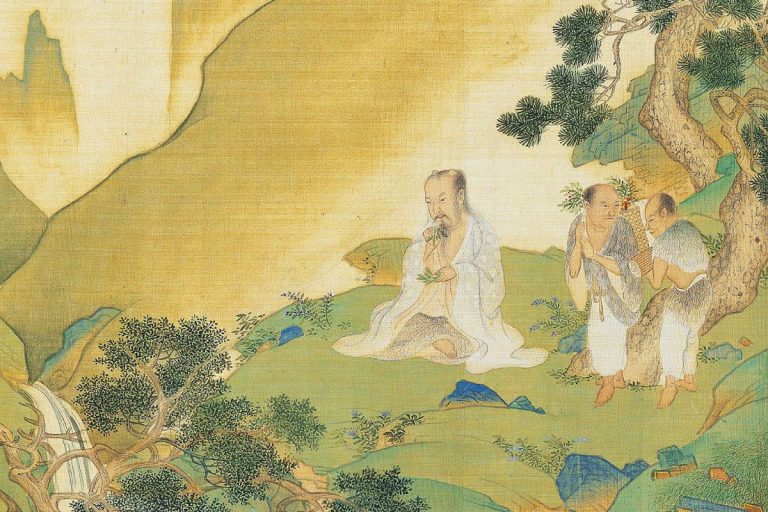
In addition to farming, Shennong wanted to help people stay healthy. At that time, no one knew which plants were safe to eat and which were poisonous. People often got sick or even died from consuming toxic plants, so Shennong decided to test every plant on himself.
He tasted hundreds of different plants to see their effects. Some made him feel better, while others made him sick. Because of his transparent stomach, he could observe how each herb interacted with his body.
He carefully wrote down everything he learned, creating one of the first books on herbal medicine, Shen Nong Ben Cao Jing (“The Classic of Herbal Medicine”), an ancient pharmacopeia that categorized 365 medicinal plants, including tea, ginseng, and ephedra. His discoveries later became the foundation of traditional Chinese medicine.
Shennong divided plants into three categories:
- Safe plants – Good for eating and keeping the body strong.
- Medicinal plants – Used to cure sickness but needed to be used carefully.
- Poisonous plants – Dangerous and should be avoided.
One of the most famous stories about Shennong’s discoveries is about tea. One day, while boiling water, some tea leaves accidentally fell into his pot. When he drank the tea, he felt refreshed and realized it helped remove toxins from the body. This tale not only credits Shennong with discovering tea but also highlights the cultural significance of tea in Chinese history.
The death of Shennong

Shennong was very dedicated to his work. He continued testing plants, even though he knew it was dangerous. Sadly, his kindness and curiosity eventually killed him.
According to legend, Shennong was fatally poisoned when he tasted a yellow flower one day. It was a highly toxic herb now known as Duanchangcao (斷腸騲), or “break heart herb,” and the poison was so strong that it made his stomach burst before he could take an antidote. Legend and tradition preserve his legacy, however, and his knowledge has continued to help people for thousands of years.
Shennong’s legacy
Even today, Shennong is remembered in China as one of the greatest heroes in history. He is often called the “Father of Agriculture” and “God of Medicine.”
He is worshipped as a deity in Taoist traditions, particularly during planting and harvesting seasons. There are many temples and statues of Shennong across China. Every year, people celebrate festivals in his honor. They give thanks for the food they have and the medicine that keeps them healthy.

Through Shennong’s wisdom and bravery, the Chinese people took a big step forward, moving from hunters and gatherers to farmers and healers. Whether he was a real person or a mythical figure, his impact is undeniable. His story is a reminder that knowledge is powerful, and those who share it can change the world.