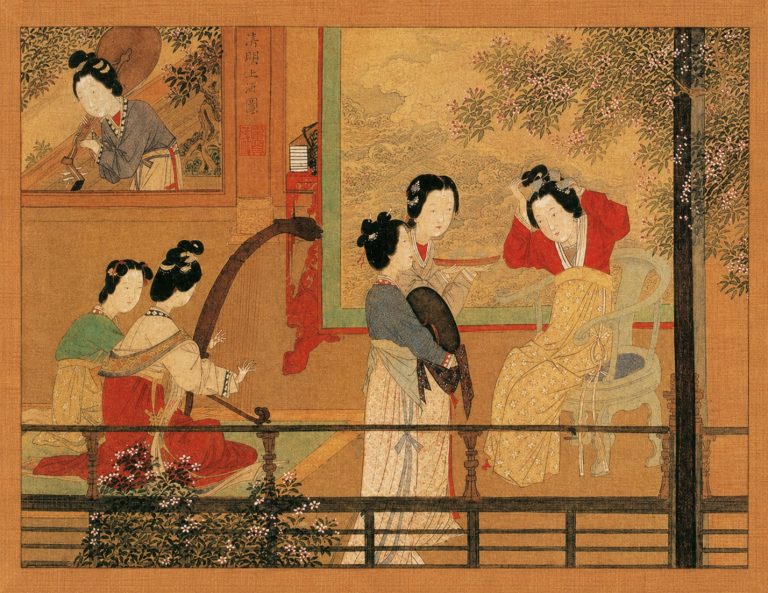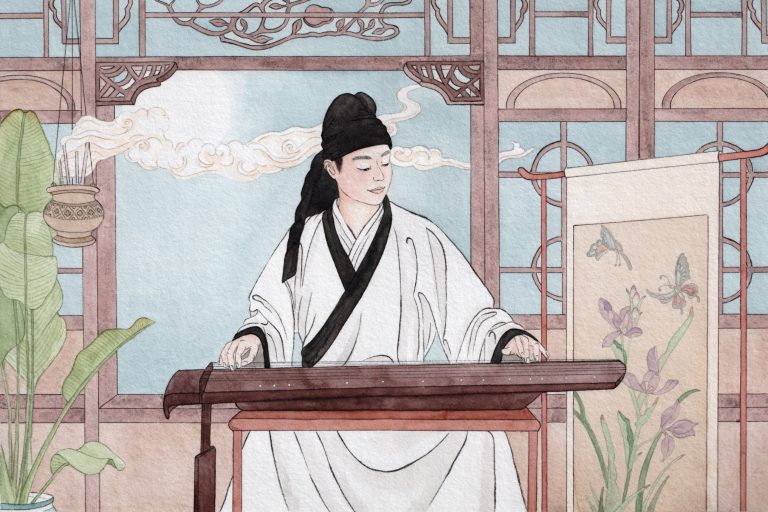
The qin (琴), or Chinese zither, is one of the oldest plucked string musical instruments in Chinese history and is considered “the king of instruments” by ancient people, referred to today as guqin (古琴), literally the “ancient zither.” The sound of the qin is elegant and melodious, and it belongs to a profound tradition intertwined with the Chinese worldview and way of life.
In his poem “Playing the Qin by Night” (《夜琴》), Tang Dynasty poet Bai Juyu (白居易, 772–846) describes his serene mood as he leisurely plucks the silken strings of the instrument on a tranquil, moonlit night, painting a beautiful picture:
蜀琴木性實
楚絲音韻清
調慢彈且緩
夜深十數聲
A qin of solid wood from Shu
The silk of Chu emits clear sound
Playing the melody slow and smooth
In the deep of night, a dozen notes abound
The Qin and its significance in Chinese culture
According to legend, the ancestors of Chinese civilization, including the rulers Fuxi, Shennong, Yao and Shun, created the qin by carving paulownia wood (削桐為琴), and using silk for its strings. These semi-divine monarchs aimed to help people communicate the virtues of the divine, harmonize with heaven and earth, cultivate one’s character, and return to innocence. For example, in “The Record of Music,” (樂書), a chapter from the Records of the Grand Historian (史記), it is written that the sage Emperor Shun used the qin to educate the people of his realm: “Shun made a five-stringed qin and played the odes of the South.”
- Shennong, China’s ‘Father of Agriculture’
- Slow Aging and Prolong Life With the Ancient Chinese Secret of Preserving Jing 精 (Vital Essence)
Later rulers added two strings, resulting in the seven-stringed qin. According to the Almanac of Popular Customs (風俗通), written in the late Han Dynasty, “The seven strings represent the seven stars, with the large string representing the sovereign and the small string representing the subject. King Wen and King Wu [founders of the ancient Zhou Dynasty] added two strings to signify the harmony between sovereign and subject.”
Success
You are now signed up for our newsletter
Success
Check your email to complete sign up
The guqin embodies the traditional cultural connotations of China. The qin is made to resemble the body of a phoenix, with its entire body corresponding to the phoenix’s body, including the head, neck, shoulders, waist, tail, and feet. The top of the qin is “round and closed, following the heavens,” representing yang while the backboard is “flat and square, following the earth,” representing yin. The instrument produces three types of sounds: harmonic (泛音), stopped (按音), and open (散音), symbolizing heaven, earth, and humanity in sync..
The qin’s five original strings represent the five elements: metal, wood, water, fire, and earth. They represent the five notes present in traditional Chinese music: gong, shang, jue, zheng, and yu (宮、商、角、征、羽). The ancients believed that proper education originated with sound, and music was used to rectify people’s hearts and minds. There was even a connection with traditional Chinese medicine, which holds that music is linked not just to moral but also physical health.
The “gong” note corresponds to the spleen and regulates honesty and trustworthiness; cultivating one’s civility and broad-mindedness. The “shang” note corresponds to the lungs to regulate righteousness and justice; hearing it can encourage moral rectitude. “Jue” corresponds to the liver to regulate benevolence and virtue; and nurtures one’s compassionate and loving nature. The “zheng” note corresponds to the heart and regulates propriety and ritual; hearing this sound fosters benevolence and philanthropy. Finally, the note “yu” corresponds to the kidneys and regulates wisdom; hearing the yu sound makes one dignified and respectful of etiquette.
The spirit of the Qin
The guqin is steeped in profound cultural tradition, embodying the rich cultural heritage of Confucianism, Buddhism, and Daoism, emphasizing harmony with nature, the pursuit of inner peace and the integration of human virtues with the cosmic order. Players of the guqin seek inner tranquility, moral clarity, and enlightenment through their music.
The Records of the Grand Historian states that while “sounds” arise from direct sensory perception, “music” encompasses the universal principles of morality and virtue. The ancient sage-kings established rites and music not merely as entertainment for the ears, but as a means of cultivating a deeper understanding of right and wrong, and bringing humanity in line with cosmic principle.
- ‘Chinese Renaissance Fest’ Celebrates Ancient Heritage in Upstate NY
- 5 Exemplary Women of Ancient China
- On the Traditional Chinese New Year
Soothing, rhythmic sounds evoke feelings of tranquility and serenity; solemn, sincere sounds evoke a sense of seriousness and reverence; gentle harmonious sounds inspire compassion.
Conversely, the ancients abhorred sounds that are chaotic, disruptive or contain elements of evil. They strove to maintain inner peace allowing their senses and faculties to function in a state of universal harmony.
Historical stories about the Qin
“Qin, chess, calligraphy, and painting” (琴棋書畫) were essential skills for traditional Chinese literati. Confucius placed great importance on musical education, stating that “[man’s accomplishment] begins with learning poetry, stands on learning etiquette, and finishes with learning music.” He compiled and edited the now-lost “Classic of Music,” one of the Six Classics, and imparted it to his students, making it an essential item of study for scholars in ancient China.
Once, while returning from the nation of Wei to his home state Lu, Confucius noticed some orchids growing in the wild. He told his students: “Orchids grow in deep valleys and remain fragrant even without people around [to see or smell them]; a nobleman cultivates virtue and integrity, regardless of adversity.” He then composed and performed the piece “Ode to the Orchid” (猗蘭操) in its praise.
Another occasion saw music save Confucius’ life. While traveling with his disciples in the minor state of Kuang, the venerable teacher was mistaken for a wanted criminal and detained en route.
Learning that the locals intended to put Confucius to death, his disciples wanted to fight their way out of Kuang. But Confucius remained calm. Declaring that his life or death was the will of heaven, he sat down to play the qin. The people of Kuang were so moved by his sincere performance that they determined he could not possibly be the criminal they were looking for.
The guqin’s melodious and lingering tones harmonize with a gentleman’s virtuous character and ideals. Shi Kuang from the Spring and Autumn Period (770–476 BC) played the guqin with “six horses lifting their heads to hear, dark cranes bursting into song and dance, and fish emerging from the depths to listen,” earning him the title “Sage of Music” in later generations. Another legend from the same era recalls musician Bo Ya’s ability to conjure lofty mountains and flowing streams through his melody, an image readily perceived by his companion Zhong Ziqi. Bo Ya exclaimed, “your understanding is profound; your heart resonates with mine.”
In later dynasties, the guqin and its sounds continued to be associated with a gentleman’s purity, discipline, and aspiration to cultivate a more noble character. Li Bai of the Tang Dynasty, the “Sage of Poetry,” wrote of his “hand dancing above the moonlight stones, my knee supporting the qin’s flowery strings.” Bai Juyi, in his poem “Awaiting the Moon With My Qin” (對琴待月), expressed his inner state:
玉軫臨風久
金波出霧遲
幽音待清景
唯是我心知
The jade tuner faces the lasting wind
Golden waves emerge slowly in the mist
Serene sound awaits a pure scene
That my heart alone can know