On April 14, the U.S. Supreme Court ruled that the Trump administration can pursue deportations of suspected Venezuelan gang members using a law first penned in 1798 that historically has only been used during wartime.
The court’s 5-4 ruling lifted Washington-based U.S. Judge James Boasberg’s order from last month which temporarily blocked some deportations under Trump’s invocation of the Alien Enemies Act, while litigation in the case continues.
It was not a complete victory for the Trump administration as the nation’s highest court did place restrictions on how deportations may occur, emphasizing judicial review.
For now, according to the opinion of a majority of justices, detainees “must receive notice after the date of this order that they are subject to removal under the Act. The notice must be afforded within a reasonable time and in such a manner as will allow them to actually seek habeas relief in the proper venue before such removal occurs.”
Habeas relief is when a court orders that someone who is being held in custody be released or get a new trial because their detention is found to be either unlawful or unconstitutional.
Success
You are now signed up for our newsletter
Success
Check your email to complete sign up
Trump had previously argued that Judge Boasberg’s ruling infringed on presidential authority to make decisions in the best interest of the nation’s national security.
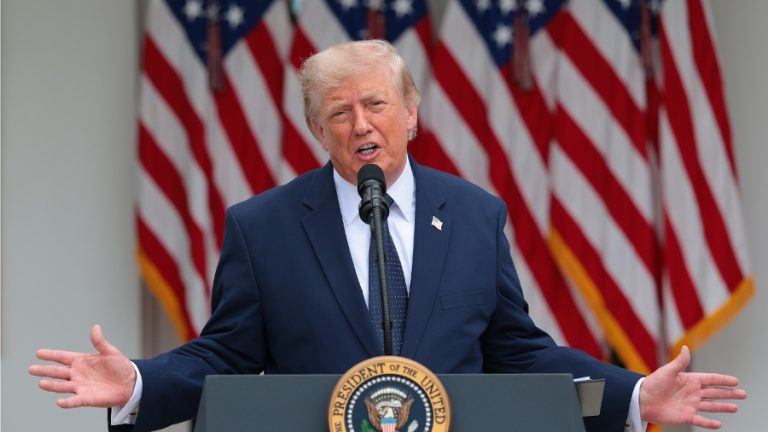
Following the Supreme Court’s ruling, Trump took to social media and wrote, “The Supreme Court has upheld the Rule of Law in our Nation by allowing a President, whoever that may be, to be able to secure our Borders, and protect our families and our Country, itself.”
Trump first invoked the Alien Enemies Act on March 15, in order to expedite the removal of alleged members of the violent Tren de Aragua gang.
READ MORE:
- Markets Climb as Global Trade Talks Gain Urgency Under Trump Tariff Threat
- Nations, Markets Brace as Trump Announces ‘Liberation Day’ US Global Tariffs
Legal challenges
Trump’s use of the Alien Enemies Act is being challenged in court, with the American Civil Liberties Union (ACLU) filing suit on behalf of a number of Venezuelan men currently being held in custody by U.S. immigration authorities.
They argue that the Trump administration has improperly used the Alien Enemies Act by using it outside of the context it was originally intended for, during war or an invasion.
Under the law, a U.S. president is authorized to detain or place restrictions on anyone whose primary allegiance is to a foreign power, or who may pose a risk to national security during wartime.
According to the Daily Monitor, following the Supreme Court ruling, ACLU lawyer, Lee Gelernt said, “This ruling means we will need to start the court process over again in a different venue, but the critical point is that the Supreme Court said individuals must be given due process to challenge their removal under the Alien Enemies Act. That is a huge victory.”
One dissenting Justice, Sonia Sotomayor, called her court’s ruling “dubious” adding that there is “every reason to question the majority’s hurried conclusion that habeas relief supplies the exclusive means to challenge removal under the Alien Enemies Act.”
Top of mind for Sotomayor is to determine whether there is indeed an “invasion” occurring, terminology the Trump administration has relied on to justify the use of the Alien Enemies Act.
RELATED:
Another legal roadblock
Also on Monday, following the Trump administration’s win in the nation’s top court, was a decision by U.S. District Judge Indria Talwani in Boston, Massachusetts which temporarily halted the White House’s efforts to end a parole program for Cuban, Haitian, Nicaraguan and Venezuelan nationals implemented by the Biden administration.
The parole program, popularly known as the CHNV program, saw roughly half a million foreign nationals be paroled into the country, allowing them to live and work in the U.S. on an interim basis.
Trump attempted to end the program in March, calling his timing for ending it both “appropriate and necessary.”
However, Talwani, who was appointed to the bench by the Obama administration in 2014, ruled that “the early termination, without any case-by-case justification, of legal status for noncitizens who have complied with DHS programs and entered the country lawfully undermines the rule of law,” and that “The court finds the balance of equities and public interest weigh in favor of preliminary relief.”
Originally, the program was launched in Oct. 2022, for Venezuelans only, but was later expanded to include nationals from Cuba, Nicaragua and Haiti.
The program quickly came under fire due to incidents of fraud with Republicans accusing the Biden administration of using it to allow inadmissible migrants into the country, en masse.
At its peak, CHNV was flying in around 30,000 migrants every month, allowing them to circumvent the country’s southern border.
In August last year, the program was abruptly paused following an internal audit that uncovered rampant fraud, such as over 100,000 CHNV forms being filled out by just 3,218 sponsors, discrepancies involving Social Security numbers, and other issues.