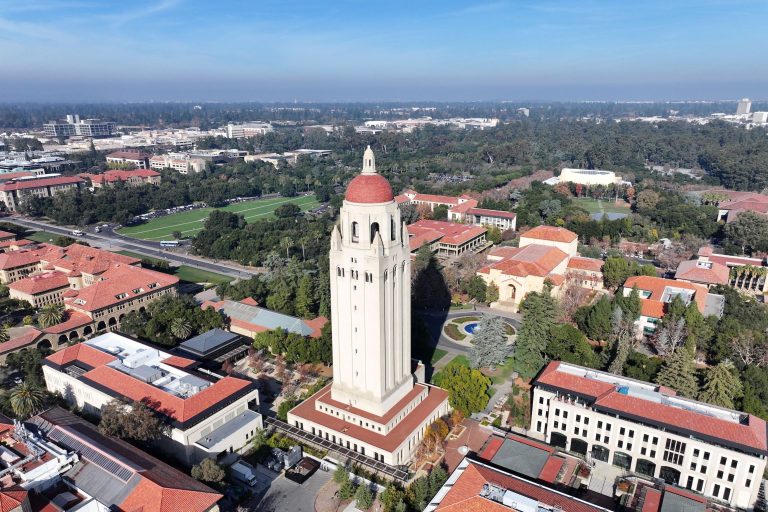
At one of America’s most prestigious academic institutions, a disturbing truth has come to light after an extensive Communist Chinese espionage network was found to be operating in the heart of Stanford University. A recent investigation conducted by “The Stanford Review” found that the Chinese Communist Party (CCP), operating through covert agents and coercive tactics, had infiltrated Stanford’s academic community by targeting researchers and exploiting international students to gather sensitive information and suppress dissent.
The investigation centers on a startling case involving a man known as “Charles Chen,” who posed as a Stanford student. Over time, he contacted numerous female students, particularly those conducting research related to China, to offer support, money, and even all-expenses-paid trips to Beijing.
One such student, listed under pseudonym “Anna” to protect her identity, became alarmed when Charles referenced private details about her life that she had never shared with anyone on campus. When he asked her to delete their messages and switch communication to China’s state-monitored app, WeChat, the situation took a turn from bizarre to dangerous.
Covert operations
Authorities later determined that Charles Chen had no official ties to Stanford and was likely an agent of the Chinese Ministry of State Security (MSS). According to experts consulted during the investigation, Chen’s behavior followed classic MSS tactics by posing as a civilian, targeting vulnerable individuals, and collecting “non-traditional” intelligence, including lab procedures, software frameworks, and academic methodologies.
RELATED: Inside the CIA’s New Recruitment Campaign: Enlisting CCP Officials to Undermine Beijing
Success
You are now signed up for our newsletter
Success
Check your email to complete sign up
Speaking under anonymity, a China expert told “The Stanford Review” that he believes “the Chinese state incentivizes students to violate conflicts of commitment and interest, ensuring they bring back technology otherwise restricted by export controls.”
This technique aligns with China’s broader strategy under its “Made in China 2025” initiative, which aims to leapfrog the U.S. in frontier technologies such as AI (artificial intelligence) and advanced robotics. With Stanford’s prominence in these fields, the university has become a high-value target.
A Stanford professor who encountered espionage firsthand recalled a conversation with a Chinese student who refused a meeting, saying cryptically, “You know why.” After persistent questioning, the student admitted he had to meet with a CCP handler.
Using fear as fuel
But this phenomenon isn’t limited to rogue actors. According to China’s 2017 National Intelligence Law, it explicitly states: “Any organization or citizen shall support, assist, and cooperate with state intelligence work in accordance with the law.”
As a result, Chinese nationals abroad — especially those studying in sensitive areas — are often compelled to serve as intelligence assets. Some cooperate willingly; others are coerced; and many comply out of fear that their families in China could face repercussions.
RELATED: Chinese Persecution Survivor Warns of Transnational Repression in the West
“Many Chinese [nationals] have handlers; they [CCP] want to know everything that’s going on at Stanford. This is a very normal thing,” one anonymous student admitted.
The Chinese Scholarship Council (CSC), which funds about 15 percent of Chinese students in U.S. institutions, plays a critical role, the study found. Experts told “The Stanford Review” that CSC recipients are required to file “situation reports” with Chinese consulates by outlining their academic research and campus activity. These scholarships come with loyalty pledges, and in some cases, relatives back home serve as guarantors that could face financial or political punishment if the student defies expectations.
Toeing the line
Professor Larry Diamond of Stanford described an environment of surveillance and suppression: Students are warned that if they express support for the Dalai Lama or criticize the CCP, their families “could get in trouble,” said Diamond.
This fear-driven silence extends beyond students. “The Stanford Review” reported that although many professors and researchers have experienced espionage, few are willing to speak out publicly in fear of retaliation from the CCP.
RELATED: DOJ Terminates ‘China Initiative’ Targeting Beijing’s Economic Espionage
One student declined to even discuss their case over encrypted messaging, stating, “The risk is too high.” Allegations of racial profiling, the threat of retaliation, and over $64 million in Chinese funding have fostered what the report calls “a pervasive culture of silence.”
Matthew Turpin, former Director for China on the U.S. National Security Council, highlighted the CCP’s manipulation tactics: “They use carrots and sticks. If you turn over information, you may get a reward; if you don’t, there is a punishment.”
The only known public case of a Chinese national being caught spying at Stanford is that of Chen Song. In 2020, she was indicted for concealing her ties to China’s People’s Liberation Army (PLA) in order to secure a research position at the university. Prosecutors revealed that she had sent reports back to Chinese authorities detailing the “nature, results, and value of her research work at Stanford.”
“Time and again,” said FBI Assistant Director Alan E. Kohler Jr., “the Chinese government prioritizes stealing U.S. research and taking advantage of our universities over obeying international norms.”
‘A silenced reality’
Beyond Stanford, the CCP’s influence reaches into student organizations across the country, particularly through the Chinese Students and Scholars Associations (CSSAs). Though framed as cultural groups, CSSAs have documented ties to Chinese consulates and receive funding to organize pro-CCP activities, including rallies and propaganda events.
RELATED: Chinese Student Living in the UK Reveals Consequences of Defying Beijing
In 2015, the Chinese Embassy coordinated with CSSAs to organize crowds of students welcoming President Xi Jinping to Washington — students were paid and instructed via WeChat (a popular blogging and social media app in China). Internal messages later revealed that CSSAs must often seek approval from Chinese consulates for events, and some charters even contain ideological requirements, such as “loving the motherland” or supporting the “one-China principle.”
A CSSA leader at a major university told Foreign Policy: “I really don’t want CSSA to have any relationship more than basic etiquette with the Chinese Consulate.” However, he admitted that he complied minimally in order to keep tensions at bay and maintain “a good relationship.”
Despite official denials, the pressure is real for these students, experts note. A Stanford-affiliated China expert explained that many CSSAs divide regions into WeChat groups monitored by consular officials, who issue directives and request proof of compliance. For instance, the Southwest CSSA — an umbrella group for campuses across California, Arizona, New Mexico, and Hawaii — even requires Chinese consulate approval for leadership roles.
While receiving foreign government funding isn’t illegal, the Foreign Agents Registration Act (FARA) mandates transparency when such influence is intended to sway U.S. public opinion. Few student groups disclose their ties or funds received, and in some cases, money is routed through personal bank accounts.
The scandal at Stanford is a wake-up call, experts note. While not all Chinese students are complicit (many are victims of coercion), inaction puts all U.S. academic and national security at risk. “We wrote this article not to advance a policy position,” the “Stanford Review” notes, “but to highlight a silenced reality.”