As of May 14, the ceasefire between India and Pakistan — two nuclear-armed neighbors — is holding but remains under significant strain. Brokered on May 10, the truce has brought a pause in hostilities, yet tensions persist. Diplomatic channels are active, but both countries continue to maintain heightened military readiness.
On May 11, the Indian military sent a “hotline message” to Pakistan, accusing the country of violating the ceasefire and informing them of their intent to respond if other violations occur, a senior Indian army officer said according to Al Jazeera.
Both sides blamed the other for initial violations immediately after the ceasefire went into place, however it has been relatively quiet since.
The truce brought to an end several days of missiles and drones being fired at each country across their shared land border resulting in almost 70 casualties.
Pressure from U.S. allies secured the deal when it appeared as though the conflict was on the verge of becoming a full-scale war.
Success
You are now signed up for our newsletter
Success
Check your email to complete sign up
However, just hours after the ceasefire was agreed upon, explosions in the Indian-administered area of Kashmir were reported.
At a news briefing, Lieutenant General Rajiv Ghai, the Indian DGMO, said of the violations to the ceasefire, “Sometimes, these understandings take time to fructify, manifest on the ground. The [Indian] armed forces were on a very, very high alert [yesterday] and continue to be in that state.”
Ghai added that the Indian army chief had given a mandate to its commanders to address “violations of any kind” from across the border in the way they deem best.
He said that on the evening of May 10 he received a call from his Pakistani counterpart proposing to “cease hostilities” and urgently requested a ceasefire.
Earlier the next day, the Pakistani Foreign Ministry said that it was committed to the ceasefire while blaming India for violating it.
READ MORE:
- World Leaders Convene at UN as ‘Killer Robot’ Threat Outpaces Regulation
- US and China Reach Deal to Reduce Tariffs in 90-Day Trade Ceasefire
War of words
The conflict, primarily spread out over four days last week, appears to have descended into a more peaceful war of words.
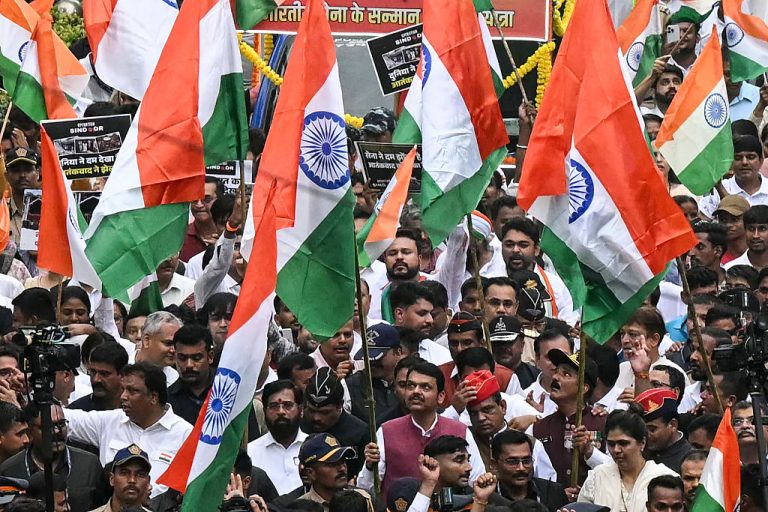
Media in both countries have featured images of their leaders, fists raised with eyes blazing while television anchors injected combative language into their broadcasts while they analyzed their leaders response to the conflict.
Both countries appear to be attempting to shape perceptions about what the clashes have achieved and who “won.”
How the conflict is perceived domestically may have far reaching political consequences and will set the stage for any potential future conflicts and bilateral relations, analysts say.
India has accused Pakistan of being involved in an April 22 terror attack that claimed the lives of 26 civilians in Pahalgam, in India-held Kashmir, prompting India to strike nine “terror infrastructure” targets in Pakistan.
Pakistan denies any involvement in the terror attack and responded to India’s strikes by lobbing artillery fire across its land border into Indian-held Kashmir.
A tit-for-tat conflict erupted, marred further by claims of disinformation propaganda by both sides.
It was then that the two sides managed to reach a peace deal, a deal U.S. president Donald Trump claims was brokered by Washington.
While Pakistani authorities have publicly acknowledged and praised the United States’ role in brokering the ceasefire, Indian authorities deny any U.S. involvement.
READ MORE:
- Residents of Xi’an, China Spot Swirling ‘Dragon’ UFO During Heavy Thunderstorm
- ‘No More Ignoring It’: House Unanimously Passes Falun Gong Protection Act, Urges Senate to Act
The conflict evolves
In a sign that the conflict has simply evolved, India has taken steps to suspend a water-sharing treaty, the Indus Waters Treaty (IWT), with Pakistan and said it is fast-tracking the construction of four new hydropower projects on rivers that flow into Pakistan.
Citing security concerns, India halted its participation in the treaty, a move Pakistan condemned as “an act of war.”
Ayesha Malik, deputy director at the LaHore-based Research Society of International law said, “This is the first time it has been suspended in history… the suspension, combined with the acceleration of hydropower projects and India’s refusal to share data on river flows, has massive consequences.”
The treaty, first signed in 1960 that was brokered by the World Bank after India cut off water supplies to Pakistan, has been lauded over the years as a cornerstone of trans-boundary water diplomacy.
The treaty impacts rivers that serve around 300 million people, irrigates vast amounts of farmland in Pakistan, and provides a crucial supply of hydropower for the Indian-administered Kashmir.
Anuttama Banerji, a Delhi-based political analyst, said the treaty was designed to keep water issues separate from political or military conflicts.
“When this agreement was crafted, the intention was to shield water cooperation from broader security disputes between the two countries,” Banerji said according to ABC News Australia.