On June 11, after two days of talks in London the United States and China approved a trade “framework” in the hopes of calming relations between the two superpowers. Following the negotiations, President Donald Trump declared the deal “done,” without going into any details.
The talks came one month after Trump halted most of the U.S. tariffs on China following talks in Geneva. The truce on the trade war will also be extended to help settle the framework’s terms. It also aims to deal with export restrictions on rare earths and semiconductors from China.
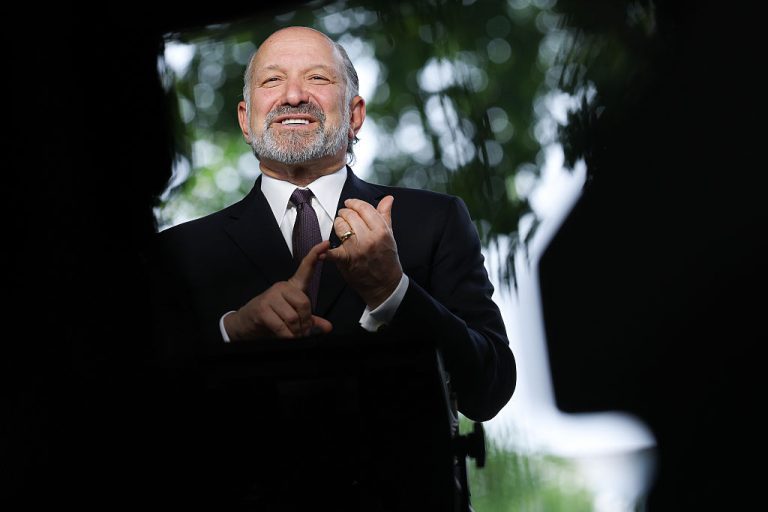
According to Howard Lutnick, U.S. Commerce Secretary, both countries will cooperate on the “Geneva consensus,” working through all issues between them. He also said that Washington and Beijing would proceed with the trade framework once both leaders agreed to its approval.
“Once the presidents approve it, we will then seek to implement it,” Lutnick told reporters at Lancaster House.
Meanwhile, China’s vice commerce minister Li Chenggang said the talks were “professional, rational, in-depth and candid.”
Success
You are now signed up for our newsletter
Success
Check your email to complete sign up
“The two sides will bring back and report to our respective leaders the talks in the meeting as well as the framework that was reached in principle,” Li told reporters. “We hope that the progress we made in this London meeting is conducive to increasing trust between China and the United States.”
Trump declared that his tariffs on Chinese goods would be placed at 55 percent; an increase from a previous 30 percent. China will continue to impose its 10 percent tariff
A report by Reuters lists the 55 percent traffic as consisting of:
- A standard 10 percent “reciprocal” tariff applied by Trump to goods from most of America’s trading partners.
- An additional 20 percent tariff specifically targeting all imports from China.
- The existing 25 percent tariff on Chinese imports first implemented during Trump’s first term as President.
Lutnick told CNBC that the 55 percent tariff would “definitely” not change.
READ MORE:
- Who’s Behind the Chaos in Los Angeles? Inside the Riots and Radical Ties
- Smuggled Pathogens: Chinese Scholars Charged in Bio-Terror Plot Against US Agriculture
- CCP-Linked Scholars Arrested for Smuggling Bioweapons Into the US in Latest Case of Chinese Espionage
Rare earths and magnets
With the continuation of the trade truce, hopes are high concerning the restrictions by China over exports of their rare earth minerals.
“Full magnets, and any necessary rare earths, will be supplied, up front, by China,” Trump said on Truth Social. “Likewise, we will provide to China what was agreed to, including Chinese students using our colleges and universities (which has always been good with me!).”
However, two anonymous sources say that the issue is left unresolved, which could lead to a more difficult deal, Reuters wrote.
Beijing has not approved exports of rare-earth magnets that the U.S. needs for its jets and missiles, while the U.S. still restricts artificial intelligence (AI) chip sales to China over military concerns.
During the London talks, Chinese negotiators reportedly linked progress on lifting their export restrictions to the U.S. easing its own restrictions on AI chip exports to China. In response, American officials are reportedly planning to extend the existing tariffs on China for an additional 90 days beyond the August 10 deadline set in last month’s preliminary Geneva agreement.
As the ruling producer of rare earths with a virtual monopoly on supplies, China imposed the restrictions in April to counter Trump’s tariffs. Washington responded with its curbs on shipments of semiconductors and jet engines to China.
Trade tensions
According to the World Trade Organization’s Tariff & Trade Data tracker, the tariff on Chinese goods peaked in April at a sky-high 143.45 percent.
A spokesperson for China’s foreign ministry, Lin Jian, said that “China has always kept its word and delivered results. Now that a consensus has been reached, both sides should abide by it.”
But the tensions have put strain on bilateral commerce, with U.S. imports by sea from China dropping 28.5 percent year-over-year in May; the sharpest drop since the COVID-19 pandemic.
On June 10, the World Bank had to cut its 2025 global growth forecast to 2.3 percent, citing “trade turbulence” as the main factor.