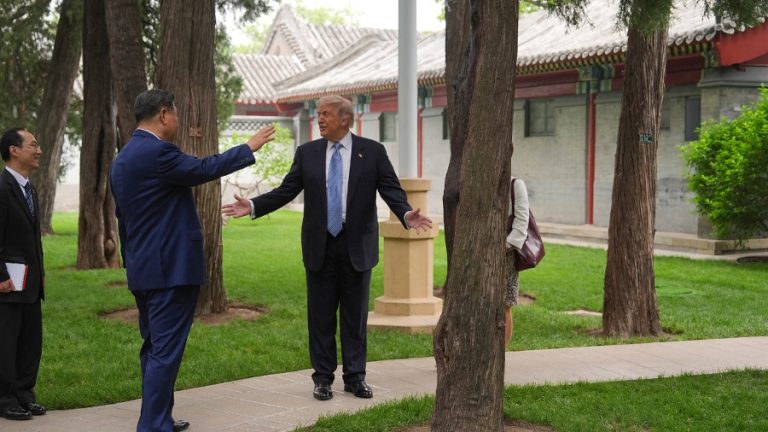
In a stunning turn of events on June 30 — just one day before the Chinese Communist Party’s (CCP) founding anniversary — Xi Jinping was forced to personally unveil a new political structure that signals the beginning of a power transition. (Image: via FinalWar/YouTube)
In a stunning turn of events on June 30 — just one day before the Chinese Communist Party’s (CCP) founding anniversary — Xi Jinping was forced to personally unveil a new political structure that signals the beginning of a power transition.
The announcement came during a Politburo meeting (China’s top ruling body) that Xi himself chaired, revealing the creation of the “Central Party Decision-Making and Coordination Body,” a new top-level organ that appears, on the surface, to centralize control.
In reality, however, it marks a dramatic curbing of Xi’s once-unchallenged authority. “Xi Jinping just placed on the table a brand-new system — one designed to strip away his own authority. And he did it with his own hands,” says FinalWar host Katherine Hu.
Behind the tightly controlled language of the Party’s official press release lies a deeper story — one of internal revolt, institutional containment, and a desperate bid to prevent a political unraveling.
A widow’s letter sparks a political behemoth
The timing of the announcement wasn’t coincidental. Just hours before the Politburo met, an explosive letter surfaced in overseas Chinese media. It was signed by Cheng Hong, the widow of former Premier Li Keqiang, who died under mysterious circumstances in 2023. Her letter was direct:
“The Party owes us an explanation for Li Keqiang’s death.”
What made Cheng’s message especially powerful wasn’t just her identity as Li’s widow — but her status as a respected political figure within the Party system. Without naming Xi directly, she used deliberate language that unmistakably pointed fingers:
“Before Li Keqiang’s trip to Shanghai, Xi Jinping personally called to arrange everything with enthusiasm.”
“Li had doubts — but out of loyalty, he obeyed.”
“All of Li’s usual aides were replaced — with a noticeable chill in attitude.”
“After Li’s death, even the handling of his remains was taken out of the family’s hands.”
But the most chilling sentence? “I respectfully request the Party form a special investigative team — ideally led by the military.”
That request sidestepped all civilian organs, including the Ministry of Public Security, implying they were complicit in Li’s death. Cheng specifically pointed to Public Security Minister Wang Xiaohong as the alleged executor of the plot. Her conclusion was clear: this wasn’t an accident. It was an arrangement—by Xi.
Confessions and leaks point to Xi
Multiple sources have since confirmed the authenticity of Cheng’s claims. According to insiders, Wang Xiaohong confessed to senior military officers that Xi had ordered the hit on Li. His chilling directive was allegedly:
“With Xi, there can be no Li. With Li, there can be no Xi. You know what to do.”
Even more shockingly, a low-ranking operative named Li Song — an insider in the so-called “action team” — came forward with detailed information about the assassination. According to Li, a nerve agent was used on Li Keqiang at the Dongjiao State Guesthouse pool, and an ambulance was delayed by 13 minutes. Li Song is still alive — protected, reportedly, by a military faction led by General Zhang Youxia.
Cheng Hong’s letter wasn’t the beginning of this shift — it was the final blow in a slow-motion political implosion. Over the past several weeks:
Former top leaders like Wen Jiabao and Li Ruihuan reportedly demanded an investigation.
Leaks confirmed Wang Xiaohong’s confession.
Li Song went public with damning evidence.
Then, on June 30, Xi Jinping was forced to preside over the very meeting that announced his own containment.
“This wasn’t reform. It was a forced handover,” says Hu, adding, “Not a top-down strategy — but a top-level surrender.”
The real meaning behind the ‘coordination body’
Since taking power, Xi has stacked the system with “decision-making” groups — centralized committees all chaired by him. From cybersecurity to military reform, Xi created 12 such bodies, consolidating more power than any leader since Mao Zedong.
But this new body is different. The CCP’s official language says it aims to “standardize” such institutions and “coordinate without replacing,” but those phrases are packed with veiled rebukes. They suggest that Xi’s past governance — marked by micromanagement and opaque decision-making — is no longer tenable.
“This statement doesn’t expand Xi’s authority. It puts it in a cage,” notes Hu.
No chairperson was announced. No leadership structure revealed. That’s because this body, analysts say, already exists — it had been operating behind the scenes, and the June 30 announcement was merely a formalization of an internal coup already in motion.
ATTENTION!
There is clearly a power shift occurring in China. China watchers need to keep a close eye on the loss of confidence by key members of the CCP, especially members of the public and state security ministries.
Seasoned Western analysts are also taking notice. Gregory Copley, president of the International Strategic Studies Association, declared that Xi Jinping has already lost real power.
Former U.S. diplomat Gregory Slayton echoed this view in a June 28 “New York Post” op-ed, listing signs of Xi’s decline:
His loyalists in the military have been purged.
His personal security detail has been halved.
Propaganda featuring him has dropped off.
Even state media omitted his titles when covering a phone call with Donald Trump.
The implication: Xi is no longer in charge, at least not in the way he once was.
The end of the Xi era?
As power slips from Xi Jinping’s hands, questions swirl about what comes next. Some speculate that Hu Jintao — the former leader publicly humiliated by Xi in 2022 — may now be working behind the scenes to facilitate this transition.
BREAKING: CCP Power Struggle? Xi Jinping Reportedly Stripped of Real Authority@NewYorkPost has recently revealed that Xi Jinping’s bodyguard unit has been cut in half, a move no “president for life” would allow willingly.
But Hu ends her broadcast with a sobering reminder: “There is no safe version of the CCP. There is no stable future under Party rule.”
Whether or not Xi is removed, the deeper issue remains: the system, not the man, is the root of China’s repression. As Hu notes, “In the end, you can’t reform authoritarianism. You have to dismantle it.”
The downfall of one strongman may be historic — but unless the system changes, history is doomed to repeat itself.