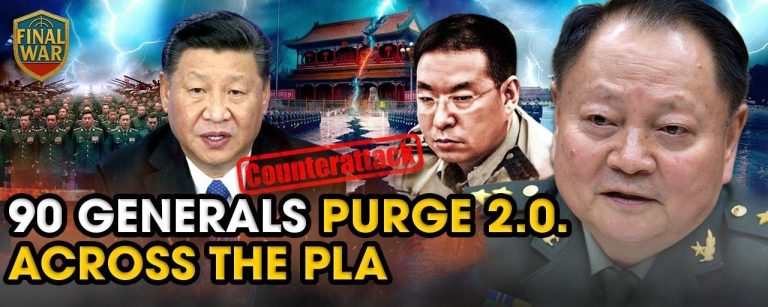
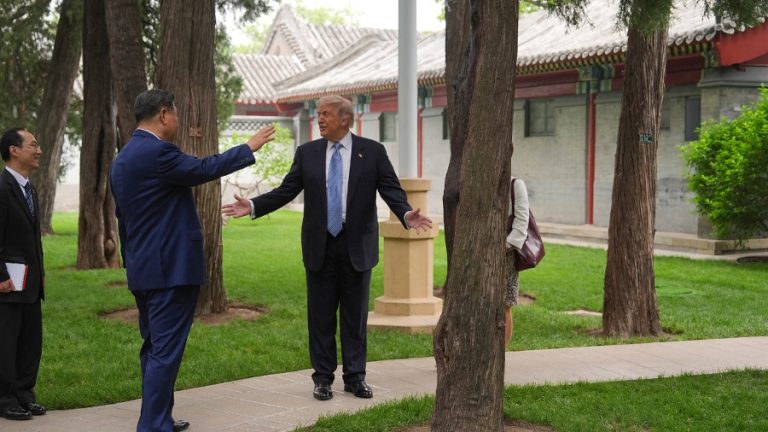
At the center of the power shift stands General Zhang Youxia, Vice Chairman of the Central Military Commission (CMC), who appears to be methodically stripping Xi Jinping of his last stronghold: the military. (Image: via FinalWar/YouTube)
In the final days of June 2025, the Chinese military was rocked by its most dramatic purge in recent memory — one that sent shockwaves through the upper echelons of the People’s Liberation Army (PLA) and exposed a deep power struggle at the heart of the regime.
At the center of it all stands General Zhang Youxia, Vice Chairman of the Central Military Commission (CMC), who appears to be methodically stripping Xi Jinping of his last stronghold: the military.
“The moment the list came out, half the CMC compound exploded.” The quote, from an insider close to the events, captures the panic now sweeping through China’s military hierarchy. With the removal of loyalists, public arrests, and strategic appointments, Zhang’s purge is not just about rooting out corruption — it’s a counterattack against a regime that once sought to sideline him.
A silent coup
The first signal came with the quiet removal of Fang Yongxiang, Xi’s top military gatekeeper, and the unexpected appointment of Zhou Hongxu as Director of the General Office of the CMC. The title may sound bureaucratic, but this post controls everything from top-level military appointments to the classified daily operations of the CMC — essentially functioning as the PLA’s command nerve center.
Zhou’s appointment sent a clear message: Xi Jinping no longer controls the military.
Zhou is no Xi loyalist. His meteoric rise came under the patronage of Zhang Youxia. Both men served in the 40th Division of the 14th Group Army, known for its jungle warfare capabilities during the 1984 Laoshan campaign against Vietnam.
Zhou, an artillery expert, has followed a career path shaped by Zhang — first in the Northern Theater Ground Forces, then to the Central Security Bureau, and now to the military’s most powerful internal post.
Around the same time, another major shakeup was underway. The National People’s Congress officially removed Miao Hua, former head of the Political Work Department, from the Central Military Commission. Once considered one of Xi’s most loyal generals, Miao had tried for years to undermine Zhang’s influence and ascend as Vice Chairman of the CMC.
Under pressure, Miao handed over a list of 90 generals—identifying those aligned with Xi and those likely to disobey orders during a crisis. The list quickly made its way through internal channels, sparking widespread panic in military circles. Officers across every major branch — from the Rocket Force to the Theater Commands — were suddenly suspended and placed under investigation.
But those promoted through politics can’t be trusted in a real war,” notes Zhang. His message was unmistakable: Loyalty to Xi had no place in a battle-ready army. He aimed to purge political officers who rose through cronyism, not combat readiness. And nowhere was that message more visible than in the public arrest of Qiao Xiangji.
During a routine meeting in late June, Qiao Xiangji — Commander of the Southern Theater Air Force — was escorted out by the Military Discipline Commission in full view of his peers. Not one general spoke. The silence was deafening.
Qiao wasn’t just any commander. He had overseen Taiwan war planning, led Fuzhou air operations, and was a protégé of General Xu Qiliang, the architect of Xi’s air force reforms. His removal was surgical—and symbolic.
It didn’t just remove a high-ranking officer. It decapitated Xi’s Taiwan war command.
Xu Xizheng and Li Han Jun follow suit
Qiao’s fall was soon followed by others. General Xu Xizheng, Political Commissar of the Rocket Force, was quietly ousted. Xu, elevated by Xi to shore up control over nuclear assets, had ties to the Fujian Air Force base and was deeply embedded in the Xi-aligned command chain.
Then came Li Hanjun, another high-profile casualty. Once Chief of Staff of the Navy, Li had been a rising star from Xi’s home province of Zhejiang and played a key role in military reforms. On June 27, he was stripped of his delegate status by the National People’s Congress—an unmistakable sign of political exile.
Taken together, the fall of Qiao, Xu, and Li signaled the near-total collapse of Xi’s influence over the air force, navy, and strategic weapons units.
The real reason Zhang Youxia turned
Zhang’s actions may appear calculated — but at their core lies a personal motivation rooted in betrayal.
In 2011, General Liu Yuan — the son of former head of state Liu Shaoqi — publicly declared war on corruption inside the PLA. His speech triggered Xi Jinping’s early anti-corruption campaign, taking down high-ranking “tigers” like Gu Junshan and Xu Caihou. But Liu, despite his loyalty, was quietly pushed into retirement.
“I’d rather die than stand down,” Liu had once declared.
Then came the disappearance of General Liu Yazhou in 2021. A reformist voice who spoke openly about democracy, Taiwan de-escalation, and the dangers of aligning too closely with Russia, Liu was silenced, reportedly detained, and potentially facing the death penalty.
To Zhang Youxia, both men were warnings. You could serve the regime, but the moment your usefulness ended, so did your safety.
“There are no allies—only tools. And once you’re not useful, you’re a threat.”
After the 20th Party Congress, Xi began targeting Zhang’s inner circle, including Li Shangfu and Wei Fenghe. Zhang saw the writing on the wall — and acted preemptively.
Xi’s last surrender
As Xi’s stroke in July further weakened his grip, Zhang used the moment to force a structural shift in Party control. The result was the creation of a new “Decision-Making and Coordination Body” — an institutional mechanism designed to constrain Xi’s overreach.
Zhang had outmaneuvered the top man in China. Through purges, back-channel alliances, and quiet repositioning, he dismantled Xi’s command of the military without a bullet fired.
Xi Jinping’s downfall in the military wasn’t sudden. It was the result of micromanagement, personalistic control, and alienating the very people who once protected him. Zhang Youxia’s purge is a strategic masterstroke—but not a blueprint for stability.
“As long as power in China flows through backroom deals and shadow purges, the country’s political trajectory will remain volatile,” notes FinalWar host Katherine Hu.
The storm inside the PLA is far from over. And as this silent civil war unfolds behind closed doors, one truth becomes increasingly clear: the future of China’s leadership is not in the hands of any one man — but in the chaos of a crumbling system. The world would do well to keep watching.