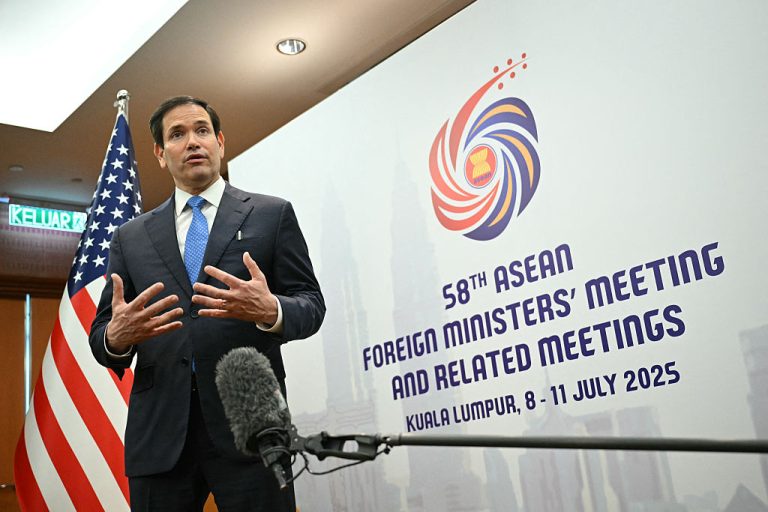
On July 11, U.S. Secretary of State Marco Rubio and Russian Foreign Minister Sergei Lavrov engaged in an informal chat during an ASEAN summit in Kuala Lumpur, Malaysia.
This “standing” conversation happened a day after the two met for a 50-minute talk, which happened at the sidelines of the ASEAN Foreign Ministers’ Meeting. Rubio and Lavrov appeared to have welcomed each other in a friendly handshake as they were seated for the informal talk.
According to the Russian-owned news agency TASS, no details were shared about what they discussed. Rubio, however, did tell reporters that talks on Thursday have led to “a new or a different approach” to resuming peace efforts in Russia’s war with Ukraine.
“I wouldn’t characterize it as something that guarantees peace,” he said,” but it’s a concept that I’ll take back to the president.”
Reuters wrote that the meeting on Thursday came as the conflict between Russia and Ukraine intensified, with more missile and drone strikes from Moscow.
Success
You are now signed up for our newsletter
Success
Check your email to complete sign up
“It was a frank conversation. It was an important one,” Rubio said.
Rubio shared with Lavrov about President Donald Trump’s frustration about his Russian counterpart Vladimir Putin’s lack of progress on peace efforts and the bombardment of several Ukrainian cities. The president said “that there’s not been more flexibility on the Russian side to bring about an end to this conflict.”
Rubio and Lavrov exchanged ideas, including the new or different “approach” to Russia’s peace efforts.
“We need to see a roadmap moving forward about how this conflict can conclude,” Rubio said.
Meanwhile on Friday Lavrov shared Moscow’s role in ending the war with Ukraine, adding that the diplomats made a “substantive and frank exchange” of views on Ukraine, along with other global problems like in Iran and Syria.
Lavrov had also claimed that relations between Washington and Moscow have not failed, despite the growing tensions between the nations.
“I think that the current U.S. administration acts in a zigzag manner. We don’t dramatize over this,” he told the state-owned RIA news agency.
Initially, Trump ordered a stop to deliveries of defensive weapons — including Patriot missiles and air defence systems — to Ukraine, following his efforts to improve relations with Moscow.
However, on July 8, he resumed the deliveries, suddenly becoming more critical of Putin’s “meaningless” statements on peace efforts. He is also said to be considering backing a bill which would impose severe sanctions on Russia, including 500% tariffs on countries that purchase Russian oil, gas, uranium, or other exports.
READ MORE:
- US State Secretary Rubio to China’s Wang Yi: Trump-Xi Meeting to Occur Under ‘the right atmosphere’
- US State Secretary Rubio Meets With Officials From Japan, Korea at ASEAN Summit
- Trump Admin Moves to Counter China’s Maritime Dominance With Steep Crane Tariffs
ASEAN summit
Rubio’s trip to Kuala Lumpur marked his first official visit to Asia since taking office, aimed at reaffirming U.S. commitment to Southeast Asia as tensions rise over looming Trump-era tariffs.
The tariffs announced in July would affect Japan and South Korea in addition to eight Southeast Asian countries — Malaysia being one of them.
The ASEAN summit was attended by delegates from its 10 member states — Malaysia, Singapore, the Philippines, Brunei, Cambodia, Indonesia, Laos, Myanmar, Thailand, and Vietnam — along with representatives from other nations, including China, Australia, Japan, and South Korea.
Other than Lavrov, Rubio also spoke with China’s Foreign Minister Wang Yi for the first time in person. The two engaged in “positive and constructive” discussions, despite Beijing’s own tensions with Washington.
Trump’s announcement of tariff hikes on China have angered the Chinese Communist Party (CCP), but Rubio and Wang Yi claimed that their talks were amicable.
Meanwhile, Washington has also tried to improve relations with Japan and South Korea to better counter possible threats from North Korea. However, the upcoming tariffs have tested the relationships, with Japan’s Prime Minister Shigeru Ishiba urging for lesser dependence on the U.S. in certain areas, Reuters wrote.