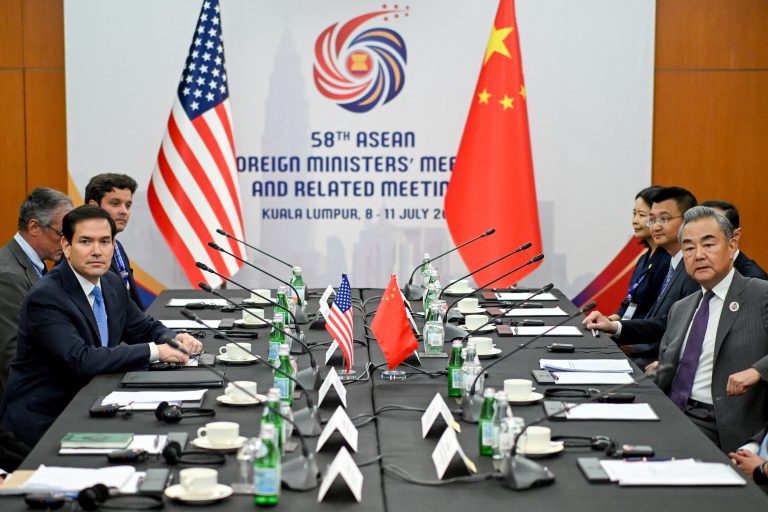
U.S. Secretary of State Marco Rubio said on Friday, July 11 that he had “positive and constructive” talks with People’s Republic of China (PRC) Foreign Minister Wang Yi, as the two major powers vied to push their agendas in Asia at a time of tension over Washington’s tariff offensive.
The top U.S. diplomat was in Malaysia on his first Asia trip since taking office, seeking to stress the U.S. commitment to the region at the East Asia Summit and ASEAN Regional Forum, where many countries were reeling from a raft of steep U.S. tariffs announced by U.S. President Donald Trump on and following July 7.
It was also Rubio’s first in-person talks with Wang Yi, who heads the Chinese Communist Party (CCP) Foreign Affairs Commission in addition to his PRC government job.
Rubio, who formerly served as a U.S. senator from Florida, was in Kuala Lumpur, Malaysia, from July 8 to July 12.
- US Targets Chinese Goods With Vietnam Trade Deal
- Chinese Premier Angles for Greater BRI Expansion in Egypt
- A Recap of US Tariff Actions, Feb–July 2025
The PRC foreign ministry has condemned Trump’s announcement of tariff hikes, which are set to take effect Aug. 1. Beijing also threatens retaliation against nations that strike deals with the U.S. to cut China out of supply chains.
Success
You are now signed up for our newsletter
Success
Check your email to complete sign up
Wang sharply criticized the U.S. during talks with his Asian counterparts in Malaysia, calling the U.S. tariffs “typical unilateral bullying behavior”.
But both the American and Chinese top diplomats said that their July 11 meeting was positive and constructive.
Rubio told reporters at a press conference following the meeting that his talks with Wang were not negotiations, but an attempt to establish a framework for future talks, including a potential meeting between U.S. President Donald Trump and Chinese leader Xi Jinping.
“We’re two big, powerful countries, and there are always going to be issues that we disagree on. I think there’s some areas of potential cooperation and I thought it was a very constructive, positive meeting, and a lot of work to do,” Rubio said.
According to the PRC foreign ministry, Wang Yi said that both the Chinese and U.S. sides had “agreed that the meeting was positive, pragmatic and constructive,” and emphasized that both countries should translate consensus reached by their leaders into policies and actions.
The Trump administration is hopes to reach a trade agreement with the PRC, but frictions between the world’s leading democracy and the powerful communist regime are deep. While the U.S. remains a leader in technological innovation and is nominally the largest economic power on earth, China has an massive manufacturing sector and population.
Beijing is leveraging these advantages, plus its growing technological abilities, to push cheap but increasingly sophisticated products to gain greater control over markets in China and around the world.
The CCP’s strategic aim is to replace the United States as the leading world power. China-watchers and other observers believe that Beijing is using a variety of means — from fentanyl smuggling and industrial espionage to political influence and “transnational repression” against overseas Chinese dissidents — to erode America’s position.
The ‘right atmosphere’ for Trump-Xi talks
On the Trump-Xi meeting, Rubio noted that the PRC side had invited Trump to China, and that “it’s a visit he wants to undertake” and “I’m sure it’ll happen because the president — both presidents — want it to happen.”
At the same time, “we have to build the right atmosphere and build … deliverables, so that a visit isn’t just a visit, but it actually has some takeaways from it that are concrete,” the state secretary added.
Analysts said Rubio would use the trip to make the case that the United States remains a better partner than Communist China, which is Washington’s main strategic rival. Rubio also met his counterparts from Thailand, Cambodia, Vietnam and Indonesia on Friday.
- China’s ‘Internal Circulation’ Trade Policy Invites Backlash for Maximizing Exports, Restricting Imports
- Beijing Touts Hisense as World’s 2nd-Biggest TV Producer
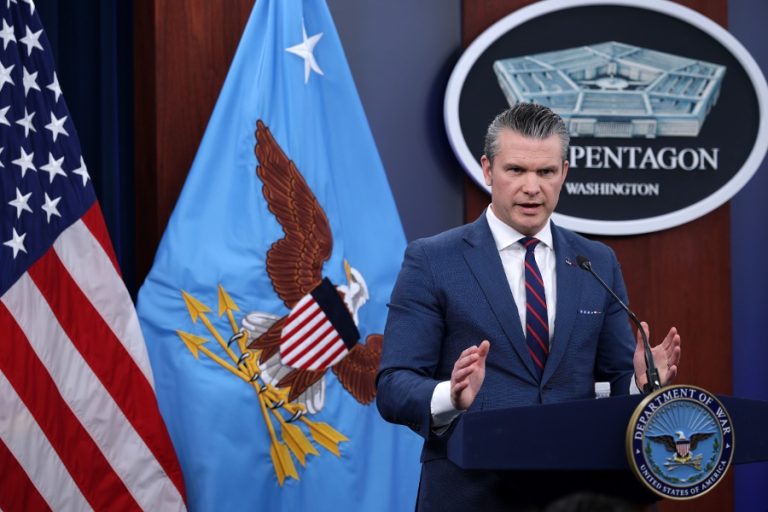
- Japan an ‘Indispensable Partner in Deterring Communist Chinese Military Aggression’: US Defense Secretary Hegseth
But some say the state secretary’s pledge about U.S. engagement was undercut by Trump’s treatment of key friends and partners on tariffs, including its main military allies in East Asia — Japan and South Korea.
“This made it much easier for Wang Yi to talk about China’s stable and reliable economic relations,” said Southeast Asia expert Murray Hiebert, from Washington’s Center for Strategic and International Studies, in remarks made to Reuters.
Tokyo and Seoul are facing a 25 percent tariff as the U.S. president accuses them of ripping America off. In addition to the United States, the two Asian powerhouses also have deep trade links with China, which dwarves them in population and production.
Rubio stressed that U.S.–Japan relations remain strong when asked about July 10 statements by Japanese Prime Minister Shigeru Ishiba to the effect that Tokyo must wean itself off dependence on the United States in key areas including security, food, and energy.
Trump has made vocal complaints to Tokyo about the country’s limited purchases of U.S. autos, rice, and other goods, which are mostly due to Japanese consumers’ preferences rather than government barriers.
“We obviously have very strong commitments and an alliance with Japan. We continue to cooperate very closely with them,” Rubio said of the relationship.
Ishiba said on July 9 (Wednesday) that the ongoing U.S.-Japan trade talks were a “battle in which national interest is at stake. We won’t be taken lightly.”
Reuters contributed to this report.