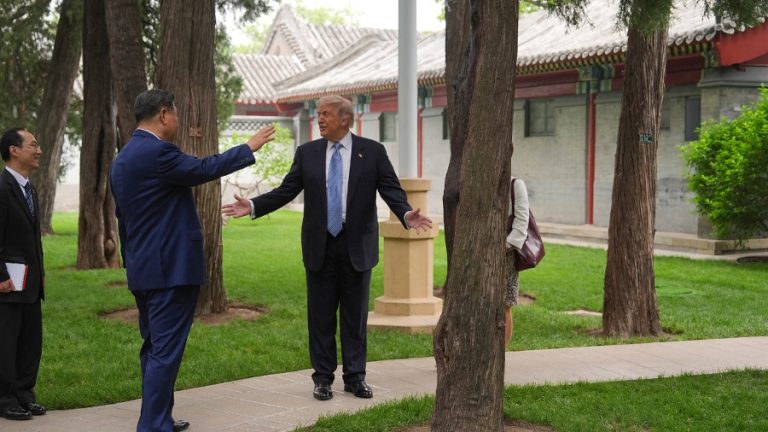
Recent reports claim that Chinese leader Xi Jinping was rushed to the PLA General Hospital (commonly known as 301 Hospital) in Beijing. Analysts suggest the incident may be linked to a collective backlash against Xi at the Beidaihe meeting, allegedly led by former top official Zeng Qinghong. If Xi’s admission to 301 was due to “political illness,” it could indicate that he is under de facto house arrest.
Meanwhile, Sun Haiyan, deputy to Liu Jianchao, head of the International Liaison Department, who was earlier rumored to have run into trouble, has now reappeared publicly — a move widely seen as an attempt to quash speculation and swirling rumors.
Liu Jianchao’s Deputy resurfaces
On Aug. 9, “The Wall Street Journal” first reported that Liu Jianchao, head of the Chinese Communist Party’s International Liaison Department (ILD), had been taken in for questioning after returning to Beijing from an overseas trip in late July. Soon after that, rumors spread that Liu’s deputy had also run into trouble.
Then on Aug. 15, Reuters, citing three unnamed sources, reported exclusively that ILD Vice Minister Sun Haiyan had been detained in early August in connection with Liu Jianchao’s case.
The news quickly drew international attention, and Beijing appeared eager to respond. That same day, the ILD’s official website released a statement showing Sun Haiyan meeting with India’s ambassador to Beijing, Raghavan Lokodong, and attending India’s Independence Day reception at the embassy. The report conspicuously included high-resolution photos of Sun with Indian officials.
Success
You are now signed up for our newsletter
Success
Check your email to complete sign up
Later on Aug. 15, Singapore’s Lianhe Zaobao also reported, citing two independent sources, that Sun Haiyan was “working as usual” and that the detention claims were unfounded.
Swirling rumors
By Aug. 16, Reuters followed up with a story on Sun’s reappearance. When asked directly at the event whether she had been detained or questioned by authorities, Sun avoided a clear answer, saying only: “Well, I’m here.” She also dismissed the Reuters report as “irresponsible.” As of now, both Liu Jianchao and Sun Haiyan remain listed on the ILD’s official leadership roster webpage.
Commentator Li Yanming, writing in overseas Chinese media, noted the timing of the turmoil. Liu Jianchao, a key protégé promoted by Xi Jinping, is reportedly in trouble; meanwhile, the Foreign Ministry under Wang Yi — another long-trusted Xi ally — has seen an unusual wave of ambassadorial reshuffles, including close aides of Wang himself. Li suggested that turbulence within both the Foreign Ministry and the ILD may be linked to shifts in the international landscape as well as intensifying factional struggles within the CCP leadership.
U.S.-based political analyst Tang Jingyuan offered a sharper take on his media channel. He argued that Sun Haiyan’s high-profile appearance at the Indian Independence Day reception was itself proof that Liu Jianchao is indeed in trouble. Under normal protocol, Liu — not his deputy — would have attended such an event.
At first glance, reports of Sun’s detention followed by her public reappearance might seem contradictory. But Tang pointed out that the two can coexist: according to Reuters, Sun had been taken in for questioning in early August. This, he noted, is routine within the CCP — when a top official is investigated, other members of the leadership team are also interrogated, asked whether they were involved, and compelled to declare loyalty.
Thus, Sun’s questioning was likely real. Whether she was cleared of involvement in Liu’s case or simply released for political stability, her public meeting with the Indian ambassador suggests an orchestrated effort to project normalcy. Tang compared her situation to that of China’s defense minister Dong Jun, who was also questioned before reappearing in public.
Fox hunt unveils hidden assets
Commentator Tang Jingyuan further noted that the repeated troubles at the CCP’s International Liaison Department (ILD) are not coincidental. As an intelligence arm of the Party, the ILD has long served as a “sharp blade” for Xi Jinping’s inner circle. Another crucial factor is that Liu Jianchao, the department’s minister, has been in charge of Beijing’s overseas “Fox Hunt” operations.
In 2015, Liu was appointed director of the CCDI’s International Cooperation Bureau, making him a central figure in Xi’s transnational campaign to pursue fugitive officials accused of corruption. At the height of Xi’s anti-graft drive, Liu was tasked with tracing officials abroad, giving him access to sensitive information on hidden overseas assets belonging to China’s elite families.
Analysts say Liu may well hold detailed lists of high-ranking families’ fortunes and offshore transfers — the so-called “Yang Lanlans” and their true wealth data. There are even claims that Liu not only participated in “Fox Hunt” but also exploited his position to help powerful Party families move assets abroad.
Notably, Liu’s reported detention coincided almost exactly with the explosion of the “Yang Lanlan” controversy. Tang pointed out that while public attention has focused on how Yang amassed her wealth and transferred it overseas, those very questions fall directly within Liu Jianchao’s portfolio — recovering illicit assets stashed abroad. This overlap, Tang suggested, links Liu’s downfall to Yang’s sudden notoriety.
Now, new rumors claim that Yang Lanlan is Xi Jinping’s illegitimate daughter. The timing is striking: during the sensitive Beidaihe meetings, both the investigation into Xi’s trusted lieutenant Liu Jianchao and the swirl of revelations around Yang Lanlan erupted. Taken together, these events may reflect the deepening factional struggle between Xi Jinping and his rivals within the CCP.
Cracks in Xi’s inner circle
On Aug. 15, Hu Liren, a Shanghai entrepreneur living in the U.S., revealed on his media channel that three top medical experts from Shanghai were urgently summoned to Beijing’s 301 Hospital on Aug. 14 to consult on a patient of “extremely sensitive status.” According to the claim, that patient was none other than Xi Jinping.
Xi’s recent appearances in state media offer a timeline of his visibility. On July 24, he met with European Council President António Costa and European Commission President Ursula von der Leyen — his last confirmed public sighting. On July 30, state media reported him chairing a Politburo meeting (China’s top ruling body), marking his final official meeting before the closed-door Beidaihe conclave.
RELATED: Inside Beidaihe: Xi Jinping Reportedly Strikes a Deal on Terms of His Exit
After Beidaihe, state outlets again carried references to Xi. On Aug. 16, “People’s Daily” published two items: one was Xi’s essay in the journal “Qiushi” on promoting private sector growth, the other a notice announcing his reshuffle of 10 ambassadorial posts. Yet these were “written appearances,” not in-person sightings.
Commentator Tang Jingyuan noted that from July 30 to Aug. 16, 17 days passed without Xi appearing publicly. Counting from July 25, Xi has been absent for 23 days. On Aug. 12, “People’s Daily” reported that Xi spoke by phone with Brazilian President Lula, suggesting he was in stable health at that time. If experts were called in on Aug. 14, Tang said, it suggests Xi may have suffered a sudden health episode that day.
Will Xi return to the public eye?
This raises two questions: did Xi actually enter 301 Hospital, and was it due to genuine illness — or a “political illness”? Earlier this year, rumors twice surfaced of Xi being rushed to 301, only for him to reemerge publicly shortly afterward. That history has fueled skepticism, and analysts stress that confirmation still requires further observation.
Tang argued that if the latest claims are accurate, and Shanghai experts had to be dispatched, it points to a serious and complex condition beyond the capacity of Beijing specialists — meaning Xi may not reappear publicly anytime soon, casting doubt even on his attendance at the Sept. 3 military parade.
Compounding the intrigue are reports that during the Beidaihe meeting, former Politburo Standing Committee member Zeng Qinghong and other erstwhile allies abandoned Xi, dashing his hopes of retaining at least one senior position in a partial handover arrangement. This also means that Xi’s hopes of staging a political comeback have been completely shattered. If true, the political blow would have been devastating, potentially triggering health crises such as hypertension, stroke, or heart attack.
Tang also warned that if Xi entered 301 Hospital for “political illness,” the implications are more chilling: It would not be his decision, but a signal of seismic shifts within the CCP’s top echelons. Such a move would suggest Xi’s long-standing tacit understandings with party elders had broken down, with 301 Hospital now serving as a form of de facto house arrest.
For now, the key question remains whether Xi will make a verifiable public appearance in the coming days — a test of whether the 301 Hospital rumors reflect reality or mere speculation.