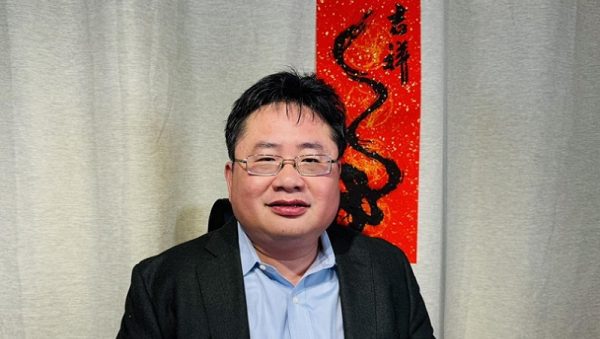
Japanese-born journalist and Indo-Pacific Strategic Think Tank Executive Director Akio Yaita said he “will never back down” after being assaulted by a Chinese national in Taichung on July 6, as Taiwanese officials and analysts warned the attack could signal a broader pattern of cross-border intimidation.
The suspect was arrested later that day while attempting to leave Taiwan through Taichung International Airport.
Yeh Yao-yuan, professor of international studies at the University of St. Thomas in the United States, said that the violent incident highlights the possibility that the Chinese Communist Party (CCP) may use individuals with specific identities to carry out “long-arm jurisdiction,” warning that more similar incidents could occur in the future.
Analyst warns of future CCP-linked incidents
Yeh Yao-yuan, a professor of international studies at the University of St. Thomas in the United States, said the assault raises broader security concerns for Taiwan.
Writing on Facebook, Yeh identified three issues he believes deserve attention.
Success
You are now signed up for our newsletter
Success
Check your email to complete sign up
First, he argued that the case suggests the Chinese Communist Party (CCP) could exploit tourist visas to conduct what he described as “long-arm jurisdiction.” Although the suspect entered Taiwan using a Hong Kong passport, Yeh said he may have been a mainland Chinese national with Hong Kong permanent residency, adding that Taiwan should strengthen screening procedures for arrivals from China.
Second, Yeh said Yaita was likely targeted because his public commentary had “directly touched upon the reality of the Communist Party,” making him the subject of what he described as an immediate “warning demonstration.”
Finally, Yeh warned that the assault was unlikely to be an isolated incident. He said Taiwan must firmly reject CCP influence if it hopes to safeguard its sovereignty and democratic freedoms.
Taiwan leaders condemn attack
The assault drew condemnation from senior Taiwanese officials.
Presidential Office spokesperson Kuo Ya-hui described it as the first case of violent cross-border repression in Taiwan since China’s “Ethnic Unity and Progress Promotion Law” took effect, and urged Taiwanese traveling to China to remain alert to potential risks.
Taiwan’s Vice President Hsiao Bi-khim called the incident “a warning sign for Taiwan.”
“Regardless of any viewpoints or ideas, we hope that they can all exist in an environment that is safe and respectful of one another. Violence will absolutely not be tolerated.”
She added:
“This incident is also a warning sign for Taiwan. We must protect our own freedom of speech.”
Kazuyuki Katayama, head of the Japan-Taiwan Exchange Association’s Taipei office, also condemned the assault, saying violence could not be tolerated. His statement drew widespread support online, with many users posting messages including “zero tolerance for violence.”
RELATED:
- Taiwan Investigates Attack on Akio Yaita as Possible Case of Transnational Repression
- Japanese-born Journalist Akio Yaita Attacked After Speech in Taiwan; Chinese Suspect Arrested
Akio Yaita: ‘I will never back down’
In a Facebook post, Yaita thanked supporters across Taiwan for their concern and described the assault as a carefully planned operation rather than a spontaneous act.
He said the suspect appeared to have waited for nearly two days at the hotel, confirmed his identity before attacking, quickly changed clothes afterward, and headed directly to the airport. Even after his arrest, Yaita said, the suspect continued to deny responsibility.
Taken together, Yaita wrote, the sequence suggested the assault “was not a spontaneous act, but something planned in advance.”
He also argued the case should not be viewed simply as an assault, noting similarities to previous attacks on Hong Kong activists living in Taiwan. He said investigators should determine whether the incident was connected to China’s recently implemented “Ethnic Unity and Progress Promotion Law” and whether it involved organized efforts to suppress free expression.
Quoting Taiwanese commentator Wang Hao, Yaita wrote that “Taiwan cannot allow itself to be intimidated by red organized gangs coming to its doorstep.”
He concluded that he would not be intimidated by the attack.
“I will not retreat or surrender because of violence or intimidation,” he wrote, adding that he would continue to speak out for “Taiwan’s freedom and democracy” while promoting friendship between Taiwan and Japan.