By Li Jingyao, Vision Times
As the Chinese Communist Party (CCP) convenes for its long-delayed Fourth Plenary Session, held from Oct. 20-23, speculation is mounting over a potential power shake-up inside Zhongnanhai — the Party’s political nerve center. Historically, such meetings have often signaled major realignments within the CCP’s top echelons.
Multiple unverified leaks circulating online suggest that Xi Jinping, long seen as China’s most dominant leader since Mao Zedong, may soon lose his position as Chairman of the Central Military Commission (CMC) — the post that grants him command over the People’s Liberation Army (PLA).
Other reports claim Xi’s movements are now under strict control, while rival factions have allegedly prepared two separate plans for handling his political future.
Xi to step down as military chief
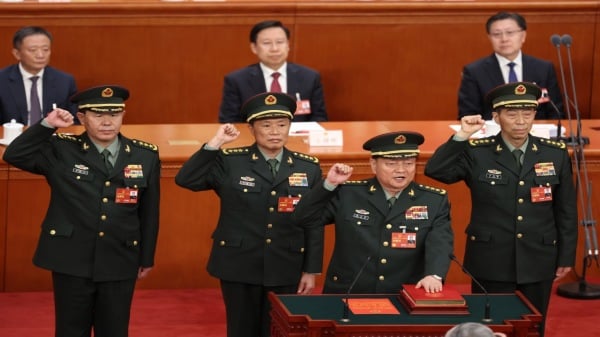
Following the downfall of CMC Vice Chairman He Weidong, who was recently expelled from the Party after an internal investigation, the seven-member CMC has been reduced to just four officials. The Politburo (the CCP’s top ruling body) has also quietly shrunk from 24 members to 23.
Success
You are now signed up for our newsletter
Success
Check your email to complete sign up
Analysts believe the Fourth Plenum may fill these vacancies — potentially marking the first step in a sweeping leadership reshuffle. Former PLA Lieutenant Colonel Yao Cheng, now living abroad and known for his military commentary, wrote that insiders told him Xi “may be forced” to give up his CMC chairmanship. According to Yao, a new seven-member military lineup has already been drafted.
RELATED: Has Qin Gang Re-Emerged in Beijing? Photos of China’s Missing Diplomat Spark Media Frenzy
“Xi Jinping will resign as CMC Chairman during the Fourth Plenum, with Zhang Youxia stepping in. The recently rehabilitated ‘deposed crown prince’ Hu Chunhua will become vice chairman,”
Yao wrote. The same report also alleges that Liu Zhenli, Chief of the Joint Staff Department, will be promoted to CMC vice chairman, alongside Hu.
It continues: “Xi and Zhang will both retire two years from now, at the 21st Party Congress, ensuring everyone’s safety. After that, Hu Chunhua will take over both as Party General Secretary and CMC Chairman.”
Because Hu Chunhua has no military background, Zhang Youxia — a career general and one of China’s most senior officers — is said to be acting as Hu’s mentor to prepare him for eventual control of the armed forces. The report also names several key appointments, including:
- Zhang Shengmin, head of the CMC’s powerful Discipline Inspection Commission, will replace Miao Hua as Director of the Political Work Department.
- Air Force Commander Chang Dingqiu, one of the few senior officers to survive the recent purges, will reportedly replace Liu Zhenli as Chief of the Joint Staff Department.
- Wang Renhua, who currently leads the Military Political and Legal Affairs Commission, is expected to succeed Zhang Shengmin as discipline chief. Defense Minister Dong Jun will also join the CMC.
If true, the new CMC lineup would include Zhang Youxia, Hu Chunhua, Liu Zhenli, Zhang Shengmin, Chang Dingqiu, Wang Renhua, and Dong Jun — representing all four branches of China’s military.
“This means the new military leadership will cover all four service branches,” the source pointed out, adding, “Zhang and Liu represent the Army, Zhang Shengmin the Rocket Force, Chang Dingqiu the Air Force, and both Dong Jun and Wang Renhua the Navy.”
The report further claims Hu Chunhua will also serve as State Vice President, echoing the arrangement made when Xi himself was designated heir apparent over a decade ago.
The Wang Yang factor: Who will run the Party?
Political commentator Tang Jingyuan, a U.S.-based analyst who frequently covers CCP politics, told Vision Times that the rumors have “some credible basis” but remain unverified. “These leaks seem to come from military insiders,” Tang said. “There may be some truth in them, but also exaggerations. We should treat this as one of several possible versions.”
RELATED: State Media Signals Hu Chunhua’s Return as Hu Jintao Faction Moves to End Xi’s Rule
The rumors make no mention of Xi stepping down as General Secretary, the CCP’s most powerful position. “But if Zhang Youxia takes over the military and Hu Chunhua becomes vice chairman,” Tang noted, “that would effectively mark the end of Xi’s rule. In the CCP’s system, Party power is built on control of the gun. Once the gun changes hands, the dynasty changes.”
Tang added that if Hu is being positioned as Xi’s successor, “he’ll have to serve not just as Vice President and CMC Vice Chairman, but also as a Standing Committee member — and the top-ranking Secretary of the Central Secretariat.”
If Hu’s role is limited to “successor-in-training,” Tang said, a two-year transition period would likely follow. “During that time, someone else must manage the Party and government. That person would almost certainly be Wang Yang.”
However, that arrangement poses a dilemma in itself: If Xi retains his General Secretary title, Wang Yang cannot publicly represent China on the world stage. “He could only run things behind the scenes as head of a coordination body,” said Tang.
Tang compared Xi’s situation to that of former leader Hua Guofeng, who peacefully ceded power in the early 1980s. “Hua was a simple man,” he said. “Xi is not. He’s cunning, unpredictable — if you give him a one percent chance, he’ll use it to create chaos.”
“As long as he loses the army, everyone knows he’s done,” Tang added. “The best move would be to step down from both roles gracefully — or, like Hua, stay on until the next Plenum and then retire completely.”
Is Xi under watch?
Tang said additional sources told him Xi has already been placed under restricted movement, effectively under the watchful eye of his own Party. The source did not specify which agency is enforcing the order, though Tang suspects either the Central Guard Bureau or military security forces. “Given the unprecedented purges of nine generals earlier this year, the military seems more likely,” he said.
He added that the anti-Xi camp has drafted two contingency plans:
- If Xi cooperates, he’ll receive a “Hua Guofeng-style exit” — a dignified retirement.
- If he resists, the fallback plan — derived from the ancient prophecy Tui Bei Tu — envisions a “golden sword entering the imperial palace,” a metaphor indicating forced removal.
Tang noted that such an exit could mirror Hua’s own downfall, which became public after the Fifth Plenum of the 11th Central Committee in 1980, when Hua’s allies resigned, paving the way for his quiet removal by mid-1981.
“If Xi goes along,” said Tang, “he might keep his titles for a while but lose real power. The Politburo and Standing Committee will likely be reshuffled — anti-Xi figures will come in, and his loyalists will step aside.” He added, “Losing real power and losing the title are two different things.”
The fall of a dynasty
A third leak focuses on control of the National Security Commission (NSC) — one of Xi’s most powerful institutions. According to insiders, the NSC’s authority has shifted to Xi’s elder sister Qi Qiaoqiao and her family. But by September, the Qi family had reportedly left China and transferred control to Xi’s younger brother, Xi Yuanping. Tang said Xi Yuanping “isn’t just a ceremonial prince.”
RELATED: Xi Jinping Under Fire After Alleged Daughter-Yang Lanlan’s Lavish Life in Australia Revealed
“He has held substantial authority. But that power, too, has taken a hit,” Tang noted, pointing to investigations into Vanke and Yuanwei Group in Shenzhen as evidence that even Xi’s family members are being looked into.
The probes, he noted, are part of a campaign to dismantle the Xi family’s financial network. Executives Xin Jie, chairman of Vanke, and Zhu Jiusheng, former president of the company, have reportedly been detained. “If even his sister’s interests can’t be protected,” Tang said, “that tells you how far Xi’s influence has fallen.”
None of these reports can be independently verified. Yet within China’s opaque political system, such leaks often provide rare insight into the struggles unfolding behind the CCP’s closed doors. As the Fourth Plenum unfolds, one question looms large: Will Xi survive the political storm — or become the next leader to fall victim to the Party’s cycle of purges and power reshuffles?
Editorial Note: Views expressed in this article are the opinions of the author and do not necessarily reflect the views of Vision Times.